

Diaspora
“Do not separate yourself from the community.” — Pirkei Avot

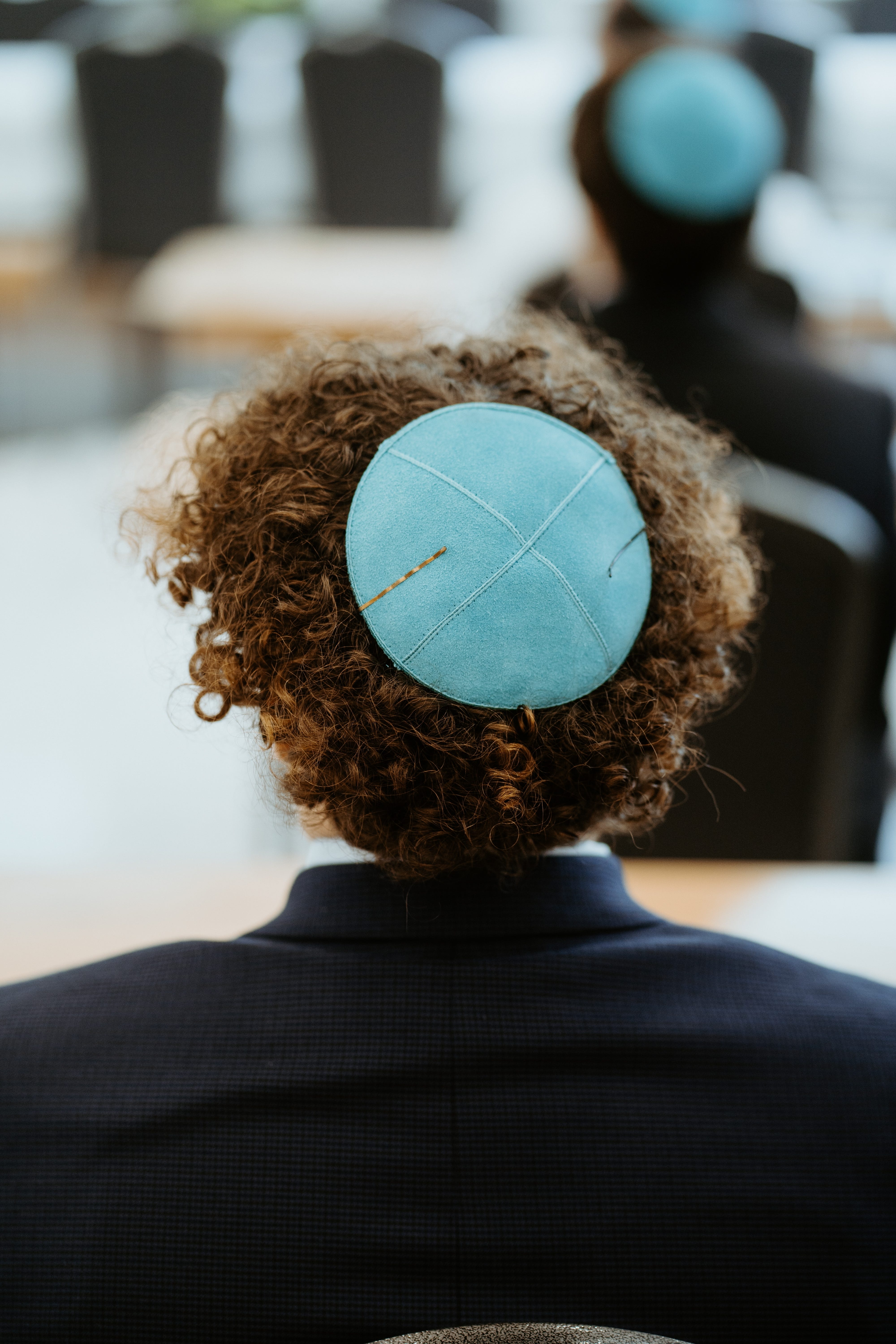
Editor’s Note: A short story by Michael Golder about the burden and persistence of inherited Jewish identity. —David Michael Slater
Diaspora
Diaspora
Next to Joey Feingold at the formica table sat a reedy old man in need of a bath. Joey was doing his best to sip air through his mouth in the man’s stuffy kitchen to avoid being overwhelmed by his foul odor. He wanted to turn away and steal a big gulp of air, but he knew that taking his eyes off his Haftarah for even a second would land him a klop on the kop from Nussbaum’s scrawny hand. And so Joey suffered as he imagined his people have suffered for millennia. And then he felt guilty for equating his small discomfort with the catastrophic horrors visited upon the Jews for as long as there have been Jews. Still, that didn’t keep him from complaining when he got home.
“Can’t you ask him to take a bath?” he begged his parents at dinner.
“That would be disrespectful,” said Mom.
“I think he’s disrespecting me.”
“He’s an old man.”
“Old men bathe.”
“He’s European.”
“And his breath! Like some fish died in his mouth.”
“That’s enough, Joey,” said Dad, pointing a forkful of roast chicken at his son.
“And he hits me!”
“Who hits you?” asked Mom.
“Nussbaum! On the back of my head!
“He might give you a tap to help you focus,” said Dad. “You should be thankful we even found a rabbi in this town.”
“He’s not a real rabbi.”
“He’s rabbi enough to get you bar mitzvahed.”
In 1967, rabbis were hard to come by in Winslow, Massachusetts. The family had moved there from Boston’s Jewish enclave in Dorchester after it fell victim to the one-two punch of redlining and blockbusting. While well-off Jews moved to tony suburbs like Newton or Brookline, those of lesser means scattered to working-class towns like Winslow, where you could barely scrape together a minyan to say kaddish. The family adjusted. Joey’s father, Alan, now had a longer commute to his sales job with a tobacco wholesaler. His mother, Donna, now took an express bus instead of the subway to her job as a bank teller. On the three days a week that she worked, Joey continued to fend for himself after school. They all missed the old neighborhood—the bagels and lox at the G&G Deli; the sound of Yiddish in the streets and shops; their temple, one of many, which they attended on the High Holidays. But the neighborhood they had known, what they now called the “Old Country,” was gone. Adapt or die, Darwin taught, and he wasn’t even Jewish.
Before the move, Joey had attended Boston Latin School, an all-boys institution famous for its academic rigor. Though public, Latin was run like a strict prep school. Students wore jackets and ties and stood to address the all-male faculty, demanding taskmasters whom the boys called “sir.” Joey began attending Winslow Junior High a few weeks after winter break. On his first day, he wore his customary jacket and tie, flagrantly out of step with the casual style of his classmates. Already ill-at-ease due to this regrettable fashion choice, he was flustered when Miss Leonhart called on him in math class. His mind raced—how to address a female teacher?! With all eyes on him, he stood and mumbled an answer, concluding with an all-too-audible, “sir.” Hoots and hollers rained down on Joey as he took his seat, and it was some time before Miss Leonhart managed to restore order. Later, her account of what the “sweet new boy” had said elicited chuckles in the teachers’ room, though Mr. Wright, the gym teacher, remarked that the new kid would likely get his ass kicked if he didn’t wise up, and fast.
Joey was about to turn thirteen, time for his bar mitzvah. The family was puzzling over how to accomplish this in a town without a synagogue until one day Donna spotted a classified ad in the local Pennysaver—Jewish Study with Rabbi Nussbaum. Call: GE6-7207. A few days later, sitting in the Winslow Diner with Alan, Nussbaum clarified his credentials.
“I am not ordained rabbi. In Hungary, I was shatz. You know what is this?”
“I’m afraid not.”
“I pray for those who cannot: the sick, the weak, like so.”
“Can you teach my son his Haftarah?”
“Zikher. Also, I lead service. Whole megillah, one price.”
A two-fer, thought Alan. What’s more, with his yarmulke and long white beard, the man looked like a rabbi straight out of central casting. He would lend authenticity to the ceremony, which, by necessity, would take place in a rented Unitarian church, what the Feingolds called the “Utilitarian” church. The men shook on a price, then Nussbaum placed a sugar cube between his teeth and picked up his glass of tea. When he drank, his shirtsleeve slid down to reveal the tattooed number on his forearm.
“You were in the camps,” Alan whispered.
Nussbaum gave a quick nod.
“Auschwitz?”
Another nod.
“And your family?”
Nussbaum put down his tea. They were in a booth by a window that looked out on the diner’s parking lot, crowded on a Sunday morning. Nussbaum peered out the window, seeming to stare at the line of people at the restaurant’s entrance. He turned back to Alan, his rheumy eyes magnified by thick glasses. He took a deep breath. His thin frame shuddered and he gave a brusque wave of his hand, as if shooing away a fly.
At school, Joey had learned to avoid the rougher boys who found it hilarious to knock books out of the hands of smaller kids or slam them into lockers. He learned not to hear his name pronounced “Jewy” instead of Joey. At lunch, he sat with the handful of other Jewish boys, students born and raised in Winslow who seemed inured to the casual insults and not so casual punches that occasionally beset them. Despite these tribulations, Joey saw a stunning improvement in his grades. His studies at Latin School had been so advanced relative to the curriculum at Winslow that without much effort, he’d become an academic star. This left him plenty of time for a new obsession—girls. Where girls had been totally absent at Latin, at Winslow they were everywhere, in skirts worn one-inch above the knee and tops that, to Joey, seemed to grow fuller by the day. At home, he’d become conscientious about taking out the trash, eager to retrieve his mother’s discarded issues of Redbook over whose glossy ads for bras he’d linger, and he was thrilled when she began bringing home torrid novels by Harold Robbins. One afternoon, when he was rooting through his mother’s drawer of underthings researching the unhooking of bra straps, he happened upon an actual sex manual—The Jewish Guide to Marital Relations. Joey spent countless hours poring over this drier-than-matzah manual. He was, quite likely, the only 7th-grader in Winslow with a thorough understanding of the clitoris.
If Joey had devoted a fraction of the time he spent in erotic reverie to studying for his bar mitzvah, perhaps his relationship with Rabbi Nussbaum would have been better. His lessons in the rabbi’s cramped, airless rental had grown fraught. Nussbaum proved to be a stickler when it came to Torah, demanding that every swoop and dip of Joey’s Haftarah be chanted just right. With each passing week, he grew more impatient with his student. When Joey flubbed a line, Nussbaum would clutch his chest. “You give me second heart attack,” he’d moan. Joey heard this lament so often, he feared he might actually kill the old man.
Nussbaum requested a meeting with Joey’s father. After they settled into their booth in the Winslow Diner, he got right to the point.
“Yossel is not ready,” he said, using Joey’s Yiddish name.
“How is he not ready?” Alan cried. “He’s been taking lessons with you for months!”
“He doesn’t study. His mind wanders. Better you should put off this bar mitzvah.”
“Are you joking? His bar mitzvah is in three weeks! The church is rented. The caterer is hired. The invitations are mailed.”
“I don’t know what to tell you, Mr. Feingold.”
“He only meets you once a week,” said Alan. “What if he came twice a week?”
“Better he should come three times.”
“And he’ll be ready?”
“I will do what I can.”
“He doesn’t have to be perfect. Just get him through it.”
“This is Torah, Mr. Feingold. With Torah, you don’t cut corners.”
Alan considered the grave man across the table. What should have been obvious from the start finally dawned on him—he was dealing with a true believer, not, as he once mused, an actor out of central casting. It was too late to search for a rabbi with a more lighthearted approach to Torah. This was the rabbi he’d brought to the dance and he had to stick with him.
When Alan barged into Joey’s bedroom that night, his son was in bed under the covers, the shoplifted Playboy hidden behind a notebook propped up on his stomach.
“You’re supposed to knock,” said Joey, hugging the notebook to his chest.
“I did knock,” said his father.
“I didn’t say, ‘come in.’”
“Can I come in?”
“You are in.”
“Thank you.”
Joey rolled his eyes. Alan plopped down at the foot of the bed.
“Can I sit down?”
“You are sitting down! Dad, you’re supposed to ask before you do things!”
“Noted,” said Alan, not wanting to get bogged down in procedural details. “So, how’s it going?”
Joey shrugged. Alan took in his son’s room. The walls were festooned with posters of rock bands, sports greats, and movie stars. There was a sullen Jim Morrison, and a preening Mick Jagger, and the mop-top Beatles. There was the Red Sox slugger Yaz, and Sandy Koufax, who, before retiring, pitched for The Jewish People and, incidentally, the Los Angeles Dodgers. Directly across from Joey’s bed was a poster of Raquel Welch in a prehistoric fur bikini, its historical accuracy questionable but beside the point.
“How you doing with the Haftarah?”
Another shrug.
“I had a talk with Rabbi Nussbaum today.”
“I hate him!”
“You don’t hate him.”
“He stinks of fish and he hits me!”
“He says your lessons are coming along.”
“They’re not!”
“But seeing how your bar mitzvah is just around the corner, he thinks it would be a good idea to meet more often.”
“No!!”
“So now you’re going to meet with Nussbaum three times a week.”
“I DON’T WANT A FUCKING BAR MITZVAH!’’
“Don’t say that! And we don’t say “fuck” in this house.”
“FUCK! FUCK! FUCK! FUCK! FUCK!”
Alan wondered whether his son was too old to slap. But then, looking at Joey’s flushed face, he wanted to hold him, to tell him everything was going to be all right, which he didn’t do. Instead, he offered to buy him a guitar.
“I don’t want a guitar!” said Joey.
“Since when?” said Alan. “You’ve been hocking me for a guitar for months.”
“You can’t bribe me.”
“It’s not a bribe. It’s your bar mitzvah present. Of course, first you have to be bar mitzvahed.”
“I’m not doing it!”
Alan was getting nowhere. It was time to deploy what was, after all, his birthright.
“You know, Joey, you’re going to disappoint a lot of people.”
“Like who?”
“Your friends.”
“I don’t have any friends.”
“As I recall, we sent a bunch of invitations to that list of kids you gave us.”
“They’re just props for the big Bar Mitzvah Show.”
“All your cousins. Your aunts and uncles. A lot of them are travelling from out of state.”
“They’ll get over it.”
“What about Bubbe and Zadie?”
Joey flinched. Encouraged, Alan pressed on.
“You think they’ll get over it? You would deny them this naches?”
Joey softened. He pictured his doting grandparents who, whenever they visited, brought him an enormous chunk of halvah.
“Dad?”
“Yes?”
“Why do we do this?”
“Do what?”
“The whole bar mitzvah thing.”
“Because we’re Jews.”
“We’re not very Jewish.”
“We’re Jewish enough.”
“What if I stop being Jewish?”
“Ha!”
“What?”
“You can’t.”
“It’s a free country. Can’t I choose whether to be Jewish or not?”
“Not with a name like Feingold.”
“I could change my name.”
“Tell you what, after your bar mitzvah, you can stop being Jewish.”
“Really?”
“If that’s what you want. No more shul, no more fasting, no more seders, none of it.”
“Can I still eat bagels?”
“Only with peanut butter and jelly.”
“Gross!”
“Everything has a price.”
Joey grew silent. He locked eyes with Sandy Koufax.
“I still get a guitar though, right?”
The additional lessons with Nussbaum did not produce the hoped-for results. Joey was bored, distracted, sleepy. Nussbaum’s sighs were more grievous, his predictions of a second heart attack more pronounced. “Where, Yossel? Where is your kop?” he asked one day, tired of whacking Joey on the head. Joey’s mind was elsewhere, but he wasn’t about to disclose where to Nussbaum. He was preoccupied with a gym class incident that had landed him in the principal’s office with his parents and Mr. Wright, the gym teacher. Gym was Joey’s least favorite class. He didn’t care that he was always picked last for the sport of the day, and he pretended not to hear when cackling boys called him “Jewy.” It was the showers he dreaded. He was the only boy in gym who had sprouted pubic hair and this led to a lot of unwanted attention.
“Check out, Jewy!” someone would shout. “He’s got more hair on his pecker than his head!” This would prompt boys to circle Joey and snap their towels at him. Joey would hunch over and cup his genitals to protect himself. “Look!” a boy would scream, “Jewy’s playing with himself!” and taunts of “Jewy Jerkoff!” would echo in the showers amid shrieks of laughter. Eventually, the tumult would draw Mr. Wright from his office. “All right, boys! Knock it off! Lay off Jewy!” Had Joey heard that right? Had Mr. Wright called him “Jewy”? In his confusion and humiliation, he wasn’t sure, but Mr. Wright had definitely heard the boys call him that and had never said a word.
The adults in the principal’s office were there to adjudicate two charges against
Joey—assault, and theft.
“My boy never hit anyone,” said his mother, a point of pride for her but not for
Joey, who felt it was past time for him to do some hitting.
“He hit Martin,” said Mr. Wright. “Punched him in the gut so hard he had to see the nurse.”
“Is that true, Joey?” his father asked.
Joey looked down at the gray carpet and tried to disappear.
Dr. Sprague, the principal, turned to Donna. “Martin had just returned to school after having his appendix out.”
Donna wheeled on her son. “Joey! Did you hit that boy?! Look at me!”
Joey lifted his head and met his mother’s anxious eyes. “Yeah.”
“But why?”
“He was teasing me.”
“Teasing is no excuse for hitting,” said Alan, wanting to make clear that Joey came from a home with a father who brooked no nonsense.
“He called me ‘Jewy.’ They all do.”
The adults shifted uncomfortably. Donna and Alan exchanged a look, as did Dr. Sprague and Mr. Wright.
“Who’s ‘they’”? Alan asked.
“The other boys,” said Joey.
Alan looked straight at the principal and spoke in a firm voice: “This, Dr. Sprague, is a far cry from teasing.”
“I couldn’t agree more,” said Dr. Sprague. “I can assure you, Mr. Fineberg—”
“Feingold.”
“Of course, Feingold. I can assure you, Mr. Feingold, there is zero tolerance for antisemitism in this school. I condemn it in the strongest possible terms.” He turned to the gym teacher. “Mr. Wright?”
Mr. Wright looked like a student who had lost his place in the reading.
“Sir?”
“Anything to add?” Dr. Sprague gave him an encouraging nod.
“We’re on the same page there, Dr. Sprague. Zero tolerance. As in, none.”
The others leaned in for more, but all that followed was dead air. Alan cleared his throat. “Have you ever heard the boys talk like that, Mr. Wright?”
“Never. If I had, I would’ve shut it down, pronto.”
Liar! thought Joey. Should he expose Mr. Wright? It was one thing to take on Martin, but another thing to take on a popular teacher like Mr. Wright. It was also true that he hadn’t hit Martin because the boy called him “Jewy.” The real reason was more humiliating.
At the end of gym, the boys were supposed to throw their shorts, shirts, and towels into a laundry bin. That day, the bin was manned by Martin. It was his job to make sure the boys turned in their gear. When Joey tossed in his shirt and towel but not his shorts, Martin noticed.
“Shorts, Feingold.”
“I put them in,” said Joey.
“You didn’t.”
“I did.”
“Put them in or I’ll tell Mr. Wright.”
Joey couldn’t put in the shorts, but he couldn’t tell Martin why.
“Just forget it, Martin, okay?”
Joey’s wheedling tone got Martin’s attention. He was a small boy, often bullied. Joey’s plea suggested weakness, and Martin relished the thought that he, for once, could bully someone else. “What happened, Feingold, did you cream your shorts?”
Joey didn’t answer, but his face turned a bright red.
“Holy shit! You did cream your shorts! Hey everybody! Jewy creamed – ” And that’s when Joey punched him.
He had “creamed” his shorts in the most unlikely fashion. In gym that day, the boys were climbing ropes. When Joey reached the top of his rope, he positioned it between his thighs for the descent. As he slowly slid down the rope, it brushed against his penis in a surprisingly delightful way. Before he knew what was happening, a wide, wet stain spread over the front of his shorts. Fortunately, class was ending. When Joey reached the floor, he bolted into the locker room ahead of the other boys. At his locker, he peeled off the shorts and stuffed them into his book bag. He would ditch the shorts in a dumpster on his way home.
“About the shorts, Joey,” Dr. Sprague began, “what can you tell us about the missing shorts?”
“I put them in the bin,” said Joey, reddening. At thirteen, he was capable of lying but not yet proficient at it.
“If he says he didn’t take them, he didn’t take them,” said Donna.
“Could Martin have miscounted, Mr. Wright?” Dr. Sprague tented his fingers in a kind of prayer.
“Sure,” said Mr. Wright. He could practically taste the Guinness at Spanky’s Bar and Grille.
“Well,” said Dr. Sprague, “Let’s chalk this up to a miscount. As for the hitting, while we certainly do not condone violence, I think we can agree that in this instance there were mitigating circumstances. In light of that,” he turned to Joey, “you will not face suspension, but you will report to detention for the remainder of the week. Understood?”
Joey nodded, but his eyes were on a bug burrowing into the carpet.
“Understood?” Dr. Sprague repeated.
Joey lifted his head. “Yes, sir.”
“Thank you, Dr. Sprague,” said Donna.
“The thing is, Dr. Sprague,” said Alan, “he has bar mitzvah lessons—”
“Alan,” Donna interrupted, placing a hand on his knee.
“Shush,” said Alan, then to Dr. Sprague, “Joey’s getting bar mitzvahed in two weeks, and he really needs these lessons.”
“A bar mitzvah! Mazel tov!” said Dr. Sprague, pleased with himself for throwing around some “Jewish.”
“Maybe he could do the detention after his bar mitzvah?” said Alan, illustrating for Dr. Sprague, though the principal did not know it, the meaning of the “Jewish” word, chutzpah.
“I’m afraid not,” said Dr. Sprague. “In matters of discipline, timeliness is of the essence. As parents, and I might add, I’m also a parent, I’m sure you can appreciate that.”
“We can,” said Donna, taking her husband’s hand, which he understood to mean, don’t say another word. And he didn’t.
On the car ride home, Alan eyed his son in the rear-view mirror.
“Did you take those shorts, Joey?”
Joey was gazing out the window at newly-built Capes and split-levels, each with a spindly, hopeful tree in its front yard. He turned to meet his father’s eyes in the rear-view.
“Did you?”
“Why would I?” said Joey.
Donna nodded and faced Alan. “Why would he?”
“Beats me,” said Alan.
When they pulled into the driveway of their own newly-built Cape, Joey was the first one out of the car. He let himself into the house and hurried to his bedroom, shutting the door behind him. Still in his clothes, he climbed into bed and drew the covers to his chin. Raquel, Yaz, Sandy, and the others beamed compassion at him from their posts on the wall. Joey reached a hand down to commune with his penis. He held it gently, as one might cradle a baby bird. As he pondered its fragility and its power, he perhaps had an inkling of the joys and sorrows it held in store for him.
At their next meeting, Joey found Nussbaum with the front page of a Yiddish newspaper laid out before him on the kitchen table. He couldn’t make heads or tails of the writing, but the pictures of Israeli tanks and troops were easy enough to understand. The fledgling country was at war with its Arab neighbors, who were sworn to its destruction. Nussbaum hovered over the newspaper, occasionally clutching his chest, his “second heart attack” gesture all too familiar to Joey.
“You see this, Yossel,” Nussbaum said, pointing at the paper. “You know what means this?”
“War,” said Joey. He watched Nussbaum unconsciously rub the tattooed number on his forearm. Nussbaum caught the boy watching him and stopped. “You see this number, eh?” Joey nodded. “And you understand?” The boy nodded again.
“You understand what?”
“You were in a concentration camp.”
Nussbaum fixed Joey with a hard stare. “Some of the boys were as young as you.”
“You’re in America now,” said Joey. “You’re safe.”
“Don’t get too comfortable in America.”
“What do you mean?”
“The Jews in Europe believed they were safe. Until they were not safe.”
Nussbaum put aside the newspaper and opened a prayer book. With only a week before Joey’s bar mitzvah, the two were meeting every day.
“Come, Yossel. You have your own war to fight.”
Nussbaum and Joey huddled over his Haftarah, and when the boy stumbled over a passage and Nussbaum hit him on the head, he didn’t mind.
The morning of Joey’s bar mitzvah, the Feingolds were up early. When his father knocked on Joey’s door and waltzed in, Joey was already dressed in his blue bar mitzvah suit.
“Ready for the big day?” said Alan.
“I don’t think so,” said Joey.
“You look ready!”
“The suit is ready.”
Alan straightened his son’s tie. “It’s normal to be nervous,” he said. “The trick is to keep going even if you make a mistake. Damn the torpedoes, full speed ahead. That’s my advice for today and for that matter, life in general.”
“Nussbaum says I have to get everything right.”
“Nobody’s perfect.”
“Torah is perfect. If it has a single mistake, it’s not kosher.”
“You are not the Torah. And between you and me, Nussbaum’s a little meshuggah.”
Who was this kid? Alan wondered. And how was he suddenly thirteen? One day, he’s learning to ride a bike, and the next, well, here they were. Alan impulsively pulled Joey into an embrace. To his surprise, his son hugged him back. He grasped Joey’s shoulders and looked him in the eye.
“You’ll be great today!” he said. “I’m going to check on your mother, then I’ll drive you to the church.”
“Today it’s a shul,” said Joey.
“So it is,” said his father. “So it is.”
On their final run-through before the service, Nussbaum was nearly complimentary.
“Not too terrible, Yossel.”
“You’re not going to hit me?”
“I would never hit a student!”
“Ha!”
“Why ‘Ha!’?”
“You’re always smacking me on the head.”
“A bissel zetz. To wake you up.”
They were at a mahogany table in a lounge off the church lobby. Nussbaum reached into a battered briefcase and pulled out a pint of whiskey and two shot glasses. Joey watched in disbelief as Nussbaum poured half a shot for him and a full shot for himself.
“Is this a good idea?” he asked.
“For courage,” said Nussbaum. “L’chaim.”
Nussbaum drained his glass in a single swallow. Joey hesitated, then followed suit.
“Yeech!”
Nussbaum laughed. Coming from him, it was a sound so unexpected that Joey was startled.
“You’re in a good mood.”
“And why not? When HaShem gives us a miracle!”
“What miracle?”
“Yerushalyim, after 2,000 years, is ours again.”
Joey was not unaware of this development. Israel, he had learned from news reports, had triumphed against its Arab neighbors in what was being called “The Six Day War.” As a result, among other significant conquests, all of Jerusalem—including the Western Wall of the ancient temple, the holiest site in Judaism—was now under Israeli control. Joey wasn’t sure this constituted a miracle, but like much of the world, friend and foe of Israel alike, he had been stunned by this lightning, decisive victory.
“I am moving to Israel,” Nussbaum continued.
“Why?”
“To kiss the Wall and die among my people. Unless with your Haftarah you kill me first.”
It seemed to Joey that the old man could drop dead at any moment. He was wearing the new white shirt—at least a size too big— that Joey’s parents had bought him. Joey imagined that a strong gust would lift Nussbaum like a kite to the heavens, his snowy beard billowing in the wind.
“I’ll try not to kill you,” he said.
“Good boy.” Nussbaum picked up the bottle of whiskey and poured himself another shot.
The Shabbat service was inching along. Nussbaum had arranged for a portable Ark and a rent-a-Torah, and the church’s lectern made for a workable bimah. Alan and Donna, the bar mitzvah boy between them, sat in the front row with relatives and friends fanned out behind them. Alan had booked the church’s reception hall from 12:00 to 3:00. He glanced at his watch—11:00—and they weren’t even close to Joey’s Haftarah.
“We’re running late,” he said to Donna.
“It’ll be fine.”
“That’s the valium talking.”
“People can hear you,” said Joey. His parents sat back and pretended to look at their prayer books. As the service droned on, Donna snuck peeks at Joey, who that morning had for the first time shaved the peach fuzz from his lip, after which he splashed on enough Old Spice for a platoon of bar mitzvah boys.
“Stop looking at me,” Joey hissed.
“Can’t help it. You smell so good.”
The congregation rose for the Amidah, the service’s silent prayer. With his eyes on the prayer book, Alan took a stab at davening. He swayed back and forth and bowed here and there. To those who didn’t know him, he might have been mistaken for a pious worshipper, but in fact, the lengthy prayer was an invitation for his mind to wander. He worried about whether he’d ordered enough food for the party, about whether anyone would be offended by the seating arrangements, about whether a half-hour open bar made him look cheap. He checked his watch—almost noon. They should be in the reception hall by now, and Joey’s Haftarah was still about 30 minutes out. If Nussbaum would just hurry the hell up, they might not be ridiculously late for lunch. From the shuffling behind him, Alan sensed that people were wrapping up the Amidah. He read a couple more lines of Hebrew. He didn’t know what they meant, so he ascribed to them his own meaning — Joey would make him proud and everyone would have a good time. “Amen,” he said, and sat down.
After more prayers, and parading the Torah around, and still more prayers, they arrived at the main event—The Haftarah. A hush fell over the congregation as Joey took his place at the bimah. The bar mitzvah boy ably read the week’s Torah portion; then, after requisite blessings, Nussbaum opened the Holy Bible to the Book of Judges. He placed a finger on the first line of the Haftarah and Joey began to chant, his young voice rising and falling. Alan and Donna hung on every incomprehensible word, holding hands and bursting with pride. But their kvelling was short-lived. Suddenly, Nussbaum shook his head with such force it was a wonder his yarmulke didn’t fly off. He clutched his heart and Joey braced for a blow to the head. But Nussbaum just stood there, wincing. Joey made a vocal adjustment discernible only to Nussbaum, and, presumably, God. Heart attack averted, he resumed chanting. Donna gave Alan’s hand a reassuring squeeze. Okay, thought Alan, a hiccup. But only a few lines later, Nussbaum again shook his head. He grabbed his heart with one hand and with the other, tapped a finger, like a biblical Morse code, on the offending word. Just keep going! thought Alan. No one knows what you’re saying anyway! But Joey stopped. He corrected the mistake, then moved on. This stop-and-go routine—headshake, heart-clutch, infernal tapping, correction—now repeated itself every few lines. Donna and Alan exchanged a look of alarm. Joey was stretching a dash into a marathon. And there were still the post-Haftarah prayers to get through. Lunch was in jeopardy. At yet another stop, Alan caught his son’s eye. He frantically twirled his finger, “Keep going!” he mouthed. But Joey seemed unruffled, even serene. When Nussbaum thumped him on the head, Joey re-focused. He would get this right. He would not kill the old man.
Donna elbowed Alan and nodded toward a side door. There stood the caterer. He pointed to his watch, then gestured, What gives? A vein in Alan’s temple began to throb. Donna slipped out of her seat to consult the caterer. Alan’s armpits were damp. He pressed his nose against the fabric of his suit. His deodorant was holding but under siege. Sweat pooled in the crack of his ass, creating an unbearable itch. And he was hungry. And if he was hungry, no doubt his guests were hungry. He could hear restless chitchat behind him, the closing of prayer books, the rustle of feet. Were people leaving? Alan couldn’t bear to turn and look.
Donna slid back into her seat.
“Nu?” said Alan
“The food is on the tables,” Donna whispered.
“But the guests aren’t there yet!”
“He said he’s on a schedule. He waited as long as he could.”
“Jeezus.”
“Everything’s getting cold. The chicken’s going to taste dry. He says you’re killing his reputation.”
“What should we do?”
They listened to Joey. They checked their copy of his Haftorah. He wasn’t close to done.
“We have to eat,” said Donna.
“I know,” said Alan.
“I’ll lead everyone to the luncheon.”
“Like Moses to the Promised Land.”
All eyes were on Donna when she rose, and when she pointed her chin toward the back of the sanctuary, her flock understood and solemnly followed her to lunch.
Joey and Nussbaum, absorbed in their sacred rite, seemed unaware of the mass exodus. Bent over the Haftarah, they plodded on. The sanctuary was now completely still but for Joey’s undulating song. Light poured in through non-sectarian stained-glass windows, illuminating hallowed dust motes. Alan looked behind him. When he was certain he was alone, he reached into the back of his pants, closed his eyes, and scratched ecstatically.
When he opened his eyes again, Nussbaum was clutching his heart and reeling.
“DAD!!” Joey cried as he tried to hold up the slumping rabbi. Alan leapt from his seat and rushed to the bimah. He and Joey propped up Nussbaum.
“I’m fine!” he said, regaining his composure.
“Come, sit down,” said Alan, attempting to maneuver Nussbaum to a chair.
“It’s nothing!”
“He had a couple of belts,” said Joey.
“Belts?” said Alan.
“Drinks.”
“You were drinking?” Nussbaum waved off the question.
“I had a drink, too,” said Joey.
“What?”
“The boy did not have a drink,” said Nussbaum. “He had a drop. To wet his whistle.”
“I’m thirteen, Dad. I can have a drink now and then.”
“No! You can’t have a drink now and then!”
“Enough of this mishegas!” shouted Nussbaum.
The old guy seemed all right, thought Alan, but who could tell? He was no doctor. Was there a doctor among his guests? Remarkably, for a bar mitzvah, no. Not so much as a podiatrist.
“How ‘bout we just say ‘Amen’ and call it a day,” said Alan.
“Absolutely not!” said Nussbaum. “We have to finish.”
“Nobody’s here. No one will know.”
“HaShem will know,” said Nussbaum.
“I’ll know,” said Joey.
Alan nodded. He was beginning to like this boy.
Nussbaum, determined, turned back to the Haftarah and placed a finger on the spot where they’d left off. “Come, Yossel,” he said. Alan and Joey flanked Nussbaum—a father, a son, and a holy ghost—and Joey began to chant again, his voice soaring, ringing clear as a bell.
Michael Golder’s story, “The Earplug,” was awarded first place in the 2024 Fabula Press Short Story Contest and was published in Aestas 2024. Recent fiction has also appeared in Gemini Magazine. His plays have been produced at the Eugene O’Neill National Playwrights Conference, the Jewish Repertory Theatre, the Boston Playwrights Theater, and elsewhere. He has also written for TV and film. Michael is a recipient of the ABC-TV Theater Award, the Helen Hayes/Charles MacArthur Award for Comedy, and a Massachusetts Artists Foundation grant in playwriting. Michael lives in New York City, where he teaches at LaGuardia Community College.
Five Things That Bring Me Joy
Swimming laps, especially if I have my own lane
Fresh, crisp sheets
Riding my bike
Good, strong coffee
Live jazz
Five Jewish Things That Bring Me Joy
The sound of the shofar
A classic pumpernickel bagel with lox
Klezmer music
The sound of singing in the air on a Jerusalem Shabbat
The ethereal beauty of Kol Nidre
What a wonderful and compelling story. Thank you for sharing this treasure, Michael!
Couldn't agree more. You really nailed the complexitys of inherited identy. Sometimes that 'inheritance' comes with a rather distinct aroma.