

Dog
From Yishay Ishi Ron, an Israeli soldier's descent into addiction—and the dog who pulls him back

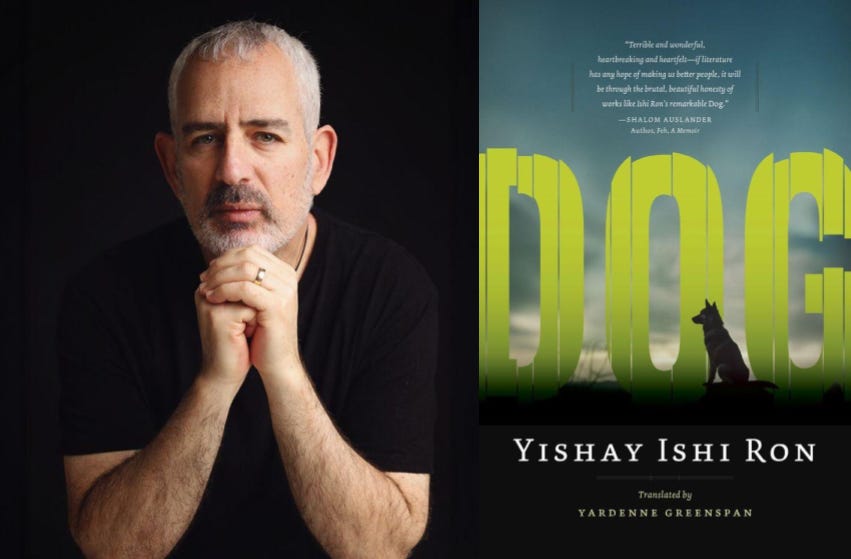
Editor’s Note: Dog, by Israeli writer and veteran Yishay Ishi Ron, was longlisted for the Sapir Prize and won the 2025 National Jewish Book Award for Book Club and Hebrew Fiction in Translation. The novel draws on the author's own experiences as a soldier living with severe PTSD. The excerpt below contains graphic depictions of drug use, combat violence, and psychological trauma. — Howard Lovy
A beam of light filters through the slats, stubbornly massaging my eyelids, which refuse to open. I fight it for a while, slowly sliding into a limp consciousness, then wakefulness, and I immediately feel Dog’s body heat. He’s asleep, curled up beside me, and though my body demands the heroin it rightfully deserves, and though I have no qualms with this right, I persuade it to wait a few minutes longer, to allow the small creature at my side to go on sleeping. It’s been a long time since I’ve felt anyone’s body heat next to me. Sometimes, at night, I can still feel the curves of Zohar’s body against mine.
In Japan, she wanted to keep traveling and I wanted to go home. It was obvious to both of us that our love wasn’t strong enough to overcome our desires. We could tell ourselves stories about how we were going to get back together, but I guess neither of us was the type to believe in fairytales. So we had dinner at Asakusa—a restaurant on the thirteenth floor with an unforgettable view of East Tokyo, ordered kabayaki, soba, sushi, and a bottle of sake, and shared stories like good friends rather than a romantic couple. Zohar went on to Vietnam, then to India, and the rate of her emails decreased and then stopped, but the memory of her body remained inside of me, and now Dog reminds me of her absence, the absence of a human body at my side.
The Georgian left. Before I raise my head and open my eyes, I know he’s gone. There’s a negative energy about that man that I can sense when it vanishes. I sit up. Dog wakes up but doesn’t budge, refusing to stretch his limbs the way dogs tend to do upon waking. I cook up a hit and check out my stock. I’m all set for today, but what about tomorrow? I’ve got the money I made yesterday, that could set me up for two more hits, assuming I don’t buy any food. As long as my next hit is a done deal, the whole world can go to hell. I’m aware of the strings by which heroin controls me, and yet I’m content with my lowly position. The outside world is crueler than my addiction. I wrap the tourniquet around my arm and ball my hand into a fist—easier to find a vein this way. With every passing day, with every shot, my veins disappear on me, sinking into the depths of my body. My arms are perforated like a sieve. I use a sterile pad to clean the area, and just before the needle penetrates, my heart skips a beat. A moment so beautiful it can weed out a derelict yard and replace it with a blossoming utopia. I pull out the needle, sterilize the spot again and bend my arm, cap the needle, and return the syringe to my pocket.
I look at Dog, still curled up and reluctant to wake.
“That’s some lazy friend I’ve made,” I say, getting up and walking to the armchair facing the sealed window, throwing my body against it, resting my hands on its tattered armrests, relaxed with the drug that spreads and pours and trickles through my body, flooding my brain.
I sink into the torn foam of the armchair, close my eyes, and allow euphoria to lap at the edges of my nerves like waves licking the shore. I adjust my body against the backrest and sink into the depths of a calm, quiet sea, trying to listen to outside sounds, detecting no wind or rain. The storm must have ended, but not before it filled the dump with streams of slime.
The drug fills my body with the illusion of warmth. I pull out my phone, turn it on, and play the Uri Geller video. I stare at it, almost hypnotized, like watching the light at the end of a dark tunnel. The video has no sound—either its soundtrack was lost over the years or the speaker on my phone doesn’t work, who can even remember. I focus on the scratches flickering on the screen. They cut to Geller’s hand as it tentatively fingers a silver spoon, fluttering over it, hardly touching it, the damaged film affording the video the believable authenticity of a laboratory experiment documented many years ago.
I’ve memorized the moment when he presents the spoon to the camera, showing its new banana shape. Then I turn off the phone and return it to my pocket before tugging on the chain holding the spoon around my neck, tug it over my head, close my eyes and search the back of my mind for the force that can influence reality and bend my spoon. I can sense it, like crude oil trapped in the belly of the earth. But if I can’t set it loose, it’ll never help me. I believe with all my heart that one of these days I’ll open my eyes and find the spoon bending to my will.
“How’s the young illusionist doing?” Crutchy Zvi asks, his statement containing a greeting, a question mark, and a sincere pleasure to see me. But he’s made me lose my concentration. “Well, my boy,” he says, “any news on the spoon front?” He lets out a long cough—not the kind one hears while waiting in line for the doctor. Crutchy Zvi’s cough is somewhere between dying and slamming the door on the world. “A day will come when you’ll perform all over the globe, just like the real Uri Geller. You’ll find diamonds and oil and they’ll give you a job at the Mossad,” he chuckles.
I nod in agreement. I don’t like being interrupted while I’m with the spoon. I’ll have to start over now. I ignore Crutchy Zvi and ask the spoon to bend, loudly pleading with it to bend for me, wholeheartedly believing it can hear me, but Crutchy Zvi is listening too, chuckling and coughing up phlegm.
“I don’t know what’s going to come of you, Geller. From time to time when we meet I can’t help but notice that your sanity is teetering on the edge of an abyss. You used to speak to the spoon silently, then in whispers. Now you and Spoon are chatting like a couple of old friends.” His laughter resembles the screeching howls of a hyena, completely breaking my concentration.
I don’t know if Crutchy Zvi is truly disabled, but I know he’s been using crutches for the past twenty years. Maybe he had to use them after an accident and has kept them for the purpose of begging on the street. He’s exactly what people imagine when they think about junkies: a mixture of drugs and time has let him faded and colorless. Life has been peeled off of him one layer at a time, and he looks like a caricature from an old newspaper that someone dumped into a puddle.
All street dwellers are dirty, but Crutchy Zvi is a pile of filth with clothes on. He seems capable of disappearing inside the heaps of trash in the room, never to be seen again. His facial hair has grown savage, most of his teeth are gone, and what remains is a dark, foul maw and a bland, cracked tongue, eyes buried in their sockets like two black marbles in a barren field. He likes to speak eloquently, perhaps in order to remind me that he used to be a history teacher, and occasionally he is plagued with scholarly outbursts, attempting to pull me into an intellectual discussion, but I struggle to find the educator inside the junkie. Too many years have gone by, and the history teacher is now history.
“You’ve got a deceased dog on your sleeping bag, Geller,” he says, causing me to give up on my attempts at bending the spoon once and for all. I place it around my neck again and slip it under my flannel shirt, then look at Crutchy Zvi, then at Dog, and then at Zvi again. He’s been coming and going, coming and going, for three days now. He has a few regular spots around the city. He’s the one who introduced me and the Georgian to the dump.
“Dog is asleep, Zvi.”
“He’s either dead or he’s about to die any minute, Geller. I’ve raised dozens of dogs in my lifetime, and the sorry creature on your sleeping bag is not a sleeping dog,” he says, leaning his crutches against the wall and sitting down on an old paint can.
I get up from the chair, bend down and touch Dog. He’s warm, which means he isn’t a corpse. But he won’t wake up, either. I feel around his body, and when I touch one of his back legs, he lets out a cry of pain. I point the flashlight at him. His eyes are closed, he’s breathing heavily, and his leg is swollen like a balloon.
“I’ve got to take him to the vet,” I tell myself, loud enough for Zvi to hear.
“You can’t afford a vet. You’d do better to share a hit with him. That way at least he’ll drop dead with a smile on his face,” Zvi mutters through his toothless grin, snorting with laughter. “And perhaps, my dear, only if possible, you’ll share a hit with your brother, too. I’ll repay you before the week returns its soul to its maker, I assure you.”
“Sorry, Zvi,” I murmur over Dog’s head, and something inside of me shifts, like a rusty cog beginning to turn. I almost fall backwards when it hits me—Dog could die just like that dog. Then everything explodes inside my head: Dog bleeding to death, a hole in his head just like Yehoram. Dog is an Arab, Dog is a terrorist, Dog is Hamas, Crutchy Zvi’s snorting laugh, the hole in Yehoram’s head, his weight against my shoulder, Dog lying in a puddle of blood in Shejaiya, and all the soldiers burned alive in their APCs, just kids with their guitars and their Messi and Barça posters and pictures of pretty girls on their screen savers.
“He’s going to die!” I cry, hearing myself talking, seeing the hands, but they aren’t mine. This isn’t my body. There’s a pressure in my chest, my heart is racing, my blood shooting through me, threatening to break through valves, veins, and arteries. I pick up Dog. It’s hard to breathe and my body is trembling. Dog isn’t heavy, but he’s positioned in a terrible dying angle in my arms. I stumble over the debris all around me.
“He can’t die,” I mumble, hearing my words echoing through my skull, but they aren’t mine. I hear yelling and I know it’s Crutchy Zvi, but inside my head I hear the cries of wounded soldiers calling out to a medic. They have two parents who birthed them and came to their cribs in the middle of the night when they cried and fed them and played with them and read them bedtime stories and took them to the amusement park and dropped them off on the first day of first grade. They’ve got brothers and sisters, a grandma and grandpa, friends.
Outside, dawn breaks over the city, a wet and miserable dawn welded together with heavy rainclouds. I remember the vet.
“Bograshov Street,” I hear the words, trying to hold onto torn seams that barely hold my personality together. Don’t fall apart, not now. But pieces of me fall to the ground and vanish between the pavement like see-through bits of skin. Fear closes in, as if I’d never shot up heroin in the first place. I put my ear to Dog’s fur but can’t hear a heartbeat. The sound of the exploding shells is deafening. They blow up everywhere, whistling through the air and paralyzing my body, and I know somebody’s about to die. When everything explodes the Gazans die and the Hamas terrorists and my soldiers and Dog—they all die.
“This isn’t Gaza, it’s Tel Aviv!” I shout. The words come out desperate, like the clucking of a chicken with a knife to her throat. Even though it’s morning, everything is war gray and dark and the buildings look like Gaza’s buildings, and the air stinks of fear like Gaza.
“Those aren’t shells. It’s all in my head, all in my broken head,” I repeat the words like a mantra, as if they can defeat the nightmare. I feel the drool dripping from the corners of my mouth. In war, fluids are no good—they mean something’s damaged, torn, leaking. My skull is pounding. I’m not in Gaza, I’m in Tel Aviv, and there are no shells here, only a dying dog, and no one is helping, no one comes. I weep, my tears staining the road, the buildings around me as threatening as terrorist cells, full of tunnel shafts. At any moment a terrorist can pop out wearing black, carrying a Kalashnikov, shooting at Dog and me.
I run, my breathing heavy and wheezing, my body sweating. The wind is cold, I’m about to die. I’m going to have a heart attack if a terrorist doesn’t shoot me first. I fight not to let myself faint. I’ve got to save Yehoram. How I loved that kid! My signal operator is strong. He never lags behind. Now Dog feels as heavy as a sack of rocks and I limp underneath it, one step at a time, sweating my fears out of my skin, but they keep emanating, straight from the fear and anxiety factory, cracking open inside my stomach.
I step in a puddle and realize I’m shoeless and my socks are all wet, but that doesn’t matter now, not at war, not in Gaza. People are staring at me, wanting to hurt me. I don’t know where to escape to. I’m in Tel Aviv, I know I’m not at war, I know this is Tel Aviv, not Gaza, I’m in Tel Aviv, the city of Tel Aviv. “I’m in Tel Aviv!” I scream at the top of my lungs, needing to hear the words in order to believe them.
But everything is so different, and Dog doesn’t feel like Dog but like Yehoram’s body, but Yehoram is dead, I know he’s dead. He was covering for us as he rescued the bodies from the APC, and then that motherfucking sniper shot him in the head and a warm stream of blood emerged between broken bones, and little bits of Yehoram’s brain began to leak out through the cracks like red shakshuka with specks of egg white, and he fell right on top of me and I picked him up and his eyes looked at mine and in spite of the darkness I could see what one can only see in the wide-open eyes of someone who has taken a bullet to the head—a great, black, endless astonishment.
So I picked him up and the radio got tangled between my legs and the bullets started whistling and I carried Yehoram’s body like a bucket with a hole in it through which life was draining out. I carried him just like I’m carrying Dog now, and the whole time I thought about his mother and how she had no idea that her life was over, she was probably still sleeping, enjoying the last good night she’d ever have. In a few hours, the casualty notification officers would show up, and she’d scream and Yehoram’s father would say nothing and would never speak again, because all of his words were connected to his eldest son’s heartbeat, and Yehoram’s brothers and sisters would lament their brother who died in Gaza, but no one would really pay much attention to their pain.
I thought about all these things as I ran with Yehoram’s body, not even realizing I’d been shot, too. Adrenalin filled my body and I was crazed, like a rabid dog. I kept running with what used to be Yehoram but had since become a lifeless lump of flesh and the bullets kept whistling by my head. I have no idea where the medic or the vet is, they need to take care of Yehoram.
I run through the bombed neighborhood, and I don’t want to die, and tears are running down my eyes, and I fall to my knees in the middle of the road, still holding onto Dog, and I want to raise my hands in surrender, but Dog is in my arms, and all around me is utter chaos and sirens or maybe it’s just cars honking and people running and I’m crying and Yehoram and Dog are crying too, and behind me a car brakes and honks and I can’t get up, maybe because of the bullet in my thigh or maybe I’ve got a big hole in my head from that fucking sniper who shot Yehoram, and the army is going to make the entire neighborhood shake and a ton of people will die just so we can catch that sniper, little kids and grandmas and mothers and fathers and even the boy we later found lying, legless, wearing a shirt that read “Falafel King of Jerusalem.”
Whole families will die and so will Dog, whom Yuval shot because he was a damn Hamas dog, a beautiful German Shepherd who didn’t wear a green flag with white Arabic writing and didn’t carry explosives. The dog didn’t even have a beard. Maybe he was hungry or thirsty. He came over and Yuval pulled out his Glock, cocked it against his belt with one hand, and blew the dog’s brains out. Then he said it was a damn Hamas dog, and I didn’t do anything because it’s war, so dogs die too, and it wasn’t a child or a woman or an old lady, just a poor little German Shepherd, an unkempt dog, and I saw the horror in his eyes as his soul escaped through the hole in his head.
People come over from every direction. They yell and talk and touch me but I can’t get up, I can’t move. I hold Yehoram as he dies, hold onto him as tightly as I can so nobody abducts his body. Whatever happens—just no abduction, even if it means blowing yourself up with a grenade, don’t let them abduct the body, then an ambulance with flashing lights comes to take Yehoram, but I hold him tight, wrapping both arms around him, everything about me confused, and I’m about to die. I didn’t say goodbye to my mother or Daphne or Amir, and my father is lying in the hospital attached to tubes, trapped inside his head, my father who’s the only reason I even joined the commando, and they’ll be sad when they hear about it. they’ll bury me next to my friends from the battalion. Next to Yehoram. Next to Dog.
All of a sudden, from within the inferno, pale arms reach out and take Dog, and these arms are connected to broad shoulders in a black t-shirt, covering a large chest with a golden necklace with the word “Doris” spelled on it. I look up and see that the whole thing is connected to a fat woman with a wide face, a small red nose, a million freckles, and ginger hair, and she smiles and tells me she’ll take care of Dog and holds him to her chest. Those words are enough to push the fear away, and all the military memories fall away like dried mud.
Yehoram vanishes in the image of Dog, Gaza is gone from Tel Aviv, a long line of cars honk behind me, I’m on my knees in the middle of the road, as if begging for my life, as if praying to God, and all around me people are talking and consulting and telling people what happened and how it happened, and I’m busy picking up the pieces of my personality from the asphalt and putting them back together again, as careful as a tightrope walker, and I let the paramedics put me on a stretcher and slip me into the ambulance; I close my eyes, and dream of shooting up.
Yishay Ishi Ron is an Israeli writer and former soldier in an elite combat unit who lives with severe PTSD. Writing has been a vital part of his healing journey, and Dog is deeply rooted in his personal experiences. Dog was longlisted for the Sapir Prize—Israel's most prestigious literary award. Most recently, Dog won the 2025 National Jewish Book Award for Book Club and Hebrew Fiction in Translation. His forthcoming book, The Girl Who Rode the White Lion, will be published by Soncata Press in June 2026.
I wrote the review for JBC of his next book, out this Spring.
Stunning excerpt. Beautiful translation by Greenspan. I am looking forward to listening to the audiobook version!