


Editor's Note: In these excerpts from Jennifer Lang's latest book, LANDED: A yogi’s memoir in pieces & poses (Vine Leaves Press), I was struck by her honest and raw portrayal of adjusting to life in Israel. Through the lens of her family’s move, she explores the complexities of navigating a new culture and embracing religious practices, all while confronting the personal challenges of settling in a land that holds deep meaning for Jews worldwide. These are the first few chapterettes from YEAR 1: 2011–2012, offering a powerful reflection on family, identity, and what it means to belong. — Howard Lovy
Balagan
Two months after the God Talk with the girls, the day after we land in Israel, we step inside our windswept-gray front door of our house in Raanana. I gasp. The late August heat suffocates me like a tight wool turtleneck.
“Alors?” my French husband Mari asks.
What do I think of a place I’d seen once, eight months earlier, in the country for my nephew’s wedding, when a realtor and I stood in the foyer and my shoulders softened, saying: “You don’t know our story, but I don’t want to move here, yet can picture living within these walls.”
She had no clue that we’d recently spent what I dubbed The Year of Living Differently in this city, to stretch our children’s Weltanschauung beyond the red-white-and-blue flag. She had no idea that we’d arrived whole and left divided; Mari and Son aching to stay, Daughters and I eager to go. She had no inkling that I’d agreed to return for ten years—from the eldest entering the army to the youngest exiting the army.
Call it payback to my husband for living in my homeland for the 15 years.
Call it shalom bayit or peace in the house.
Call it compromise…
“You really want to know?” I ask Mari.
My thoughts are vicious and biting like a rattlesnake.
The girls race from room to room, shouting to each other, their voices bouncing off the stone walls, reiterating what I already know: it’s a mess.
We’ve arrived in time for the Jewish New Year but long before the house is livable. Construction workers roam every room. Hefty tools litter the tiled floors. The kitchen countertop is MIA. New appliances stand forlorn in the barren space. Layers of grime cover every surface. Outlets malfunction. Paint splotches spot windows and walls.
He puppy-dog eyes me.
“Aze balagan[i]!”
Mari and I speak a linguistic hodgepodge—French, English, Franglais, Hebrew, Hebrish—depending on mood.
“You might want to sleep on an air mattress, but the kids and I will stay elsewhere.”
I morph from upbeat into kvetch as I emigrate from New York to Israel.
Mari drops it. He neither confronts nor cajoles in his usual way. Living in America was never his fantasy, returning to Israel, never mine. My surrender came with conditions. At the top of my list: let me be.
ZIM
Days later, a mammoth truck carrying our red clay-colored container reverses into our driveway, its seven stars and three letters recognizable from afar. Six weeks earlier, it decamped from the Port of New York, heaving with our material possessions, leaving me to stare at our stripped century-old New York Tudor, the only one that ever felt like home in the 21 years of our mobile marriage, and sob.
Here, halfway around the world from my American-girl-reference point, the movers taunt us with ready-or-not-here-we-come. We’re far from ready. Inside is a wreck, but outside, the sun broils me.
Mari and I watch them unload. A boy vrooms on his skateboard. A high-hanging date tree provides insufficient shade. A couple emerges from the house next door. I await the ordinary onslaught of questions: Where are you from? Do you have kids? What do you do?
After trading names and professions, the salt-and-pepper-haired veterinarian with an unmistakable Israeli accent says they raised kids on Long Island.
“I can’t believe you came here when we dream of living there,” he says.
I cackle to cover my desire to cry.
Mari and I exchange a long-married-couple look: save me.
A mover asks where to put our dining room chairs. Mari directs the swarm of stocky men air-traffic-control style. I dash inside to indicate what goes where:
Our sofa, mattresses, desks, nightstands, and flat-screen TV are encased in bubble wrap like King Tut. Cardboard boxes of books and photo albums along with Container Store bins of Legos and American Girl dolls tower above us.
As movers schlep in and out, I recall my children’s favorite bedtime story, a Yiddish folk tale called It Could Always Be Worse. The tale of a man who lived with his mother, wife, and six children in a one-room hut. Miserable, he ran to the rabbi, who instructed him to take in the chickens then the goat and lastly the cow until the chaos became unbearable, and his rabbi then told him to free the animals one at a time at which point the family slept peacefully and the man relished the relative quiet.
While these burly men heave and ho, I think about the civil war raging in Syria—a mere 500 miles north—realizing how fortunate we are: immigrants by choice, completely intact.
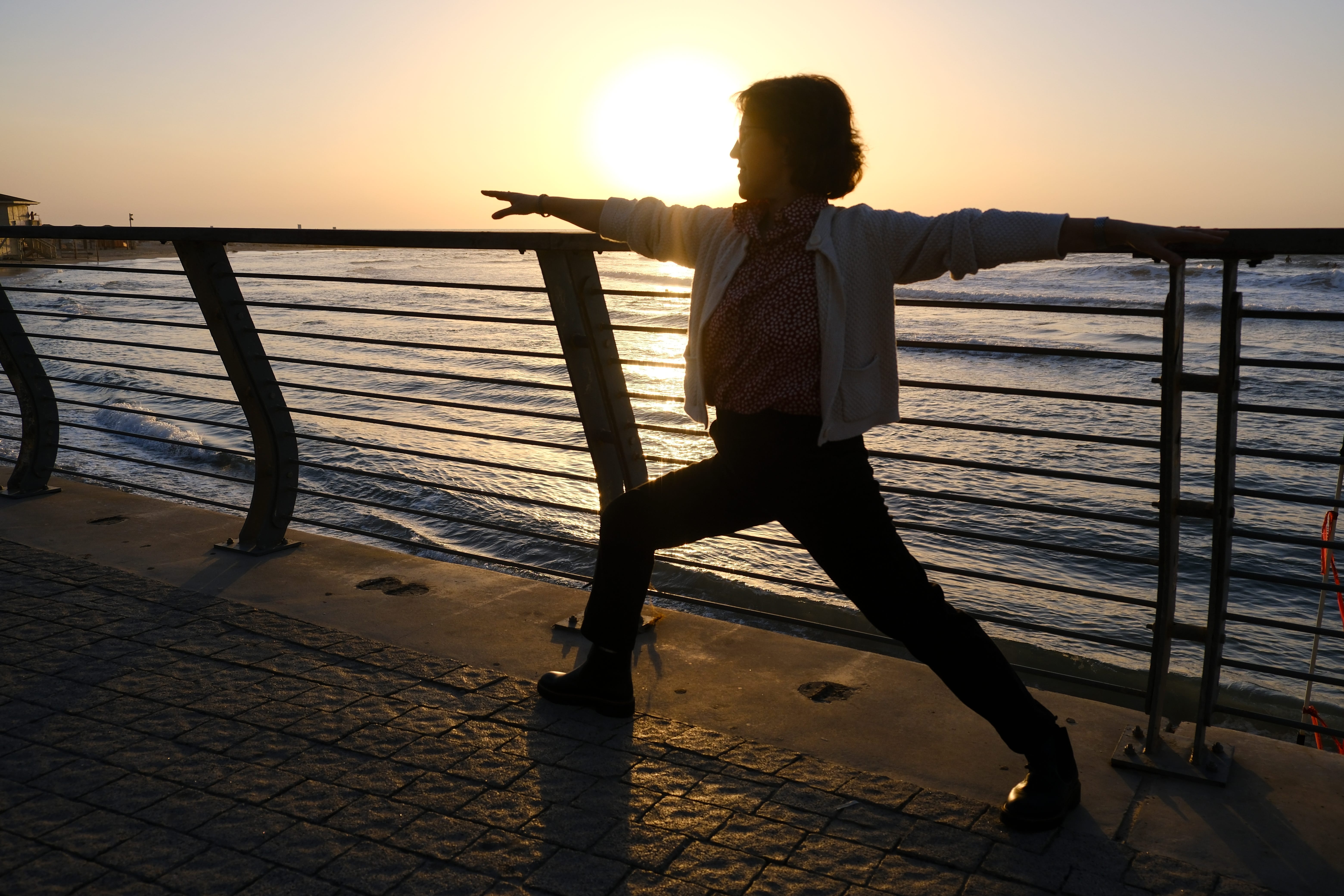
Warrior I Pose
While the girls attend school and Mari shadows the workers, I sweat on my mat at Omyoga.
The instructor, Shani, sticks closely to the 41 poses in the primary Ashtanga series, leading us from pose to pose, her words calculated and crisp, her delivery, worldly and wise. The sun penetrates through wide-open windows. No fan, no AC, pure desert heat. Her burnt umber skin glows.
I detect active verbs like lilchotz, leharim, leharchiv, making my hippocampus work intensely to recall words from Hebrew immersion class over two decades ago. My tank top clings to my torso. Buckets of perspiration drip down my sides.
Eight years earlier, during my teaching training in New York, we studied the battle between two sides of a family—the Pandavas and the Kauravas—in The Bhagavad Gita. Warrior I isn’t about the physical warrior but the spiritual one, facing the universal enemy of self-ignorance, the ultimate source of suffering. Am I warrior enough to live here? If terrorism resurges or war ensues, am I strong enough to soldier through it? If my children grow up and leave the country, is our marriage sturdy enough to anchor me?
As I listen to 20-something-year-old Shani, everything compresses: the gray matter, the white matter, the water.
Blur
Days into our new Israeli lives, the girls and I enter the ersatz synagogue in a school gym. Hundreds of Jews sit in cheap plastic folding chairs. Day one of the two-day New Year. My eyes blur.
“Shana tova,” friends and acquaintances and strangers murmur Happy New Year as we sidestep into a row.
Everyone clutches a prayer book. Married women cover their hair with a hat or scarf or cap or doily or beret or bandana. While they bow heads and sway bodies in supplication, I stare at the basketball net and stacked bleachers. Somewhere, on the other side of a low curtain are Mari and Son, who stopped observing Judaism in high school but remains respectful of his father’s ways. All day, we play musical chairs: stand, sit, stand, sit, stand again.
While my girls gab, I flip through the book, counting pages until the end of the service before removing my rings, passing each one from hand to hand.
During my childhood, Rosh Hashanah only lasted one day, the siddur transliterated prayers from Hebrew, and the rabbi always told us the page number so no one could get lost. Visions of little-girl me sitting obediently in temple, pantomiming for my mother to take off her jewelry so I could fiddle and make time pass quicker. Memories of teenager-me traipsing to the ladies’ room to meet my best Hebrew school friends Judy and Marcia during Rabbi Waldenberg’s sermon. Recollections of juvenile-me officiating the prayer services during youth group weekend conclaves.
My ears perk when I hear Adon Olam, the hymn sung at the end of services, a sure signpost for Jews across the globe. Outside in the yard, Mari and I chat under a tree in the abusive September sun. People wish each other shana tova. The kids beg to leave.
“Wasn’t that lovely?” someone asks.
I refrain from answering and motion to my family: let’s go!
Poser
Six days later, another holiday and countrywide closure, beginning the evening before and ending after nightfall. Erev Yom Kippur—the eve of the holiest day of the year—swells with sad air and solemn people. Complete quietude blankets a large strip of the land: no cars, no cafes, no forms of entertainment regardless of belief or observance level. Even Ben Gurion International Airport is dark. Millions of Jews abstain from food and water and stand-sit for hours in synagogue, close eyes, bang fists against chests, chant prayers, and ask forgiveness from Elohim for sins they have committed over the past 364 days. On the outside, I show up for services, but inside, I bolt to a far-flung galaxy.
After synagogue, the city’s main thoroughfare is awash in white—the color of purity and cleanliness—as worshippers stroll, stopping to greet friends and to wish each other an easy fast. The kids head to the house, while I accompany Mari, who wants to see and be seen.
Ahuzza Street offers an unexpected contrast. The devout repent while the secular, more than half of the city’s 47,000-something residents, release. Mobs of boys race each other on bikes. Families ride with total disregard for rules of the road. Parents teach children to pedal without training wheels. Recklessness reigns. Every year, heaps of people land in the Emergency Room.
On this day, also called Festival of Bikes, I picture myself on my green Trek hybrid, cruising through the city, the cool evening wind fluttering on my arms and legs. I picture myself alone, Mari and the kids walking to and from synagogue, famished and parched. I picture myself flying and free.
California-born Jennifer Lang lives in Tel Aviv, where she runs Israel Writers Studio. Her prize-winning essays appear in Baltimore Review, Under the Sun, Midway Journal, and elsewhere. She holds an MFA from Vermont College of Fine Arts and served as an Assistant Editor at Brevity. Her first book, Places We Left Behind: a memoir-in-miniature, is a finalist in Foreword Reviews, Next Generation Indie, American Legacy, Independent Author Network, and the Wishing Shelf Book Awards. Landed: A yogi's memoir in pieces & poses launched in October (Vine Leaves Press). A longtime yoga instructor, she leads YogaProse. Findable @jenlangwrites.
Five Tiny Delights
Strolling along the beach promenade on an overcast December day when the waves are lashing
Potlucking with friends on Friday night in orange plastic city chairs a few feet from the Mediterranean Sea
Hearing a hum of different languages in the souk: Hebrew, French, Spanish, Russian, and other unidentifiable ones
Being so engrossed in a book that all I want to do is read
Flowing on a yoga mat, melting into muscle memory and music and my own breath
Five Tiny Jewish Delights
Hosting friends and my grown-up-ish kids on Friday night
Listening to beautiful, soulful lyrics in Hebrew by favorite Israeli singer songwriters (happy to share names, just ask)
Experiencing only-in-Israel moments (Narkis in concert at the Barby club, pauses to share a screen of the prayer for Israel and the soldiers, and recites it between songs)
Meeting friends for Shabbat afternoon sunset and snacks under the shaded structures a few feet away from the Mediterranean Sea
Standing for "HaTikva" before a Comedy for Koby show
What wonderful, descriptive writing! I can identify with so much, especially about the feeling of suffocation in shul and counting the pages to the end - especially on Yom Kippur. It takes time for Israel to be a part of you, and you a part of it. But from the moment I arrived I knew I was HOME! Thank you for such an entertaining excerpt.
I loved her memoir, Places We Left Behind.