

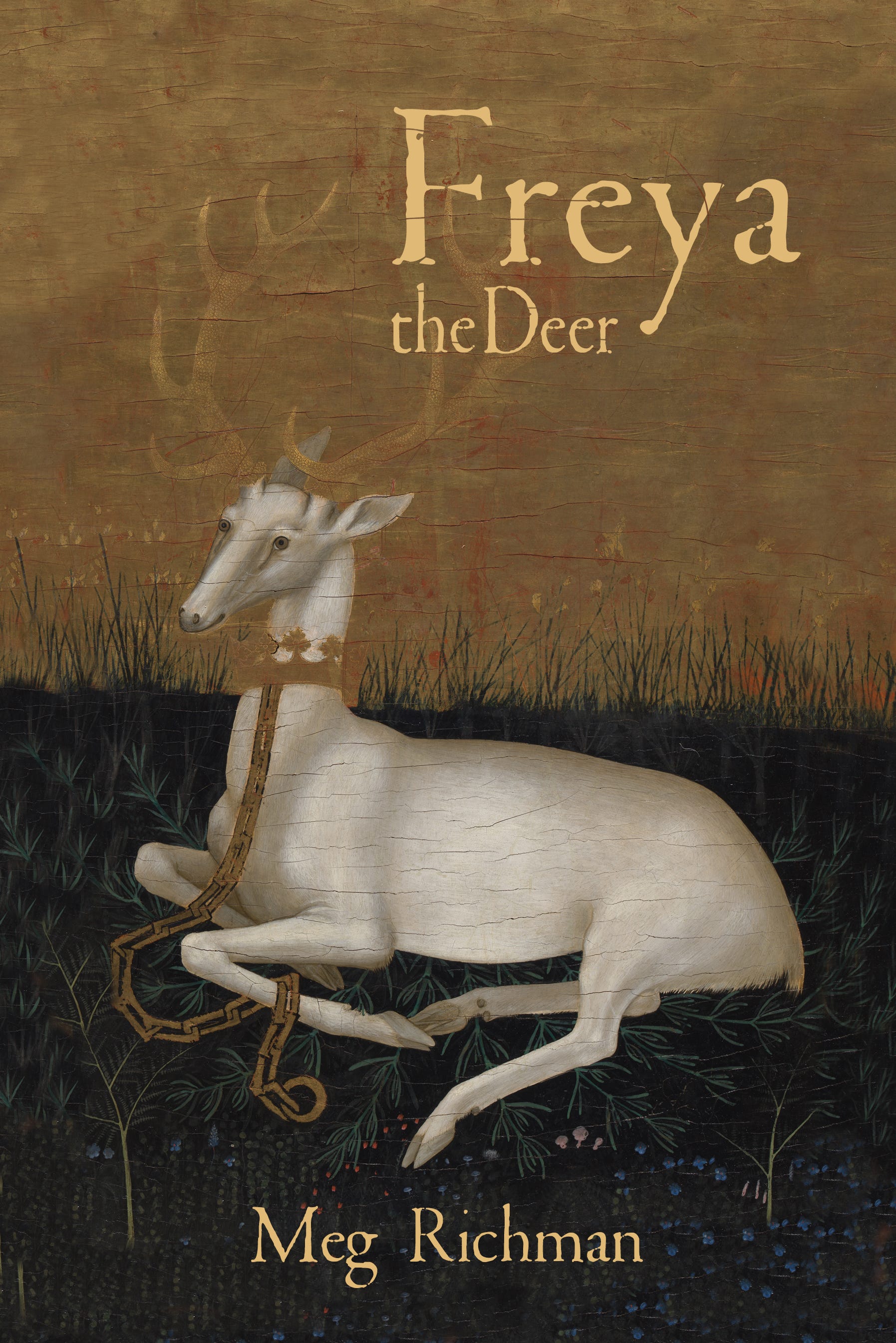
Freya the Deer
“I have set before you life and death, blessing and curse; therefore choose life, that you and your offspring may live” —Deuteronomy

Editor’s Note: An excerpt from Meg Richman’s just-released debut coming-of-age novel about a neurodivergent young woman trying to navigate love, identity, and political upheaval in the Pacific Northwest. —David Michael Slater
Chapter Nineteen
Trey moved into Caleb’s old bedroom. Regina, who had always enjoyed having Caleb’s sports teams and tribe of friends around, welcomed Trey into their pod as soon as he got a negative Covid test result. He had been living at an inexpensive motel usually inhabited by truckers since the virus closed the dorms. Now his savings were exhausted. His family was in Chicago, where they wanted him to return, since it looked like school might be remote indefinitely. But he had become accustomed to the freedom of escape from family strictures and the harsh city. Going back to parents and thus childhood and its limits was not an option. Especially not now.
For Caleb, his friendship with Trey was the entrée to manhood he craved. He had an unconscious, visceral belief that Trey’s experiences of racism and the streets made him a paragon of masculinity. By being tight with Trey, Caleb was masculine adjacent; it might rub off. His own privilege made Caleb feel spoiled and unmanly, like some pampered prince. Trey could initiate him into a different world. Caleb was excited to have him in the house.
This newfound brotherhood of her husband with Trey was disturbing to Freya. She felt a film growing between herself and Caleb. A fog that distracted him from seeing her with the focus he once had. It wasn’t just a feeling she had. His priorities were shifting.
Two odd things happened. Saturday, the guys said they were going out to play frisbee. They were gone for several hours. Meanwhile, Freya noticed their orange frisbee, their only frisbee as far as she knew, on the porch. When they returned, empty-handed, she pointed out their lack. Trey and Caleb exchanged a look. Some might have thought it conspiratorial or guilty, but Freya didn’t have a suspicious mind, despite her sense of greater distance from her husband.
“Yeah,” said Caleb. “We just walked around.”
“You could have taken the dogs.”
“Yeah. We weren’t thinking.”
What they were actually doing was scheming. Scheming how to express their horror at the world, how to tear it apart like an elaborate Lego castle. Caleb loved to hear Trey’s stories about life in Chicago, the ghetto as he re-imagined it through Trey’s description. Caleb felt he was catching a whiff of the wind that surrounded the truly oppressed.
They walked over to the cemetery and sat down on someone’s blocky gravestone. Caleb traced his finger, unthinking, along the letters of the dead person’s name etched into the granite. Meredith Mason 1899-1962. The angles of the m’s were satisfying to his touch. Trey was in the middle of a story about the high school he went to, and how even the Black teachers were racist. “Because they believed in the whole frickin’ set-up. The books we read. Fuckin Lord of the Flies. Memorizing the Periodic Table. What the fuck. What the fuck am I going to do with the Periodic Table? I can look it up on my phone. And the tests. The ACT and the SAT—and you won’t get into a university if you don’t score high. And you have to go across town to take them cause not enough kids in our school plan on going to college anyway. I mean, you believe in the system, you support the system, it’s racist. Doesn’t matter the color of your skin.”
“It’s hard not to be complicit. Just by virtue of living,” agreed Caleb.
Trey emphasized his words like a preacher, cutting both hands through the air by his ears. “I don’t want to comply.”
“Yeah. No. Me neither.”
“I wanna burn it the fuck down.”
Caleb realized he had scraped the skin off the tip of his finger by rubbing it too hard on the stone. He sucked the blood off in his mouth. Blood was sweet and sour and metallic all at once.
“I wanna buy my mom a house in this neighborhood. Move her out here. It’s like living in the country, but you’re still in the city. You can hear the birds singing. That’s crazy.”
Caleb, once again reminded of just how lucky he was, since his mother already lived in an ample home in this leafy neighborhood, so safe and so sound, didn’t know what to say. He was reaching, reaching past his middle-class existence. “We need to take action. Parades and demonstrations are ok, but we need to start dismantling this motherfucker.” He tried to say motherfucker like he said it all the time. He thought he pulled it off pretty well.
They daydreamed a while about what kind of action might make a dent. Obviously, they weren’t going to nuke the whole capitalist catastrophe that was the U.S., either literally or figuratively. But people were ready, people were angry, they could get the party started. They could lead by example. They could make the powers that be shiver in their shoes.
A few days later, they went off alone again. They didn’t take the dogs or the frisbee this time, either. “Just some guy talk,” Caleb explained.
“Guy talk?” Freya asked before they left. “Plotting to uphold the patriarchy?”
Caleb looked at her in wonder. “You told a joke.”
“No, I didn’t.”
“Freya. Trey just has some stuff he wants to talk over with me, okay?” And so off they went, leaving her behind to practice guitar and brood.
It wasn’t that she needed undivided attention, exactly, but she A) didn’t want to be demoted to wifey and B) she wanted a magical connection. At all times and in all places. He seemed so excited by the radicalism and friendship he shared with Trey. Was she becoming just an ottoman? A place to drape his legs, while his mind was churning elsewhere?
Their minds indeed churn. Caleb and Trey went to the library to do some research. They were paranoid about seeking information on the internet; anything could be traced, especially if their plotting included any suspicious keywords. At the library, they could go into the stacks, which smelled of dust mites and leather, and no one would ever know what they discovered there. Information on DIY bombs. Explosive ingredients, fuses, timers. They didn’t want to take photos of the diagrams and lists on their phones, so they carefully copied them into a composition notebook. It took hours. Afterwards, they carefully returned the library books to their rightful places on the shelves, leaving no ghostly traces behind. They decided they should splurge on some burner phones going forward. Did burner phones have cameras? They weren’t sure. They’d find out.
Freya and Regina ate dinner alone. Freya had made a stir-fry with tofu and broccoli over brown rice that smelled of soy sauce, garlic, and ginger, and Regina was grateful, if not wowed. She knew it was good for her, but missed the depth of flavor chicken or meat provided. She poked at it with her chopsticks as she asked where the boys were. Freya said they were out bro-bonding. Regina crinkled up her face. “Like at a sports bar? A shooting range? What does that even mean?”
“I don’t really know,” said Freya.
Regina, who wasn’t a particularly gentle person, especially where Freya was concerned, in this instance spoke kindly and without aggression. “Is there trouble in paradise?”
“Only that I feel forlorn and forsaken,” admitted Freya.
This jolted Regina. She realized that she had come to rely on the sweet happiness that flowed between the two young lovers, a soothing drone in the background of their new shelter-in-place life. It assuaged any anxiety she might feel on Caleb’s account. It was an ugly era, what with Covid, Trump and his nasty policies, and the climate hastening them all to their apparently inevitable doom. She had been resting in the assurance that her boy was happy. What if that happiness soured? Meanwhile, Honeymoon and Evelyn were both staring up at the diners with moony eyes reserved especially for food quest.
“No,” said Regina. “Stop begging.”
Under the table, Freya gave each of them a cube of tofu, making sure there were no onion bits attached.
When Trey and Caleb came home, they smelled of beer and weed. Freya thought maybe Regina was right. Maybe they were watching football at a brewery. Caleb pulled her up the stairs to their room, laughing at his own lust. “I missed you,” he said as he rushed her into the bedroom, onto the bed. They didn’t speak, not more than exclamations and moans, as he eagerly undressed her and himself, at least enough to fuck. It was like he’d never seen her delicate mounding breasts before with their bright pink nipples, her black fur pussy, her rosy vulva. His desire made her wet, and their excitement left them suspended together in a thrilling fairground ride of near-ecstasy, not quite achieved. Until it was, for Freya. She came and felt the release rippling through her body, but Caleb didn’t cum, and he kept moving inside of her. She came again, and again, and she felt like she was a pond, whose concentric waves overlapped each other, creating flowing patterns, arabesques, paisleys. Her watery pleasure, save some residual pulsing, ceased when Caleb said angrily, “Fuck,” and pulled out of her.
“What?”
“It’s chafed. It hurts.”
He turned away from her onto his back. She didn’t pick up on his sense of shame, his imagined lack of virility for this imagined failure. But she did have her own sense of the incomplete. Things needed to be finished in Aristotelian structure; beginning, middle, and, in this case, end. She made sure her mouth was filled with saliva to soothe the chafing and took his penis gently in her mouth. He groaned, shutting his eyes. She felt it harden – it had started to go limp outside of her. She used her tongue, her lips. She could feel his veins snaking beneath the skin and taste her own body – salt and gardenia. It was hard to tell as his breath sped again, and his body tensed in a pure agony of desire, whether it was the rhythm of his hips guiding the actions of her mouth, or the other way around. They were in sync. And then Caleb erupted. He yelled in relief and joy. The semen was viscous and saline in Freya’s mouth. Some women felt it a matter of pride to swallow – not so Freya. She spit it out on a nearby soiled sock. In the throes of his physical and mental bliss, Caleb couldn’t care less. When his breathing settled, he turned to her on his side. “You’re so beautiful,” he said. “I love you.” They slept with their arms around each other all night long.
Nonetheless, Freya had not forgotten how abandoned she had felt while Caleb was gone so long with Trey. The next morning, she addressed it. “Dog Boy.”
Something in her tone caused him to snap to attention, sitting in his spot at the kitchen table. Regina was in her den, already doing lawyering work, and Trey had not yet emerged from his upstairs bedroom. They were drinking coffee and reading the newspaper, which Regina still had delivered to the house in paper form. Freya was good at the crossword puzzle, and Caleb read all the political stories, national and local.
Noting that he was looking at her, she went on, her own eyes on his chest. “I’m not feeling safe.”
He smiled a bewildered smile, which she didn’t see. When she didn’t continue, he prodded her to say more.
“I’m afraid you’ll drift away from me.”
“Freya. We were fucking like bunnies a few hours ago. Why would we drift away from each other?”
She clenched her fists around her long curls. “Trey.”
“You’re jealous of Trey? Are you kidding?”
“I’m not jealous. I just see your focus shifting.”
He started rocking back and forth in his seat like a davening yeshiva boy. She waited.
“Yeah,” he admitted.
She released her hair. She had been pulling on it, and it bounced up several inches.
He didn’t want them to grow apart, either. He was feeling close to her right then, after she had salvaged his dignity and pleasured him so completely the night before.
“There’s something I’d tell you, but I’m afraid you wouldn’t want to know. I’m afraid you’d tell.”
“Tell whom? If I never had to talk again, you know I wouldn’t. I only talk out of necessity.” She meant it at the moment. Conversation was hard and often fruitless. In any case, it would not be a challenge to keep silent—if charged to do so.
“We’re planning something.”
“You and Trey? What?”
“Revenge.”
The word sent a chill through Freya.
They talked in low voices so that Regina wouldn’t hear.
By the time Trey came down to the kitchen, bleary-eyed with sleep, Freya had learned of their plot, which Caleb had described as kidnapping. The bike cop who ran Trey over. She argued against it, it was dangerous, what about his gun, they could get killed, they could get locked up, they could harm another human in the process. Caleb assured her they would plan it better than that, that they would find him out of uniform, unarmed, that no animals or people would be harmed, that it was all to create a platform to get attention for their message, to ultimately change the world. Their ransom would be meaningful police reform.
Finally, she was persuaded to go along, at least to get along. Once again, it came down to the sense that if she were to diverge too radically from Caleb, she would die. Flesh of her flesh, certainly, and it would mutilate her to separate. There was no chance that she could simply agree to disagree. Her nature required one hundred percent adherence to a thing.
Caleb made pancakes.
As he poured syrup, warmed in the microwave, pure from Maine, paid for by Regina’s law practice, Caleb told Trey, who had grown up with Mrs. Butterworth’s and Kroeger’s frozen waffles, that he had shared their plan with Freya.
Trey glanced over at Freya, then licked his lips nervously. “Okay.”
But it was clear from his voice that he wasn’t sure it was okay. “She’s gonna help us.” Caleb was trying to reassure him and spare Freya’s feelings simultaneously.
“I just… whatever…” Trey didn’t want to insult Freya, but he knew she was weird and working with her on something so hush-hush, and actually life-risking, seemed iffy. Her commitment to the cause seemed fragile at best.
“Trey,” said Freya, “You can trust me. I would never harm Caleb, nor you for that matter.”
“She won’t even eat an egg,” pointed out Caleb, who had had to make the pancakes with egg substitute and soy butter. Trey wondered to himself how she could possibly participate in their plan. He fervently hoped it would result in the red-headed bike cop’s death. How powerful that would be. The whole country would hear and be set on edge. Did Freya not understand their purpose, or was she just pushing it out of her mind? Or maybe Caleb had lied to her, or he didn’t understand the potential for violence himself. He watched Caleb kiss her, deep and long, on the other side of the counter. Love was fucking strange.
But it turned out that Freya was useful. She could sit in the café across the street from the police station in her careful way, watch the comings and goings without drawing any attention to herself. She had a sketchpad where she kept track with a secret code she devised, and along with a few schoolbooks, her open laptop, and a tall soy latte at the table, she looked like any other college student trying to learn remotely. The boys wanted particularly to keep tabs on the bike cops, and especially Red. Freya drew on her screen a freehand chart of her own invention, illuminated with birds and butterflies. She drew cartoon caricatures of each of her marks, and timed their exits, their entrances. Tried to discern the patterns. Did they come on foot or drive into the underground garage? She came to recognize their personal cars, their bikes, their police vehicles. Her attention to detail was exact, as it always was. Her work was a gift for Caleb.
Because of Covid and an added exodus of disillusioned officers from the department after the summer of CHAZ, those who stayed were working many extra shifts. Really, it became evident that it was impossible to predict Red’s schedule as it was so irregular. Just when they thought they’d pinned it down, he’d come in unexpectedly for the night shift, or on a Tuesday, his day off. Caleb and Trey began to reimagine their plan. Their revenge need not be so specific to one particular bike cop. The point was, after all, to make a point. To clarify that there would be a new order and the old order would fall. Freya was recalled home to cease her intel activities. They regrouped.
Caleb and Trey decided to make a set of bombs and place them strategically around the newly reinhabited precinct station. The place was a symbol of all that was wrong with the world. Dominance, violence, racism. Existing to protect capitalism and capitalists over all else. Wearing stiff military-style uniforms that enforced a uniform world of compliance and mediocrity through intimidation. A world Caleb and Trey refused to live in going forward. Like blood brothers, they committed together to forge their own path and live politically sinless, as much as was humanly possible.
They set themselves up in the basement workshop, where Caleb’s father had left most of his tools when he moved out into a crisp downtown condominium with a view of Puget Sound. Regina never went into the shop —if she needed a hammer, she sent Caleb because of the spiders who inhabited the dank recesses of the cellar. Conveniently for the revolution, she suffered from severe arachnophobia, so no danger of discovery from her. Strategically, the three young people went out and bought the necessary materials separately, choosing additional decoy products to allay suspicion, each going to a different store, paying in cash, relying on their pandemic masks to help disguise them from any cameras that might record the transactions.
Once the materials were assembled, Freya, hands accustomed to delicate work, was set to task constructing the product. As if it were a complicated sweater pattern, she was focused on completing her craft to perfection. The boys sometimes hovered, but she needed to focus and shooed them away. No music, no background noise. Cement walls, low ceiling, fluorescent light. She was making three bombs with internal clocks that would be triggered remotely from a burner phone. The fact that the boys were playing video games or making snacks felt normal to Regina. She was mostly working in her study on a case that required a lot of research, and she hardly noticed Freya’s frequent absences. Easily explained away by a vague school project.
On the night, or rather very early morning they scheduled, each of the young people was to set one package down outside the station (assuring success even in case any one of them was apprehended or one of the bombs failed to detonate), and the explosives would go off simultaneously once they were at a safe distance. Windows would break, and possibly, just possibly, the structure of the building would be compromised. And it would have to be torn down. What the CHAZ occupation couldn’t accomplish, their act of creative violence might. Two weeks into August, Freya finished the bombs, and they planned to deploy them on the next Monday night, four days away, when it was least busy in the neighborhood and at the precinct, to minimize potential civilian casualties.
That night, Freya and Caleb slept out in the backyard where they could look at the stars. On their backs, they lay there, trying to pick out the constellations from the random glimmering sprinkle. It was easy to find the Dippers, small and large, and the Pleiades, but beyond that, they weren’t sure. So they began to invent their own, organizing clusters into images only they could see. Freya gasped when a meteor shot across the night and dissolved into nothingness as it entered Earth’s atmosphere. She suddenly felt an enormous coldness in her chest, despite the fragrance of jasmine that filled the yard. A morbid sense of loss. She thought of Mei, hanging in the garage, the scent of auto oil greasing the air. She thought of the people dying miserable and lonely deaths from the epidemic. Tubes stuffed down their throats in hopes to siphon oxygen in. She began to pant – her body syncing to the bodies in the video footage she had seen, the old, the infirm, unable to breathe.
“Freya?” Alarmed, Caleb pulled her out of her nasty reverie.
“Oh,” she said, remembering where she was, with whom she lay.
“You ok?”
“Yes.” Her breath slowed down as she practiced counting as she inhaled, held, exhaled -- regulating herself back to normal, the way the Lady had taught her so long ago. “Yes. I’m fine.”
And really, wasn’t the sky salted with a million glistening suns? Weren’t there likely planets revolving around some of them, filled with life one could only imagine? She wondered why space aliens were always pictured as having those strange turnip heads, with eyes positioned in their faces like humans. Why wouldn’t they look completely other? Even the ocean was full of creatures who looked like they were from another universe entirely. Consider the octopus, the starfish, the anemone.
Caleb’s breath had deepened beside her. She saw that he was asleep. Dog Boy, she thought. She could read him about as well as she could read Honeymoon, who was snoring at their feet. One could sense but could not know another being. So much was unspoken, unrevealed. Almost everything, really. She began to drift down into sleep herself, but came to abruptly, aware that she had been almost gone but was now awake again. The next time she descended, she stayed. And began to dream. An explosion splintered the building, an old ornate building, and every fragment of stone and glass spun into space and became a star. She tried to comprehend the constellation that was forming, but there was no comprehending. No more than that of a dog’s mind.
And then her father was there, as will happen in a dream. He said, “But where is your Torah portion, Freya?” He was holding the Torah scroll, wrapped in its ornately embroidered velvet mantle. Suddenly, it exploded in his arms, and its bedazzled fragments too spun out into space. The scraps of parchment and fabric became stars, shaped like daisies, bejeweled like Tsarist brooches caked with emeralds and pearls.
When she woke, she only remembered her father’s voice asking her about her Torah portion. Hers, from her Bat Mitzvah, was a weird one. Leviticus gave directions for how to purify oneself from a particular skin ailment. For her Bat Mitzvah speech, she had approached it metaphorically – an ailment of the skin could be read as an issue of how one presents oneself to the world, the skin being the membrane between one’s inner and outer self. Freya spoke about honesty and personal authenticity, and the ways one must be true to oneself to be true to the world. Her speech was received well by the congregation, and of course, her parents swelled with pride. Afterwards, there was a catered luncheon in the dining hall, but Freya had had enough of people and took a bowl of fruit to eat and a book to read behind the heavy burgundy stage curtain on the far side of the vast community room.
And now. Lying in the dawn beneath a sky tinged coral at the eastern horizon, beside her husband still in deep sleep, she found it difficult to swallow. She realized she had an ailment of the skin. Inner self and outer self were at odds. What had niggled at her conscience since Caleb admitted his plot over pancakes was now screaming at a volume she couldn’t ignore: It was not possible to risk the life of the people inside the police station. It was simply impossible. There could be a teenager there, brought in for passing out drunk in the Seven-Eleven parking lot, and slowly finding his way back to consciousness. There could be a night-shift receptionist who had a husband at home with emphysema, and adult children who needed her to watch their kids during the day. And even Red. Suddenly, she saw him as a red setter dog, high-strung, bound by his instincts and training. Limited by the many and varied limits that humans have. Dogs have. The three of them, she, Caleb, and Trey, had no right to harm him.
Justice was God’s job. God who could see with a God’s eye view. God, who knew all. God, who could see inside the skin. If, of course, there was a God. She figured it was the same answer as the soul. Either there were both, or neither. But God or not, soul or not, there was right, and there was wrong. That was Judaism. That was its truth.
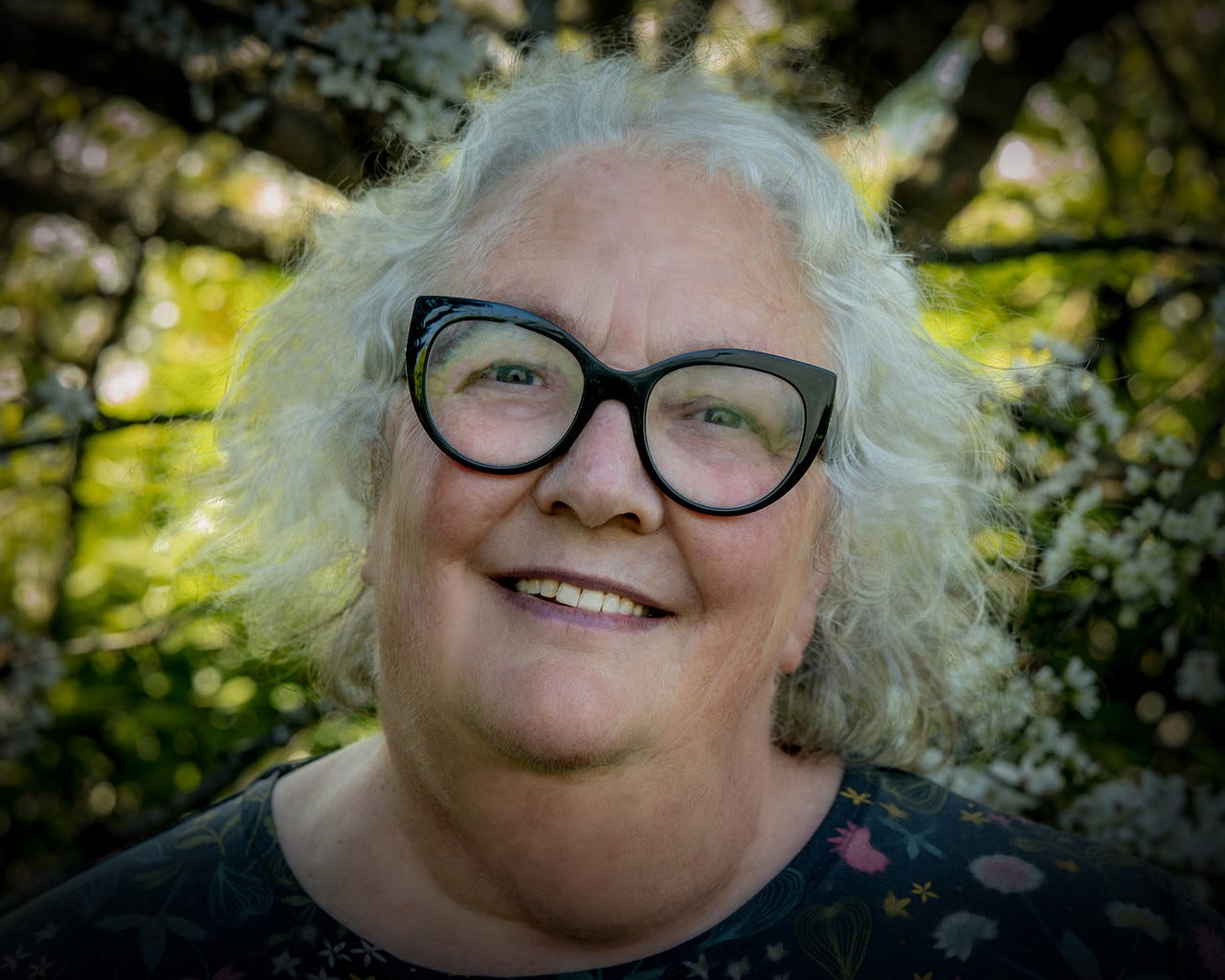
Meg Richman, a Seattle native, worked as a screenwriter in Hollywood for 15 years. She wrote the original treatment for Tim Burton’s The Corpse Bride, a draft of Up at the Villa for Sydney Pollack’s company, and the pilot for Aaron Spelling’s series Malibu Shores. The film she wrote and directed, Under Heaven, was a jury selection at the Sundance Film Festival and a nominee for an Independent Spirit Award for Joely Richardson’s performance. Motherhood brought Meg home to the Pacific Northwest, where she became an inner-city high school English teacher for thirteen years. She has short stories published in Louisiana Literature, Isele Magazine, and Judith Magazine. Freya the Deer is her debut novel. She lives with her son Jesse and oversized dog Gidon in an old farmhouse surrounded by the sounds of birdsong and city sirens.
Five Things That Bring Me Joy
Walking with my dog in the woods
Joking around with my son
When the words are flowing as I write
The glory of art and nature
Synergistic conversation
Five Jewish Things That Bring Me Joy
Singing prayers in shul
Baking a golden challah
Celebrating Pesach with my family and friends
My rabbi’s wise words
A strong sense of international community, especially since October 7
I have preordered! Can't wait to read it all.
Very excited to read the rest of this book!