

Hamsa
By Mark P Cohen

Editor’s Note: A short story by Mark P Cohen that explores whether shared humanity can overcome inherited hatred. —David Michael Slater
The first blast sent Fred flying through the air, crash-landing him onto the stairwell platform. He felt his shoulder crack, but no pain—at first. The second explosion deafened him with an intense ringing in his head. Blinded by the stairwell’s darkness, he was in shock. The sensation of concrete bits raining down on his face was all that told him he was still alive.
Emma’s hands came up dry after patting down her body for blood. Limbs all moved, though slowly. She dusted shards of concrete off her clothes. Her ears were ringing, but she could still make out a moan from… somewhere. Nothing was visible in the stark, dark stairwell.
She remembered fleeing to the President’s building for safety. She was filming the encounter between the protestors and campus police with her phone’s camera when two protestors pulled out what she thought were probably AR-15s and started firing, one toward the police, the other at the opposition. The police returned fire. She’d sought refuge in the stairwell. She couldn’t account for a bomb—either bomb. The first blast came from above, probably the second floor, then another, from behind the stairwell’s firewall door, just after she’d slammed it shut. Seconds had separated her from incineration.
Emma had caught a flickering glimpse of someone ahead of her climbing the stairs, but all went dark when the blast from above thrust her down. The second heaved her sideways. As the ringing faded, the moaning grew more distinct. Someone was nearby. She reached into her back pocket, hoping to use her phone’s flashlight, but then realized it was in her hand when she entered the stairwell. She’d kept right on filming during her flight from the violence. She patted around in the darkness but couldn’t find it.
Fred felt the touch of a hand on his leg, then his knee, stomach, and face. He tried saying something but couldn’t put words together. His head was going to explode. He felt pain now. His left arm, or shoulder, or back. He wasn’t sure. The pain pulsed through his body. He reached for the searching hand with one of his own. The touch of her skin—he knew it was a woman by the softness—told him there was hope. He grabbed hold, clasping tightly, and drew it to his heart as if its touch would save his life.
“Are you hurt?” Emma asked… whoever it was. But he didn’t answer. She tried to slip her hand out of his grip, but he refused to let her go. Frightened, she jerked it free, jarring the man, who screamed in agony. “Sorry!” Emma cried, uncertain what she’d done.
“The surge of pain brought on by this woman ripping herself free somehow revived him. “My arm. My shoulder. I can’t move it,” Fred reported, laboring to breathe. “But it hurts.” He laughed at himself for the understatement and how foolish he felt. Just before he saw the gunfire and Mo in his black overstuffed hoodie running toward the President’s building, he felt so sure of himself, so brave. He taunted the police, daring them to break up the demonstration. “Resistance!” He led the chant, setting an example. But when the reality of Mo’s offhand proclamation at last night’s meeting that “we’re going to blow things wide open” hit him at the sight of the AR-15s, Fred freaked. It was nuts. Suicidal, as it turned out.
What Fred had always chalked up to Mo’s depressed, fatalistic personality, Fred now understood was actually Mo’s suicidal ideations. He ran from the scene, chasing after Mo in his black hoodie, now convinced it concealed a suicide vest. “Mo… No…don’t,” Fred shouted between breaths. Fred followed Mo into the President’s building and up the stairs. Then, the first explosion, just as the second-floor stairwell door closed behind Mo. He remembered that sensation of being carried aloft on a cloud of energy until landing, only to be thrust backward by a second burst of force. Now, he was lying there, covered in dust, throbbing in pain, dying, and it made no sense.
”Let me get help,” said Emma, trying to stand. But she was too dizzy and wound up on the floor again. She took a long, calm breath to steady herself, then resumed groping around for her phone. All she came up with was debris. “Do you have a phone?” she asked, giving up.
“Do I have fun?” Fred asked, unsure what she’d said.
“Phone. Do. You. Have. A. Phone.”
“Yes, phone. My pocket.”
Emma reached toward the voice, aiming for a pocket, but wound up striking the man in the gut again, which elicited another scream. Too set on getting help to apologize this time, she grabbed the man and searched him all over, perhaps more roughly than necessary. The man screamed throughout the frisk. And all for naught. No phone. She gave up.
“I must… have… lost it,” Fred gasped when the pain subsided. He could barely get the words out. “Are you hurt?”
“I don’t think so,” the woman said. “I’m dizzy. My head’s ringing. It’s pitch black. I can’t see you. The blasts must have destroyed the backup lights. There’s supposed to be emergency backup lights in the stairwell.”
“I’m dying,” Fred declared. Emma found the poor man’s hand. “No, you’re not,” she insisted, even though he likely was. “We’re going to get out of here. My phone is somewhere. I just need to clear my head.”
“I was pre-med,” Fred said, pondering his life choices. Moments ago, he was a twenty-year-old straight-A junior at Berkeley, full of radical passion. He believed in the Palestinian cause. Fuck the Jews. They took his land. Well, maybe not his land. He was born and raised in Austin, Texas, just like his parents. But he had cousins in Gaza, or was it Jerusalem? So what if he never met them? So what if he’d never been to the Middle East?
Fred had grown up in a 4,000-square-foot home in the affluent Austin, Texas, neighborhood of Barton Hills. His father was an electrical engineer, his mother an architect. No one spoke Arabic at home. Every Christmas, they had a tree and hung lights outside so their neighbors could see they were as American as a Hallmark Channel Christmas movie. But hanging out with his fellow Arabs on the Berkeley campus helped him embrace the olive tone of his skin and the tight curl of his hair. Lying on the ground now, broken, unable to move, head splitting, body throbbing in pain, covered in concrete dust, dying, he had regrets. He’d dreamed of becoming a doctor and playing in a Grateful Dead cover band, not of martyrdom!
“I’m a graduate student,” Emma said. “Computer science.” She, too, had curly black hair, but more like Ilana Glazer’s, and she wore it pulled back in a fuzzy, bushy ponytail. Her eyes were blackish brown. Nose: Askenazik from her mother. Skin: olive from her Sephardic father. She was slight in form; not a trace of body fat. She ran five miles a day and was a vegetarian. “I have to get us out of here,” Emma insisted, trying to stand again. Again, the dizziness overwhelmed her, forcing her to lie back down. “I must have a concussion,” she moaned. “I need another minute. Tell me about yourself. What’s your name?”
“Fred.”
“Fred. Okay good. Fred. I’m Emma. Where ya from?”
“Austin.”
“I was there once for a concert. Great music town.”
“It was my scene.”
“Scene?” Keep him talking, Emma thought. Stay awake.
“The music. Blues, country, all of it. I was in a band in high school. I played guitar.”
“What kind of music?”
“Mostly the Dead.” It was a struggle to speak, but Fred told Emma about his musical journey from high school gigs to outdoor concerts at the Moody Amphitheater to sneaking into Austin’s small clubs to see obscure artists. “Tell me about you,” he asked after getting out as much of it as he could.
“Is this a date?” Emma asked and laughed, which felt good. The absurdity of the thought momentarily displaced the trauma of explosions, violence, and hate that drove her into the stairwell.
“Yes,” Fred wheezed, “a date. A blind date,” he added, and that made him laugh, which hurt. “Tell me your life,” he asked.
“Grew up in a Park Slope brownstone in Brooklyn,” Emma said. “My mother’s a writer. My father works in advertising. I went to Stony Brook on Long Island. I have a younger and older brother. I had enough of New York’s winters, so I decided to come here for grad school. I’m glad I did,” she added, ignoring the irony as she gently squeezed Fred’s hand. She’d left out the part about rediscovering her Jewish identity during her sophomore year, when she started attending Shabbat dinners at Chabad, and how she ended up minoring in Jewish history, keeping kosher, and becoming a radical religious Zionist. Okay, so she was a third-generation American Jew who’d never visited Israel, but she was planning to spend a semester there. And she had cousins in Tel Aviv. “So,” she said, choosing not to think about any of that, “where are you taking me on our first date?”
“Dead concert,” Fred whispered, “at the Greek Theatre here in Berkeley. We’re going right up front and twirl around to the music.”
“You do realize that Jerry Garcia died before we were born.”
“Let’s not dwell on the details,” Fred said, smiling weakly in the dark. “Let’s… Let the Good Times Roll.’
“I see what you did there, Jack Straw.”
“It’s All Over Now.”
“No, it’s not. We Can Run as soon as we catch our breath.”
Back and forth they went, announcing their favorite Dead songs, holding hands all the time.
Until a rumbling screech from above ended their date. The building was collapsing. They clung together as chunks of concrete and shards rained down on them.
“Ow, fuck!” Emma screamed. Something had fallen on her side. She could barely breathe. She had broken ribs, for sure. Panicking enough to ignore the pain, she crawled around searching desperately for her phone while bits of building came down all around her. “Fuuuuuck!” she screamed again when her head hit something sharp. Blood dripped down her face.
But then, suddenly, everything went quiet again.
“Come back,” begged Fred. “Let’s not die alone.”
“We’re not going to die!” Emma cried, wincing and bleeding but still crawling around.
“Sit next to me. Hold my hand.” His breath was weak. “We’re still on our date,” he whispered. Exhausted, Emma felt her way back to Fred and found his hand again.
“I love you,” Fred said, breaking the silence as he held the hand of this woman who was about to accompany him into heaven. He’d never been in love before. But with the prospect of death as a sieve screening out the impurities of his life, love was what settled in.
His words pushed against Emma’s fear, calming her trembling body. “I love you too.” Greeting death with love seemed like a good idea to Emma as well.
They heard a buzz.
Emma jolted upright, ignoring the wave of nausea it caused.
Another buzz.
It was close. Really close.
She was crawling again. Her hands sweeping the floor, cut and bleeding.
Another buzz, louder.
And then it was in her hands.
A message lit up: Where are you?!
…
The blasts obliterated the first and second-floor exterior walls, exposing naked beams, dangling electrical wires, and sections of concrete, which clung to twisted rebar. The third and fourth floors threatened to collapse with the removal of a single Jenga piece. To aid the rescuers, several banks of portable high-intensity lights illuminated the catastrophic scene, giving it the appearance of a disaster movie set. A gawking audience of hundreds—protestors, counter-protesters, the press, concerned citizens, and armed police—stood watch for hours as Search and Rescue crews methodically removed the rubble to reach those trapped inside.
Fred went in and out of consciousness during the wait. Each time he faded, Emma listened to his chest and slapped him, demanding that he stay awake. She would not let him die—not on her watch. Her phone, however, died within minutes of her call for help. All she and Fred could do was wait and listen to the rescuers as they cleared debris and shouted periodic progress reports.
Power saws penetrating the concrete wall and stairwell door permitted narrow beams of teasing light to flicker into the chamber with each cut. Then, as a chunk of the door collapsed, a stream of light gushed through the stairwell, blinding Emma. She shielded her eyes as the rescuers, their headlamps on, came toward her.
“We need to get you both out of here quickly,” one of the rescuers said, draping a foil blanket over her. “This building can collapse at any minute.” As she was led away by the arm, Emma looked over her shoulder and saw four paramedics sliding Fred onto a backboard.
The outdoor audience cheered when Fred and Emma emerged from the ruins. TV crews filmed. Bright lights glared.
“Where is she?” Fred called out, reaching for the hand that had given him life and the woman who had given him love.
Emma’s eyes, still adjusting to the lights, turned to the man on the stretcher she had willed alive. Her mind refused to accept what her eyes now told her until a pulse of revulsion coursed through her body. Emma knew this man. To her, Fred Amrani, the leader of the campus Palestinian cause, was the embodiment of hate. She retched.
His hand dropped at the sight of Emma Benoun, hunched over. “There is no West Bank, only Judea and Samaria; Jewish land, the resting place of Abraham, Isaac, and Jacob. There is no such thing as Palestinians. It’s a made-up identity. They are just Arabs.” Fred charged through the crowd when he heard Emma Benoun shout this blasphemy through a bullhorn while addressing a crowd of Zionists in Sproul Plaza celebrating Israel Independence Day. “Zionist pig,” he shouted as several Zionist pigs held him back from attacking Emma. A brawl ensued. The police broke it up. No arrests. Fred despised this colonizer ever since.
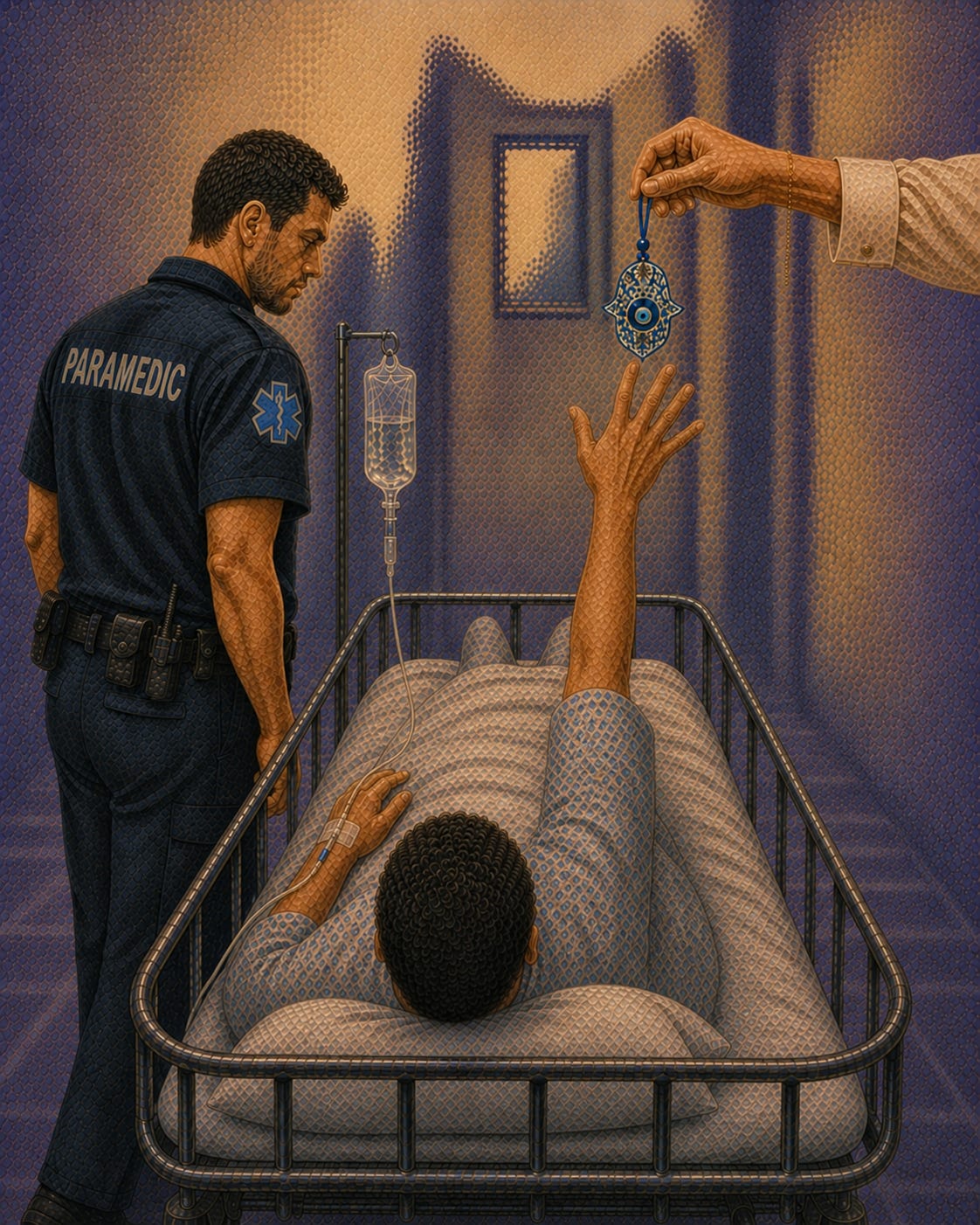
Tears of shame for loving a Zionist woman streamed down the sides of his eyes. Fred convulsed and went into cardiac arrest. Emma stood frozen as the paramedic pounded Fred’s chest. She wanted in on it. To what end, Emma was unsure. The paramedic listened with his stethoscope for a heartbeat. Nothing. Another applied defibrillator pads. “Clear.” Fred’s body jerked. Emma’s eyes welled beyond her will. As the paramedic listened again for a heartbeat, Fred’s right arm rose slowly from his side, reaching out, searching in all directions, hoping for a heavenly hand.
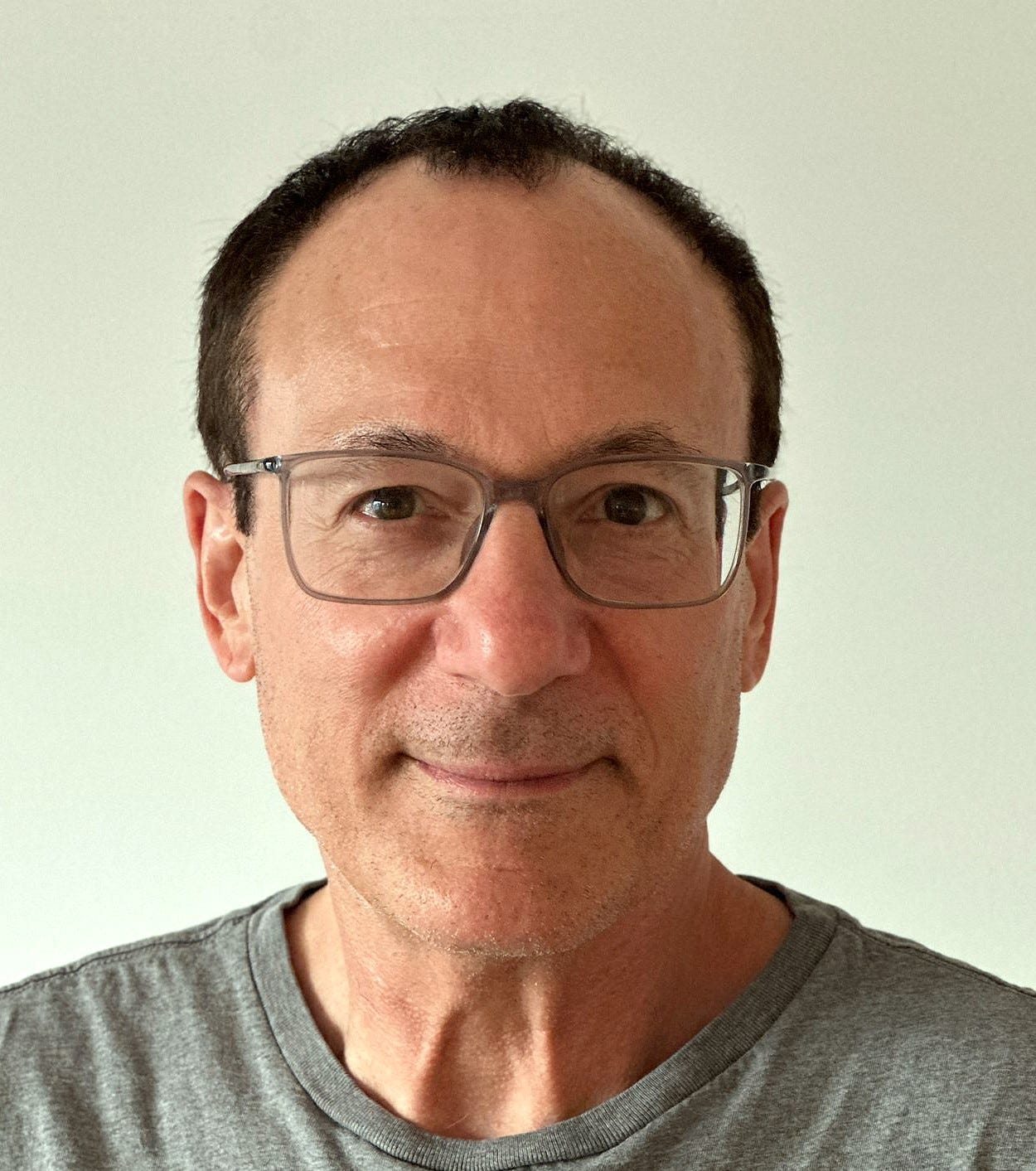
Mark P Cohen is a writer and a very part-time lawyer. His 2018 short story, Neighborhood Ghosts, won the Brooklyn Film & Arts Festival’s award for Best Nonfiction Story About Brooklyn. He regularly publishes on the Times of Israel blog and on Substack as The Red Heifer. Mark also participates in Nellie Neeman-Bochner’s Jerusalem Writers Group.
Things That Bring Me Joy
Couples holding hands
My granddaughter calling me Popa Z
Coffee at Casa Lavi on Derek Beit Lehem in Jerusalem
My son’s pizza made from scratch
My daughter’s pro-Israel Instagram posts
Jewish Things That Bring Me Joy
Waking up in Jerusalem
Cooking a Shabbat meal
Being the tenth minion man
Baking Shabbat Challah
Walking to the Kotel from my Jerusalem apartment