

Safe Travels
Irena Smith takes a stormy California road trip with her mother and daughter, drawing parallels to her Soviet Jewish family's history of flight and survival.

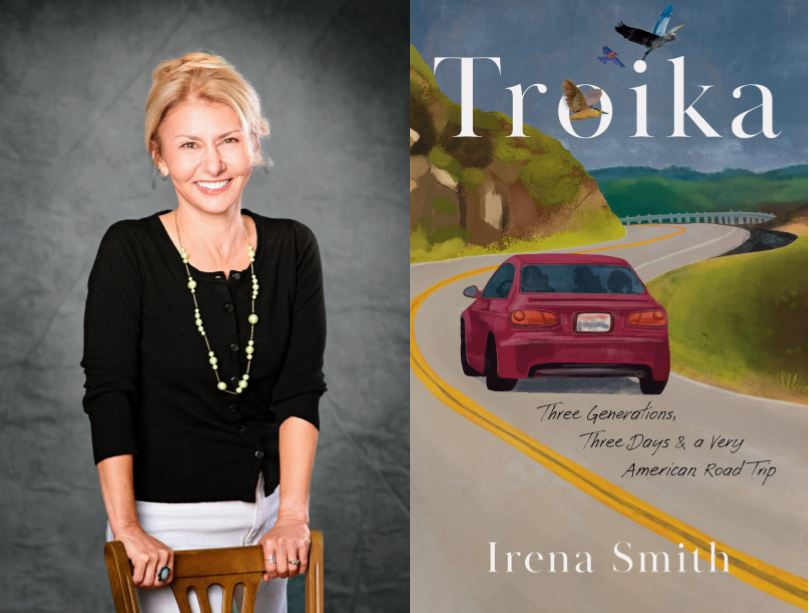
Editor’s Note: A three-day California road trip with her mother and daughter leads Irena Smith back through her Soviet Jewish family's history of flight, survival, and devastating loss. An excerpt from her forthcoming memoir Troika: Three Generations, Three Days. — Howard Lovy
The second time my father tries to give me a CB radio is in January 2023, right before I go on a three-day road trip to Solvang and Paso Robles with my seventy-seven-year-old mother and my twenty-two-year-old daughter in the midst of an epic storm. The storm knocks out power, uproots trees, floods streets, and brings down a pier in Santa Cruz. Meteorologists describe it in apocalyptic terms: bomb cyclone, atmospheric river, gale-force winds. A hiker films a water tornado off the Sonoma coast, a swirling wall of water rising from the ocean.
The storm shows no sign of abating on the morning we set out.
I saw a meme once where Odysseus announces to his crew that they’re embarking on an odyssey. A sailor raises his hand and asks what an odyssey is, and Odysseus tells him it’s a dangerous journey named for the only known survivor, and the sailor says, “Oh okay—wait what?” This is like that, but all three of us made it back. I was the only one who drove. I’m also the narrator, so I get to tell the story. The two are not necessarily related, but they’re not not related.
If you already know we survived, the question is no longer Did they make it? The question is, How? The question is, What are the stakes? The question is—or rather, the questions are—Where are they going and what’s so important about this trip that it can’t be postponed and what’s up with the dad and the CB radio?
Red sky at morning
My father hired himself out as an apprentice electrician when he was thirteen, after his father drowned on a beach picnic with coworkers. We almost never talked about my grandfather, but my father often told stories about working on huge ships and about growing up in Odesa, a colorful port city on the Black Sea where the neighborhood hoodlums relieved passersby of their watches by having a young child run up to them and say, “Mister, can I have your watch?” If the passerby refused (and the passerby always refused), a hulking man would step out from around the corner and inquire why the passerby was bullying a little kid. The hoodlums in his stories were comical and clever and only a little frightening.
He taught me to identify different kinds of clouds—nimbus, cumulus, cirrus—and to swim parallel to the shore until the current slackened if I was ever caught in an undertow. He taught me to ease up on the gas and steer into the skid if a car ever slid on a wet road. For as long as I can remember, we had a barometer hanging in a hallway or in the study wherever we happened to be living, and he monitored fluctuations in barometric pressure attentively. Once, a barometer fell from the wall and we joked for weeks about falling pressure.
My father loves maps and compasses and shortwave radios. He owns an extensive library of tools. He drops expressions like “Red sky at night, sailor’s delight; red sky at morning, sailors take warning” into conversations. I always assumed that he learned them while working on ships in the port while rubbing shoulders with sailors and seafaring merchants, but when I recently asked him if he learned “red sky at night” while working at the port, he said no. “Then how did you learn that?” I wanted to know. “By osmosis,” he replied, and didn’t offer any additional details.
In writing about my family, I have to resist the pull of what I assume is true, the siren call of what makes a better story. What makes a better story is not always true. Or sometimes it is true, but people don’t want those details in the story. Or they don’t want to be in the story at all.
Reservations
My father calls me the night before we’re scheduled to leave. The rain is coming down in sheets. The roads are flooded. He thinks driving almost three hundred miles in a storm of this magnitude is a terrible idea and asks whether my mother and I might consider postponing the trip until the weather settles. I say no. He asks me if I’m sure, and I say yes, absolutely positive. We have hotel reservations, in Solvang for the first night and in Paso Robles for the second. There’s a spectacular outdoor light installation in the hills near Paso Robles, and we have tickets for that too. I’ll drive slowly and carefully, I tell him. Then I ask him to put my mother on the phone.
My mother and I make a plan: She will take an early morning train from San Francisco, where she and my father live, to Palo Alto, where my husband David and I live. That way, she won’t have to drive in the rain, which makes her nervous. I’ll swing by the train station to pick her up; from there, we’ll drive thirteen miles south to Cupertino to pick up my daughter, and then the three of us will continue south to Solvang.
But on the morning of our trip, my phone buzzes. It’s my mother, calling from the train station. The trains aren’t running because earlier that morning, heavy winds knocked over an eighty-foot eucalyptus tree whose trunk is now blocking the train tracks. It occurs to me that this is a bad omen, but before I can say anything, she tells me that my father has offered to bring her to Palo Alto—an hour-long drive through a torrential downpour—and I say, “Great, see you soon.”
He could have refused. He could have said, “This is ridiculous.” But he ferries my mother to our house, and the two of them hurry to the front door, their heads bowed under the pelting rain. A wet gust of wind blows inside when I open the door to let them in, and they’re barely through the door when my father hands me the CB radio.
How to get from Northern to Southern California
The first time my father tried to give me a CB radio was on a perfect summer day in 1987, when I was about to leave on a road trip to Los Angeles with my friend Leslie to spend the weekend with several high school friends who were subletting an apartment near UCLA. We were eighteen. We had just finished our freshman year of college, and Leslie and I were back home for the summer—she from Boston University, I from UCLA. Home was Sunnyvale, California, where we came of age in ranch houses built in the 1960s and attended Homestead High School—the high school in neighboring Cupertino that graduated two world-famous Steves, Jobs and Wozniak. Between the two of us, we had four years of driving experience, most of it navigating the few blocks between home and school, home and the nearby mall, and home (or school) and the Denny’s at the intersection of Homestead Road and Foothill Expressway to have coffee and gossip and smoke. The latter was strictly forbidden at my house and passively tolerated at Leslie’s.
We thought we were adults, but we were, in effect, babies. We were full of collagen and unearned confidence. We were irresponsible. We thought nothing bad would ever happen to us. We had no idea that catastrophes sometimes lie dormant for years, or decades, biding their time. We didn’t know that we would drift apart, take different paths, become different people.
There are two major routes from the Bay Area to Los Angeles: the fast way and the scenic way. The scenic way (Highway 101) winds through some of the most beautiful scenery in California—the rolling hills along the Central Coast, the palm trees lining the absurdly blue ocean along Avila Beach, Pismo Beach, Santa Barbara, and Ventura County. The fast way (I-5) cuts through sun-parched, dusty Central Valley, mile after mile of farmland and pasture and desolate clusters of gas stations and fast food outposts. It’s bookended by Pacheco Pass on the north and the Tejon Pass (which everyone calls “the Grapevine”) on the south. In the middle, it’s monotonous and soporific, the monotony broken up by flashes of terror while passing 18-wheelers at high speeds. Pacheco Pass was known to us as “Blood Alley,” rumored to be haunted by the ghosts of the victims of head-on collisions and massacred Native Americans. The Grapevine was not known for anything except its long, relentless uphill stretches where cars overheat, its severe winter weather, and its ubiquitous semis.
When Leslie came to pick me up, my father carefully explained which buttons on the radio we needed to press to call for help and how to tune it to the same frequency that truckers use so that we could hear updates on road conditions. In the car, Leslie turned to me and asked, “Did you get all that?” I had not. I had, in fact, gotten none of it. Leslie hadn’t either. We tossed the CB radio in the back, popped a cassette into the tape deck, backed out of my driveway, waved enthusiastically to my parents, who were standing forlornly by the garage, and lit cigarettes as soon as we were out of my parents’ sight.
In the Iliad, Agamemnon sacrifices his daughter Iphigenia to the goddess Artemis hoping for a favorable wind that will allow a thousand Greek ships to sail across the wine-dark sea to Troy. He tells Iphigenia that she is to marry Achilles, and as she approaches the altar in her wedding finery, he slits her throat. Unlike Odysseus, who wanders for ten years after the fall of Troy, Agamemnon returns home smoothly and without incident. His wife Clytemnestra orchestrates a hero’s welcome, spreads sumptuous purple tapestries along his path into the palace, ushers him into a bath, and stabs him to death.
I had not yet read the Iliad or the Odyssey or the Oresteia when Leslie and I hurtled down I-5 past mephitic cattle herds and fields of lettuce, smoking and blasting OMD and Springsteen and the Beatles. I didn’t yet understand that going too fast could be dangerous. We didn’t cover hubris in my AP Literature class, or maybe we did and I didn’t remember. In any case, our safe return justified our extravagant carelessness.
I insist
“You know what they say about children and fools,” I say to my father after I finish the story of that long-ago uneventful road trip. I make my voice extra jaunty, because inside I don’t feel jaunty at all. “Anyway, we have cell phones now,” I add. “And I’m pretty sure I’d be just as inept at figuring out the CB radio now as I was in 1987.”
The three of us—my mother, my father, and I—are still standing in our entry. I’m itching to get going, but my father lingers, as though hoping that I’ll change my mind if he finds the right words. My mother, who has been twisting the shoulder strap of her purse, says, “I’m sure we’ll be fine.”
My father has a rueful smile and a half shrug for occasions when he gives up trying to convince my mother or me of something. He smiles, half shrugs, and tells us to drive safely. Then he nods for emphasis and walks out into the rain.
If you’re not home, you’re in danger
Two months after my father was born, Germany invaded the Soviet Union, and two months after that, my grandmother Tsilya and my four-month-old father boarded a train crammed with refugees headed to Kirov, an industrial city over a thousand miles to the northeast. My grandfather was sent west to fight. My grandmother’s parents, her two sisters, and her nieces and nephews were going to take a later train.
Then they disappeared. I always thought their train was bombed en route, but my father told me recently that no one actually knew what happened to them, that the train being bombed would have been the best possible outcome. He didn’t say what the worst possible outcome was. One of the sisters had a newborn.
But on the train to Kirov, my grandmother, who was not yet my grandmother, didn’t know any of that. She was preoccupied, I’m guessing, with breastfeeding and diapering and keeping my father from crying. When the train stopped, she washed out the diapers and strung a rope between the train cars and hung the diapers to dry. One night, the car to which she had attached the other end of the clothesline was uncoupled and went elsewhere, snapping the rope and taking all the diapers with it. After that, she claims, she trained my father to pee in a tin can. Whenever she talked about the war, which was not often, she talked about the indignity of that broken clothesline, the triumph of my father’s early toilet training.
This is a story about a three-day road trip, and also a story about broken threads. A real-life clothesline snaps in the distant past and becomes family legend. Grandma Tsilya passes it on to my father, to my mother, to me; I pass it on to my children, this story about loose ends.
When I was growing up, Grandma Tsilya kept tabs on everyone’s whereabouts. She liked it when we were home and worried when we weren’t. If she called and no one picked up the phone, she would leave a plaintive message on our answering machine. She always said the same thing: “This is Babushka. Where could you be in such weather?”
It didn’t matter what the weather was. It could be raining or it could be 72 and sunny with a light breeze. Weather stood for something else: unexpected catastrophe, chaos, people vanishing. “Where could you be in such weather?” had nothing to do with the weather. It meant If you’re not home, you’re in danger.
And yet
And yet it was Grandma Tsilya, who worried whenever any of us weren’t home and who fretted about cold drafts and sewing needles getting into the hands of small children (needles were sharp and children were soft and vulnerable), who told my father to emigrate. My parents and I were visiting her in Odesa in the summer of 1975, and over tea my father launched into a litany of complaints about anti-Semitism, corruption, ignorance, stagnation, lack of opportunity—all the usual hallmarks of Soviet life in the 1970s. Grandma Tsilya listened, looked him in the eye, and said, “Then leave.”
In 1975, her words were tantamount to inviting my father to walk off a cliff. There was no knowing where he and my mother and I would land, only the hope that it would be someplace better. If my parents applied to emigrate, there were two possibilities: Their application would be refused or it would be approved. In either case, they would lose their jobs and their Soviet citizenship as soon as they applied for an exit visa. The waiting period between application and permission to leave ranged from several months to several years, and permission was not guaranteed; some families were refused after spending months or years in limbo. Some were arrested. In the event that my parents’ application was approved and we made it to the United States—an entity almost entirely unknown apart from carefully couched descriptions in letters from relatives who had emigrated earlier—there were also two possibilities: Our American lives would either be better than they were in the Soviet Union, or they would be worse.
A destination of our choosing
Like the English word itch, the Russian word zud has two meanings: an uncomfortable sensation that causes a desire to scratch, or a restlessness, an irresistible urge to do something.
My mother and I could have acknowledged my father’s disquiet. I could have taken a look outside, where the wind was whistling in the power lines and shaking trees like a belligerent drunk, and decided that it wasn’t worth it, and my mother would have agreed. We could have heeded the weather alerts lighting up both our phones that advised staying home except in cases of essential travel. I could have texted my daughter and said, “It’s horrible out, let’s wait until the weather clears or go another time.” I could have considered the fact that if something happened to the three of us, my father, who had already lost so many people, might lose his only wife, his only daughter, and his only granddaughter.
Except this frivolous, ill-advised, unessential road trip feels essential. I don’t know exactly what my mother is thinking, but I’m thinking that we’re not getting any younger, that a change of scenery would do us all good. That the time would come when my mother would not be able to travel easily. That my daughter and I had never traveled together, just the two of us—at least not to a destination of our choosing. My daughter and I had never traveled with my mother, and quite possibly, I had never gone on a mother-daughter trip with my own mother. Going feels inevitable. We have to do it, come hell or high water (hell, to be determined; high water, practically a given). A look passes between my mother and me, acknowledging that although this may very well be a bad idea, there’s only one way to find out.
We run through the downpour, throw our bags in the trunk, and duck into the car, shaking water from our hair. The rain beats an insistent tattoo on the roof. It’s possible that before I turn the key in the ignition, one of us says davai, which, like zud, is a Russian word with more than one meaning. Davai means “give,” but it also means “Let’s go, let’s do this.”
Let’s go
In the summer of 1941, my maternal grandparents—Grandma Ester and Grandpa Benya—fled Dzerzhinsk, a small town in Belarus, on the back of the last transport truck heading east, only hours ahead of the advancing Germans. My grandmother was nineteen and pregnant with her first child. Her parents stayed put because her father refused to believe that Germans—a civilized nation of composers, scientists, philosophers, businessmen who sealed deals with a handshake and remained true to their word—could be capable of the kind of brutality terrified refugees fleeing from the west were describing. My great-grandparents are still there, in one of the mass graves that was said to heave for days after the Germans shot the Jews.
My grandmother and grandfather sought refuge in a village called Mordovka. My grandmother gave birth there before they continued east. She had a difficult birth and tore badly and never received proper care. The tear remained. The baby died from malnutrition when he was two.
Irena Smith is the author of the award-winning memoir The Golden Ticket: A Life in College Admissions Essays and Troika: Three Generations, Three Days, and a Very American Road Trip. Her obsession with how words work began early — as a child growing up in Soviet Russia, she was known to occasionally stand on furniture and recite Pushkin poems — and her writing focuses on migration, memory, motherhood, generational expectations, the petty indignities of middle age, and the importance of embracing a broader, more generous vision of what it means to succeed. She writes two Substacks, Personal Statements and The Curmudgeon's Guide to College Admissions, and lives in the San Francisco Bay Area with her husband, a rotating cast of children, and two cats who are working on resolving their differences.
Five tiny delights
Getting lost in a good book
A freshly refilled fountain pen, even though I know I will end up with ink-stained fingers
A gossipy text exchange with a friend (ideally beginning with “Can I be catty for a second?”)
A really good croissant
Solving Wordle in one try (this happened once; the word was “money”; I bought a lottery ticket because that seemed the right way to go; predictably, I did not win anything).
Five tiny Jewish delights
Next-day charoset (don’t knock it till you’ve tried it)
Singing Lo Yisa Goy even though I can’t carry a tune to save my life
The story of Ruth and Naomi
The way my grandmother used to say “meshuggeneh” and twirl her fingers near her head
Maira Kalman’s book Women Holding Things
 | A guest post by
|