

Sealed Spaces
Author Rachel Tzvia Back recounts pregnancy, childbirth, and the shadows that followed during the 1991 Gulf War

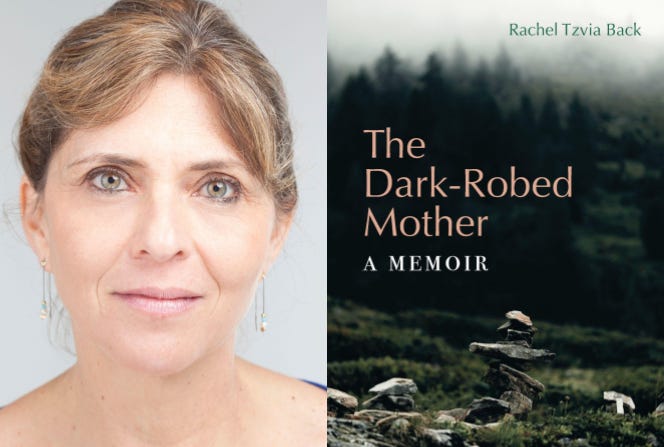
Editor’s Note: This piece is excerpted from The Dark-Robed Mother: A Memoir by Rachel Tzvia Back, forthcoming from Wesleyan University Press in February 2026. Back’s memoir weaves together her experience of early motherhood in Israel with broader questions about trauma, memory, and what it means to mother in a place perpetually shadowed by war. — Howard Lovy
It’s January a year earlier, and my pregnancy, my first, is an easy one. I am healthy throughout. I’m never nauseous and am barely tired. I wear short, flowery dresses that allow my belly to slowly swell undisturbed even as the rest of my body stays as it was. I have a blue-and-white–striped oversized T-shirt that I wear often, with short white tights underneath; I remember it as a garment of youthfulness and whimsy. Later, when we’ve passed the first trimester, and I go for monthly checkups with my gynecologist, I am entranced by the ultrasound images of the growing baby, by the mystery of the black-and-gray field that is completely indecipherable to me until he says, “Here, look here. This is his head; this is his hand,” and I see the miraculous (though still vague) form of the baby growing inside me.
But through the first twelve weeks, we keep the pregnancy a secret, Yoni and I, telling no one and not even visiting any doctors. In this still-secret period, Israel is readying itself for a new threat: Iraqi president Saddam Hussein has been promising for months to lob “nonconventional bombs” on Israel, chemical warfare, to annihilate the land and its people—to annihilate us. His threats escalate through late 1990 and into the early weeks of 1991, all geared toward a January 15 deadline when, reports state, the first bombs will fall.
Thirty years later the date is etched in my memory. Gas masks are distributed throughout the country, every citizen receiving a mask packaged in a small, rectangular cardboard box with a long, black-plastic strap so it can be carried over one’s shoulder like a handbag. The sealed box, which also contains (we are told) an atropine pen, is not to be opened until instructions to do so are given, but the box is to be carried everywhere, available at any emergency moment.
We enter a state of high and surreal readiness. Later, the children, who continue for many weeks to carry these gas-mask boxes to school, will decorate the cardboard sides with colorful stickers and drawings.
Now, in the before, we start preparing in our homes what becomes known as “the sealed room”—a room where, at least theoretically, one will be safe from the gas. The instructions are to choose the room in one’s house with as few outside walls and windows as possible. The windows are to be boarded up with cardboard and masking tape, all the seams of the windows sealed. For sealing the door of the room at the critical moment, when the bomb is incoming, one is to prepare ahead of time a bucket of water and rags. And the room should be outfitted with drinking water, food, a television or radio for news, a telephone, and anything else needed for however long one must stay inside. A colorful map of the country divided into “alarm zones” is printed in the newspapers, so one can know in real time which zone is being targeted and who must stay in their sealed rooms, with gas masks firmly placed on their faces, until an all-clear signal is given. Like everyone else in the country, from north to south, we cut the map out of the newspaper and tape it to a wall of the bedroom we’ve made into our sealed room.
My brother Aaron and sister-in-law Beth live in Jerusalem with their baby, Tamar, who is only a few months old. The strange dangers at our threshold, coupled with the embedded vulnerabilities of an infant and of mothering an infant, lead Beth to decide to leave the country before the looming mid-January date, to return to her childhood home in Michigan until the threat abates and normalcy is restored. Aaron plans to come south to stay with us as we near the threatening deadline. We place a mattress on the floor of our bedroom, so the three of us can all sleep in the room when it is sealed. Looking at newspaper images of the tentlike plastic apparatus parents of newborns are supposed to erect over their baby’s crib, I feel fortunate that my baby is safe inside me.
In the middle of the night between January 17 and 18, the telephone rings, waking us from our sleep; it’s my father on the line, calling from Buffalo. Overseas phone calls are then still rare, and in the middle of the night they are exceptional. I can hear in his voice that he’s been crying, something my father never does. He is saying, “They are doing it again; they are gassing us again.” He has just heard on the news that the first bomb has fallen, somewhere in the country’s southern region; it’s unclear at that point whether it carried a chemical warhead or not. Yoni, Aaron, and I have slept through it, and, if there was a siren, we didn’t hear it. Quickly we close the bedroom door, shove wet rags beneath it, and turn on the black-and-white television to hear the first reports of what is happening around us.
Later it turns out that none of the thirty-nine Scud missiles launched at Israel over the next six weeks carried chemical warheads, but the fear that they might continues until the warfare ended.
In a lull between barrages of missiles, the first trimester of my pregnancy is completed. We contact an Ob/Gyn who has a clinic in his home and hence can see me, even though most community medical services are still closed. With gas-mask boxes slung over our shoulders, we go off to his clinic in Be’er Sheva; the town feels deserted, the roads completely empty. Everyone is cloistered indoors, close to their sealed rooms for when the next siren pierces the air, announcing incoming missiles. In the eerie quiet of a seemingly closed-up city, our visit to the doctor feels somehow clandestine, a covert meeting. It’s evening, and this will be the first ultrasound of our baby. The checkup is quick: all is well. The doctor prints out two of the murky images and sends us on our way with the most normative instructions: drink milk; take vitamins; you’ll probably need iron supplements. Carry your gas masks with you and stay close to a sealed room; drink milk and take vitamins. All is askew in our world and continuing as though completely normal.
When we get back to our car, ultrasound images in hand, city in shutdown, and country in anxious readiness for the next round of missiles, we decide to do something that feels in that moment, in that context, as reckless and wonderful as anything we’ve ever done: we decide to not return home, ten minutes away, but drive two hours north, on the open highway, to the village home of Yoni’s parents, to deliver to them in person the happy news that we are pregnant.
When we arrive at the back door of their home, we can hear the TV; we know we’ll find them sitting side by side in their regular chairs, in the small inner TV room, watching the steady and unending stream of news reports. We walk in and they are stunned, first scared and then delighted to see us. We tell them we’ve come to show them something important, and I hand my mother-in-law the ultrasound images that I held in my hands the entire drive north. She studies the images but cannot decipher them. Yoni asks her, “Do you know what you are looking at?” Jose responds, “It looks to me like a satellite image of a missile site.” I see what she is seeing, the same uncertain borders and shades of gray and black. When Yoni tells them it is the first image of their grandchild, to be born in six months, they are disbelieving and overwhelmed. There, between sirens and missiles, in a small moshav TV room, we are filled, all four of us, with unmitigated joy.
In the weeks and months to follow, through the strange six weeks of what will be called the Gulf War and then into the spring, we are fully in a celebratory mood. From the beginning of July, the start of the ninth month, I’m in a new state of high readiness; for no reason at all, unconnected to any signs or the baby’s development, I’ve convinced myself I’ll give birth early. Every Friday night we walk through the quiet streets of our tiny village, blossom fragrances in the desert air, and wonder aloud whether this will be the last Friday night we are only the two of us. In the second week of July, my older sister, Adina, and her partner, Linda, come to visit—they are traveling with Linda’s mother, Lee. Quirky and eccentric, Lee has recently discovered Rilke’s Duino Elegies, and she spends much of her days with us copying out the poems into her journal and reciting them out loud. “Who, if I cried out, would hear me among the angels?” she exclaims to us in wonder as we drink tea on our tiny, shaded patio. I am praying the baby arrives while my sister and sister-in-law are still with us; I can think of nothing better.
But the baby tarries, and the fiercely hot summer days drag on; the ninth month is completed. From the beginning of the forty-first week, I must go every other day to the hospital for a checkup in their prenatal unit, adjacent to the delivery rooms. I’m anxious to deliver, anxious for the pregnancy to end, even as I find good reason for the baby to resist arriving in our world. I imagine the uterine safety as singular, unlike any other—that safety, absolute at least in my imaginings, will be the first loss the newly born baby will experience. Toward the end of the forty-second week of my pregnancy, at that day’s hospital checkup, the doctors identify a decrease in amniotic fluid and decide to induce labor at once. Though I’ve been in heightened readiness for weeks, I’m taken off guard; the moment arrives as though it is sudden. I’m admitted to the hospital, and twenty-four hours later, our son, Daniel, is born, in the early evening hours of August 7. Elated and stepping very naturally into his new father role, Yoni whisks him away for his first bath; someone brings me a piece of bread with soft white cheese spread on it, as I’m suddenly ravenous.
In the first weeks of Daniel’s life, the first weeks after labor and delivery, I think that the greatest conspiracy of Western culture is how little childbirth is talked about. I want to talk about nothing else. I think, How can we possibly talk about anything else when this most astonishing event has just been experienced? Certainly, every detail and every moment of birthing a baby—incredible and impossible in equal degrees—must be told and retold. For weeks I study the women around me who have given birth, my mother included, and I’m stunned realizing what they too have gone through. And in those first weeks, in the otherworldly state of middle-of-the-night nursings and eradicated routines, with everything in a state of newness and strangeness, and alert consciousness despite fatigue, I come to believe I’ve stumbled upon the raison d’être of patriarchy. I convince myself that patriarchy rose up in order to silence the most astonishing story ever, the story of women giving birth. Excluded from actually experiencing childbirth and hence excluded forever from life’s truest center stage, men simply couldn’t bear it, couldn’t bear being left out of something extraordinary, couldn’t bear not having the leading role. And so they relegated the experience of childbirth to back rooms, to secrecy and silence. Everything in patriarchy, I tell myself, followed from there.
Through the wonder and change of it all, I do not feel, as has been suggested by others, that, in entering the land of motherhood, I awoke “in a foreign country where . . . neither the language nor the customs” were known to me. Despite postdelivery pains, the disorientation of those first altered days, and of course fatigue, the movement into motherhood feels organic and somehow obvious. I benefit significantly from Yoni being a natural at fathering an infant; his confidence defuses any doubt or worries I may have had and transforms all the firsts into adventures that are joyous and even fun. In addition, in those first postpartum weeks, I am exceedingly happy to no longer be pregnant; I experience a great relief in having my body returned to me.
At six weeks we take our baby on his first transatlantic flight, to the United States, to meet his American aunts and uncles, his cousins, his great aunts and great uncles, all of us staying at my parents’ welcoming Buffalo home. Traveling with a six-week-old infant is surprisingly easy and surprisingly fun. Everyone wants to look at him and marvel; Yoni and I feel like rock stars. He sleeps on the plane—cuddled in the little basket crib attached to the bulkhead—and I nurse him when he wakes; besides being tired, I feel well and vibrant. In America he is the star of the family gathering. After a family meal at the expanded dining room table, baby Daniel—wearing a black-and-white soft-cotton brimless cap, a gift from his great-aunt—is passed from person to person, each one holding him to welcome him into the family, heaping blessings and fervent wishes on his baby self.
But something starts shifting—gradually, almost imperceptibly, but undeniably.
We return from our American trip and resume our lives, Yoni completing his final year of medical studies, me entering my second year of PhD coursework and continuing my teaching. To enable my trips to Jerusalem a few times a week, we find a woman in the village who takes care of infants, and we place our baby in her care. In the middle of the night, I nurse him in the dark, on a green futon couch, beside a small radiator exuding focused warmth. On sun-drenched mornings, I take him to the baby clinic in the village for weekly (and later monthly) weigh-ins and checkups. There is nothing exceptional to tell. But something is changing.
At first it feels like I’m standing in a shadow, and I can’t seem to step outside of it. I can see that there is light to the left and the right of me, but not where I stand. The shadow gradually expands and lengthens, growing broader, until it is not a shadow at all. There is then a then, though I wouldn’t be able to locate it on a timeline, when the it that was a shadow external to me becomes an it that is now inside of me. As though it has the properties of that imagined poisonous gas we feared and sealed our rooms against all those months ago, this it has seeped under the door and into my body.
As the darkness grows within, the feeling shifts again, no longer a shadow or a spreading gas; I feel myself standing on nothing—as there is nothing to stand on. Someone or something has ripped the floor away, and all that there is beneath me, and around me too, is a nothing that is, dark and bottomless. It is the tehom of origins, that ancient Hebrew word of unknown etymology referencing a depth, a place utterly without light, a place from before light is even created. This becomes my Underworld: a pre-light landscape, unpeopled and unworded. Isolation and silence reign here supreme.
Rachel Tzvia Back is a poet, translator, and professor of literature. The author of twelve books, her poems and verse translations have received numerous honors, including the Times Literary Supplement Award, the PEN Translation Prize, and finalist recognition for the National Poetry Award in Translation.
Five tiny delights
The sound of the wind chimes in my garden.
Morning coffee
First rain of the season
First wild anemones suddenly blooming
Being captivated by a novel
Five tiny Jewish delights
Lighting shabbat candles when the children are home
The textual beauty of certain Hebrew prayers
Baking oznei haman, my mother’s recipe
Following the moon for location in the Jewish calendar
The havdalah ritual, all of it
 |
|
Brilliant and beautiful writing. Without either overplaying or underplaying this drama of pregnancy, childbirth, motherhood and family happiness in a time of political tension, Rachel Tzvia Back makes me feel every moment of joy…followed by encroaching dread.
Alicia Ostriker