


Editor’s Note: A short story by Naomi Shepherd about the ways war fractures families —David Michael Slater
I never met Rafi. So I never found out how it worked out, whether I was right or wrong. Perhaps that’s why I keep thinking about that boy and his parents, going over the story in my mind again and again, wondering whether there was something else I might have done.
It was about three weeks after the end of the Yom Kippur War. The first shock was over, and the recriminations had begun in earnest. We knew who had gone and who had survived by then. At least, I thought we knew, until I got the phone call. David, a teaching colleague in the army reserves, rang me to ask whether I was still available for voluntary work. After school hours, of course. Was there one morning a week I had free? Two, I said glumly, forcing myself to be truthful. Teachers are good stopgaps, and I’d served on those little committees which break the news to bereaved parents—on condition that they weren’t parents of kids in my own school. Two mornings, I said, and perhaps an afternoon. I wanted that time for myself, but my own husband and sons were safe, and the war wasn’t over for everyone.
David said: ‘They really need a trained psychologist, but there isn’t anyone available, so just use your common sense.’ Talk about a back-handed compliment. He told me to report to a news agency near the army compound and go down to the basement. Was it something to do with bereaved families again? I asked. Not quite, he said, not exactly. He wouldn’t say more.
There were three men waiting in the basement: David, an army education officer, and a technician sitting in front of an ancient moviola. They explained that the film I was going to see was of Israeli prisoners of war in Syria. The film had been shot by television reporters from a European company; it was rough footage, I was to understand, and that was why it was so repetitive. What I saw was about fifty Israeli kids, their hands tied in front of them with Arab headcloths, and they were being pushed forward by soldiers, Syrians, I supposed, into a field or open space. Then there was another sequence which showed them sitting there, their bound hands now behind bent heads, though some had raised their heads as far as they could and were glaring at the camera. Each time one raised his head, a soldier came over and pushed it down again. ‘They’re not supposed to show their faces,’ said David. ‘That’s the whole point.’ I didn’t understand.
All the kids were very young—boys just out of school, the new recruits who’d been at the front for the first time when the Arab offensive began—and they didn’t look at all like the obstreperous, noisy, self-opinionated kids I’d known all my teaching life. They looked beaten, sullen, and afraid, just like those Arab prisoners shuffling along without their boots in the newsreels we’d seen after the other wars. Except that these were our boys, and they were shuffling not because they hadn’t any boots, but because someone had removed the laces.
I must have groaned.
The officer said: ‘The problem is that we can’t identify them all. We have a rough idea; there are lists of the soldiers in each platoon, but the picture isn’t complete. We were supposed to exchange lists of prisoners, but they won’t hand over the list they have. Psychological warfare.’
‘Can they do that?’ I asked, stupidly.
‘They can do whatever they want,’ he said. ‘The real trouble is that while the numbers are right, we’re not sure who they are. There are two in hospital we know about; the Red Cross has visited them. But we’ve had a few unidentified bodies from that front. They grabbed a few boys and shot them at point-blank range, and their identification discs were taken. So, since we’re not sure who the dead boys are, we’re not sure exactly who these boys are either. And that’s tough on the parents.’
‘What have you told them?’
‘Everything we know. Not much. A couple of American journalists in Syria talked to the boys who are prisoners and got a few names. We’ve used all the data banks and identikit stuff on the material we have, but we’re at the end of the road now till we have an exchange of prisoners. It’ll happen sooner or later, but the parents are going through hell meanwhile. We have two couples who’ve recognised the same boy—you can’t see much of him, he’s in the corner there—but he can’t belong to both of them. And then there’s another couple—the parents of a boy called Rafi. The father says he’s sure that the one in the third row on the left, with his head raised, is Rafi. You can just see a corner of his cheek and his hairline. The mother says it isn’t him.’
‘When do you think we’ll get the names?’
‘Probably not long before the actual exchange; we’ve got twice their number of prisoners, so they’re playing nasty. They held out against Red Cross visits for days. Now they’ve gone in, but we’ve still had no names. One of the kids shouted his name, but he was dragged out. You can see that they won’t let them show their faces.’
I asked how I could help.
‘Just talk to the parents. That’s all. Talk. Pass the time with them. We’ve opened an office for the parents who want to come and talk; we’re the halfway house to the kids. They haven’t all turned up. The office is supposed to pass on information as we get it. In fact, what we’re doing is providing therapy.’
I asked to see the film again. The machine flickered as the technician rewound the reel, and the rows of ragged boys danced backwards out of the field. I wondered aloud where they were.
‘The TV reporter said it was a fairground. They put the boys on as a kind of propaganda show; people came to look. They’re in a prison now.’ David jabbed at the screen with a pointer as the film was shown again. ‘We know a lot about the boys who managed to show their faces, the one in the second row, for instance, with his head up. He’s a kibbutznik, and the reporter said he was encouraging the others to raise their heads, but it wasn’t easy; you can see the Syrians were standing over them with rifles. The one on the right with the curly hair is a religious kid who volunteered to help with front-line services over the fast. The computers didn’t even register him as being there; he was officially missing somewhere else, so that’s lucky for the parents.’
The officer looked displeased at all this information getting out, and cut David short. ‘What the parents need is support. We’ll keep the office open for as long as they keep coming.’
Officially, the parents were confined to a shed near the perimeter of the huge army compound, but I noticed that quite often they managed to wander around and even get into other buildings in the hope of finding their sons’ files or someone responsible. I never saw them challenged, or even stopped, and soldiers hurrying from one building to another just dodged around them. I think everyone knew who they were, bereaved parents or potentially bereaved parents, and gave them a wide berth. They were a kind of unfortunate by-product of all that was happening, of the war that had struck us with no warning, of the end of all the talk about being a great power in the region. No one wanted to notice them, though no one could really ignore them.
David had told me to think of myself as a parent-teacher committee, so I talked to the parents about their kids as if they’d not done very well that term, as if going up a class next term was dependent on their behaviour from now on, as if they were on probation. Not all the parents turned up every day. Some came in the morning, some after work. But after a few days, I was able to make a kind of personal roll-call (I had no access to army files, as I had no official status) and to form a picture of the kids in my mind. Most of them had been at school till a few months earlier, which made it easier; we could chat about studies and future prospects. Most of them also had steady girlfriends, so I heard, but the girls weren’t invited to the office; that was the parents’ privilege.
In the first few weeks with a new class, I’d often made a mental picture of the parents from the kids, even before I got to meet them, but I’d never tried doing the reverse. It wasn’t easy. I wondered how the boys in the film were standing up to being kicked around and humiliated. That wasn’t something they’d been taught to do, even—to judge from what my own boys said—in basic training, however tough they made it. All our kids are emotionally coddled—perhaps because at the back of our minds is the thought of the army, and somewhere in our minds, and in theirs, the thought that maybe they will never get to grow up. Together with that, they’re too innocent, or too callow, to understand real hostility. So, I wondered how long they could endure imprisonment, these boys who’d been so praised and pampered, who’d raced their jeeps round corners laughing at old people who had to get out of the way. I wasn’t too worried about the rebellious boys, the ones who’d lifted their heads and had them cuffed down again by the Syrians.
The kibbutznik David had pointed out looked just like the kind of boy who gave you hell, that handsome, impudent look that meant chaos in class. The boy I worried most about was Rafi, the boy who had been recognised by his father but not by his mother. For some reason, I didn’t like that disagreement. I wanted to meet his parents to find out more about him, and when I did meet them, I worried more than ever.
I met Rafi’s mother, Lior, first. I thought she was the psychologist who was supposed to take my place after the first week, but never turned up. There were only three of us on duty in the draughty shed, an old Nissen hut raised on a concrete platform to keep it away from the damp field: an army chaplain, a young medical student with the key to the medicine cupboard, and myself. The two men and I sat drinking tea, eating dry biscuits—I can still remember the taste, there was a vague odour of paraffin—and going endlessly over the same ground with the parents who wandered in. Sometimes we drafted petitions to be sent to international organisations, and every now and again we rang the Red Cross offices, or the news agencies, to see if there was anything new. There wasn’t.
Rafi’s mother was sitting there ready, on our side of the table, when I came in. The men hadn’t arrived. She was a neat, prim-looking woman, with her hair pinned up in a bun, blue eyes much magnified by her glasses, wearing an old-fashioned dress with a ruffle at the neck. She began by asking if there was any new information, and I told her that a Swiss journalist was arriving from Damascus that day, and we expected news from him, though he hadn’t been allowed to take photographs. Then I made the mistake of asking if she was taking over that day, as I was finding the job rather a strain. So it was awkward when she told me that she was Rafi’s mother.
We both ignored what I’d said and began to talk about her son. She said that she was pleased that she knew that he had definitely been taken prisoner, that he had definitely been serving with that unit. That was better than to wonder, as some parents did, where the boy had got to, whether he hadn’t perhaps been sent somewhere else. Some of the boys in the unit had gone on leave over the New Year; some had been on their way back to the front. But Rafi’s friends—those who had come back—had said they had seen him in the bunkers that were overrun. Those were the facts, she said.
All the rest was guesswork. She looked squarely at me, as if daring me to disagree. Her training, she said, had taught her not to make guesses, except when they helped bridge the gap between two irreconcilable facts. What did I think?
I was taken aback. The other mothers had counted the days of their sons’ captivity, packed gift parcels, and had tiny stratagems to keep them going, signs which convinced them that their boy was still alive: what he had said or done during his last days at home, or projections of the Syrians’ probable behaviour. It was enough to listen or sit silently with them, nodding. But here was Rafi’s mother proposing a hypothesis on scientific grounds and asking me to agree or disagree with her.
I said I agreed.
I asked what her profession was, and she said she was a research biologist. She asked me what I did and why they had chosen me to counsel the parents. I couldn’t really answer that, but I tried, conscious of the fact that my explanations sounded hollow. Suddenly, she asked me point-blank: ‘Do you think they’re still alive?’ She meant, she added, the boys in the film. Her ‘you’ was in the plural, asking me to speak for the army in general, which I couldn’t do, but what frightened me was that she’d asked her question as if any answer, as long as it was accurate, truthful, would be accepted. Her blue eyes, grotesquely enlarged, it seemed to me now, by the glasses, showed no apprehension.
I started reciting what I hoped was a convincing summary of the facts. There was the evidence brought back by the journalists, I said, the fact that the kids were being kept together, had been filmed and could be counted, which suggested that no one would be hurt now—it would be too public. Of course, we knew there had been murders; everyone knew that, but they had taken place immediately after the fighting ended, it was thought, not in prisons. The Syrians were using the families to create political pressure, perhaps hoping for concessions on our side. There would be no point in that if the kids weren’t alive. And so on. I wouldn’t have dared talk to the other parents like that, and I wished her husband were there, too. All the time I was talking, she kept those owl eyes on me, and when I’d finished, she gave a small involuntary sigh, as if she’d been holding her breath. Then she stood up, took down her coat, and consulted her watch. She’d be back when the Swiss journalist arrived, she said. There was no point unless there was fresh information. I watched her go out the door. From the back, she looked even more like a girl.
As you often do, I formed a mental picture of her husband, who, as far as I knew, hadn’t appeared in the office at all. Perhaps she was representing them both. He would be a man, I thought, who closeted himself with his worries. She had a German name, so I assumed he would be a fellow yekke, a fellow scientist, or perhaps a government employee, a Herr Doktor, precise and controlled, the kind of man who wears socks under his sandals in summer and a scarf in winter. I could imagine mother, father, and son playing chess together, listening to chamber music, very rarely watching television. A bit inhibited, a bit secretive, even from one another, Lior and her husband, parents of an only child (I’d established that), who had always worn warm vests in the winter, did tiny, precise drawings in one corner of his exercise books, made bookmarks and ashtrays for his parents in handiwork classes. So Rafi might have great inner strength, like his mother, or he might be horribly vulnerable and shy.
A few days later, a crowd of parents gathered in the shed to meet the Swiss journalist. I translated for the parents who didn’t understand his English. They had brought photographs of their sons for him to identify, but he was bewildered and afraid to make mistakes. Quite obviously, these snapshots from family albums and instant photo booths bore no resemblance to the boys he had seen in a quick tour of the prison compound. He said they were being held in a separate wing, and that he had tried to count them. The number seemed right. The parents bombarded him with questions. Had the boys received the parcels they had sent through the Red Cross? Had he spoken to them? He begged me to explain that he’d only been allowed to speak to the boys who were in hospital, and whom he understood were getting adequate medical treatment. The boys were being treated ‘correctly,’ he thought.
At this, one of the fathers, a hulking fellow with unkempt hair, wearing an old army windcheater and smoking one of those thin, cheap cigars, snorted audibly and pushed his way out of the room. I was relieved, because the reek of the cigar had made the steamy room unbearable; it was raining heavily outside, and the windows were closed. The Swiss was asked increasingly difficult questions.
Why hadn’t he insisted on talking to the boys? Had he asked the Syrians the reason for the delays? ‘I am neutral, my country is neutral,’ he said. ‘Now I must go and visit the Syrian prisoners here.’
He smiled at me in an embarrassed way as if he expected help. I conveyed official thanks, though I wasn’t an official; the officer in charge hadn’t turned up. The parents watched the journalist go, and then they gathered up their photograph albums and the parcels one or two had brought in case he was returning home through Damascus, which he wasn’t. When the last of them had left, I sat in the office alone. The visit had depressed me, reminding me how petty our troubles looked to the outside world.
The hulking man with the stinking cigar pushed the door open and walked over to the tea urn, where he drew himself a plastic cupful of hot water, shovelled in a spoon of our instant coffee, and threw himself into the chair opposite me, the cigar still clamped in the corner of his mouth. Suddenly, he wrenched it out and threw it onto the table. ‘So what are we doing about it?’ he demanded, ‘What are we doing to get them out?’
‘What do you mean?’ I asked nervously. I knew the man’s name—Shlomo—and his surname, though I’d never talked to him. The medical student, who kept out of his way, said he thought he was potentially violent. He had led the parents in a demonstration one day, but now they, too, avoided him. That had been before I was called in, and I didn’t know the reason. ‘Aren’t you from the Foreign Ministry?’
I explained hastily that I wasn’t.
‘So, what the hell are you doing here?’ I tried to explain, but he wasn’t interested. ‘We should go in and get them out,’ he said. ‘We know where they are, it’s outside the town.’ Now I remembered hearing that he’d urged the army to break the ceasefire and launch a rescue attack, and the rest of the parents had dissociated themselves.
They didn’t want other kids’ lives endangered in a suicide mission, because that was what he was proposing. I said that I’d heard people were working hard behind the scenes; that the Americans were doing their best. I assumed this was happening, though no one had told me so.
‘Rubbish,’ he said, ‘no one’s doing anything. The Americans don’t give a shit.’
‘Perhaps we shouldn’t have given them the list of their boys till we had ours,’ I said, hoping to look less feeble.
He laughed harshly. ‘They don’t care about their own people. They don’t give a shit whether they get them back or not.’ I said I couldn’t believe that.
‘Oh, can’t you,’ said Shlomo. ‘Then you’re like my wife.’ It didn’t sound like a compliment. ‘We have to do something,’ he insisted. ‘We can’t just let them rot. We know what their prisons are like.’
I had no answer.
‘Mind you, my boy’s all right,’ he said, as if I’d asked a question.
‘Tough kid. Got both his arms and legs. I saw that in the film. Kept his head up, too. You can’t see the face, but you can see the shape of the head. Setting an example.’ I asked who his son was, and he told me. My first thought was that they must have been divorced, since their surnames were different. This man had one of those invented Hebrew names, not a straight translation from German or Russian. A self-named man, Shlomo. If they were divorced, perhaps it was the reason for the tension both of them projected, an extra tension. It was hard enough, I thought, to face this situation as a couple or a family. I couldn’t imagine facing it alone. I’d wondered what I would have done if a son of mine had been missing, and I’d concluded that my husband and my other kids would have taken the stress with me, like stones in a wall. We’d all have had to forego something of our individual feelings. That didn’t look like the case with Rafi’s parents.
I wondered what had brought this pair together. Shlomo was difficult to place. I’d put him down as a lorry driver, or a mechanic, but now I settled for farmer; there was something about him that was ill at ease in the town. From a cooperative farm, perhaps. Certainly not a kibbutznik. He wasn’t the husband I’d associated with Lior.
He brought his hand down on the table with a thump, indicating that the conversation was finished.
‘I wish I could help more,’ I said lamely. ‘We can only wait.’
‘Rubbish,’ he said, but not to me. ‘Have you seen the picture of my boy?’ he asked abruptly. I asked whether he had the photograph.
‘Couldn’t find the album,’ he said. ‘She’s hidden it somewhere. I’ll find it, though. Want to come round and see it?’
None of the other parents had tried to strike up a friendship. They associated me with their ordeal and didn’t want to see me outside the compound. But I couldn’t refuse, though I was afraid his ex-wife would resent my visiting him. He gave me the address. It was in town, so I was wrong again.
All that afternoon, I couldn’t get Rafi’s parents out of my mind. It wasn’t just the fact that they didn’t seem like a couple. She rejected intimacy, and he invited it. She looked like someone from a different country, a different era, and he was a caricature of the tough old sabra with his shabby windcheater and his abruptness. I couldn’t imagine what sort of boy this couple had produced together. Their names were both beside the door, but on opposite sides. His was on a visiting card with ‘Desert Tours’ engraved underneath, and hers (the surname alone) on a small, elegant brass plate, very worn—probably a family heirloom. They occupied the ground floor of one of those curious houses, semi-oriental in style, with turrets and arched windows, which the first Jewish architects built in old Tel Aviv, reminders of a time when this was a town for dreamers. There was a garden with old palm trees and dusty cacti, but the house was surrounded by high-rise office buildings. I wondered immediately where Rafi would have gone to school, because there wouldn’t have been anywhere he could go out and play with his friends; he would have been isolated with his parents.
Shlomo opened the door barefoot, wearing a singlet and trousers. He led me through a hall to the living room, which was dark, chilly, and full of heavy mahogany furniture, which I guessed was also Lior’s inheritance. He had found the photograph album, which was ready on the sofa. The album was the old-fashioned kind, too, with ‘My Childhood’ on the cover. None of my kids would have agreed to an album like that.
‘You’ll see,’ said Shlomo, as he motioned me to sit and opened the album. ‘It’s the shape of his head. I knew from the head that it was Rafi. When they’re babies, you see the shape best, before they grow hair. I’d know his head blind.’ He said this so savagely that I was alarmed again. I asked for some light, in order to see clearly, and also because I didn’t like sitting in the dark with him.
The first photograph showed his wife at the seashore. Lior had long hair then, covering her shoulders, and she had her feet in the waves, and was very pregnant. She looked beautiful and awkward, like a swan on land. I wondered which of them had put that photograph in the album. I thought that if it was a family joke, a picture of Rafi before birth, it would make them a bit more normal. But it wasn’t the joke I expected.
‘Rafi in storage,’ he said. ‘Women are warehouses, aren’t they?’ He flipped over the pages rapidly. There were many snaps of a baby, then a few of a small boy with toys, carefully posed. By our standards, it was a modest collection. Shlomo said, ‘Rafi hates being photographed.’ The photographs over which he now paused confirmed this. Some had been taken when the boy was unaware, perhaps, of the camera; he was constructing models or working at a desk. But what he wanted to show me was the photograph of a boy standing awkwardly, unsmiling, in army uniform. Kids like clowning for the camera, and at first, I thought he was acting up, heels together and giving a stiff salute. I looked more closely to see his face, and then I saw that the smile was a forced grin. Perhaps he thought he made an odd soldier. It was a disturbing photograph.
‘Handsome boy,’ I said, because that was true.
‘A man,’ said Shlomo. ‘When he gets out of the army, we’ll make a team; he’s coming in with me.’
I asked if he was in business, unsure what Desert Tours were.
‘I’m a guide,’ he said. ‘One man show. One trip a week, four days, the hard way. Most of it on foot. Going over the old patrol routes. Mostly for our own people, plus a few tourists. It’s too tough for most of them.’
I heard keys turn in the lock across the hall.
‘Lior,’ he shouted. ‘See who we’ve got here.’ So, they were indeed a couple. I was pleased that Lior had arrived because I wanted a little formality. She looked tired; strands of hair were escaping from the bun at the back of her head, and I discerned a faint, momentary resemblance to the girl on the beach. She asked Shlomo whether he had given me tea.
While she was in the kitchen, Shlomo shouted again, impatiently: ‘She’s recognised him. I showed her the photos and she agrees about the shape of the head. Don’t you?’ There was nothing I wanted to do except to go home. Lior didn’t answer. I decided to say nothing and let them both interpret my silence as they wished.
Lior came in carrying a tea tray. ‘I’m sorry there’s no cake.’ Before I could answer, Shlomo said, ‘She didn’t come to be fed, she came to check the photographs.’
Lior looked at neither of us. ‘Where did you find them?’ she asked.
‘Where I told you. She identified him straight away.’
This was so outrageous that I started to say something, but Lior, who was pouring the tea, said: ‘There were a lot of boys with their heads down; he wouldn’t have wanted them to take his picture.’
‘He’d have kept his head up. He’d have wanted us to see him. He wasn’t afraid.’
‘What difference does it make?’ said Lior wearily. ‘It’s all guesswork.’
‘I know the shape of his head. You may not, but I do.’
‘It’s not fair to our visitor to argue in front of her,’ said Lior.
‘Forget it,’ I said hastily.
As if explaining something which was not clear, she said, ‘We would feel easier in our minds if we could have recognised him in the film.’
‘We did.’ Shlomo glared at her. ‘How is it you can’t recognise your own son?’ Lior asked me if I would like to see Rafi’s room, and I gratefully agreed and followed her out.
‘He is very tense,’ she said. ‘He cannot bear the uncertainty.’ I was looking at Rafi’s room. There was a tank of fish, a collection of seashells, a tennis racquet, and an antique revolver. It could have been one of my own boys’ rooms, except for the tidiness. On a shelf over his bed, I noticed a collection of small model cars, rather battered.
‘My boys would be interested in those,’ I said. ‘They look very old.’ Lior nodded. ‘Museum pieces now,’ she said. ‘German. My father brought them out with him in 1935. I played with them when I was small. I had no other toys.’
Shlomo had followed us into the room, and he, too, was looking at the cars. ‘I told you to put those away.’ He brushed them off the shelf into a heap on the bed with one sweep of his hand. ‘He’s not a child anymore.’
‘He doesn’t play with them,’ said Lior to me, trying to explain away Shlomo’s anger. ‘It’s a collection, a hobby. In the family. He likes them.’
‘Only because you keep going on about them. To keep you quiet.’
Lior said nothing. Shlomo laughed and said to me, ‘You see, I have two kids to look after.’
He went over to Lior and ruffled her hair. It was an affectionate gesture, but, in front of me, it was an affront to her dignity. ‘I never had time for these hobbies she talks about,’ he said, challenging me to disagree. ‘We were too busy. I had to earn my own living when I was Rafi’s age, and the rest of the time I was in the youth movement. We were all in the youth movement in those days—even Lior.’ He squeezed her shoulder so hard that it must have hurt, but she did not move, looking straight at me, as if he hadn’t touched her.
‘Have you got kids?’ he asked me.
‘Four.’
‘That’s a family,’ he said to Lior. ‘All boys?’
‘Two of each.’
‘We wanted more,’ said Shlomo, putting his arm around Lior, who stood like a statue. ‘But she couldn’t. Not her fault. But it’s a problem having an only child if he isn’t the sociable type. I was an only child too, so I know. You have to push them out into the world. I bet yours are off on their own most of the time, right?’
‘A bit too often for my liking,’ I said, my eyes on Lior.
‘A boy can’t be too independent,’ said Shlomo. ‘You listen.’ He left Lior and came over to me, putting a heavy hand on my shoulder. I thought he was unable to talk without seeking physical contact, but he was threatening. ‘You know how a boy survives an experience like this—being a prisoner? We know what they’re like, we know the way those boys are being knocked about.’
I glanced at Lior, but she had turned away and was carefully replacing the model cars on the shelf, one by one. ‘The kids have to help one another. Encourage one another. They’re not alone. They don’t want to be alone. It’s no use thinking you’re apart, thinking you’re superior. Understand?’
I nodded. ‘Good,’ he said. ‘I’ve been trying to explain to her’—he talked as if Lior had left the room—‘to reassure her, because she’s worried, any mother would be worried, but she thinks he needs books. Books she’s been sending him. Think he’s in a rest house?’ This was addressed to Lior’s back. After a moment or two, he shrugged his shoulders and went out of the room.
Lior finished with the cars and took down a recorder in a soft cloth sheath, hand embroidered with Rafi’s name. ‘He played this at the academy.’
‘Does he study music?’
‘He did for a while. Then his studies began to take up too much of his time. But he’ll come back to it. It was the same with me. At some stage, studies come first. When he leaves the army, he’ll study applied physics. He has exceptional talent. All my family were gifted in the sciences.’
‘That’s nice,’ I said.
‘I believe,’ Lior said, ‘that when people are in a difficult situation, they need their inner resources. I mean, what they have learned and studied, whatever can make them forget their immediate surroundings. Then the past and future become more real than the present.’
‘That must be very difficult at Rafi’s age,’ I said.
‘Not if you are properly trained,’ she said. ‘I’ve done it myself.’
Her eyes became luminous. ‘Rafi has a wonderful memory,’ she said. ‘He has inner strength, and he will be able to abstract himself from everything around him. That will enable him to survive.’
I rang David that evening and said that I thought that with Rafi’s parents, I was out of my depth and that a psychologist was needed.
He listened to what I told him and said that perhaps I should consult Rafi’s regular class teacher, who was also his counsellor. When I did so, I found that the teacher knew that Rafi was a prisoner and she wanted to hear all the latest information. I asked her whether the boy had made plans for his future, after the army. There was a short silence at the other end of the line, and she said that Rafi was a very gifted boy who, for some reason, had postponed all his plans for studying until after army service. His final grades had been so high that he could have served in the special unit, enabling him to study and do his service at the same time. It was surprising that he hadn’t done so. Beyond that, she couldn’t or didn’t want to tell me more. I know when another teacher is holding out on me, but I didn’t press her.
After my visit to their home, I had expected Lior and Shlomo to keep away from me. But Shlomo appeared the next day and said he wanted to speak to me alone. We took a walk along the gravel paths of the compound in the pouring rain. Shlomo ignored the rain; I put up my umbrella. He went on talking with the rain pouring through his hair and running down inside the collar of his windcheater.
He wanted me to understand, he said, that his wife was out of touch with the real world. Gifted, yes, exceptionally, and always had been. He was very proud of her, though not an academic type himself. She had been the youngest graduate awarded a lectureship in her subject, and for that reason had never spent much time with Rafi after he was weaned. It was Shlomo who’d changed the nappies, given the feeds. He wasn’t saying that she wasn’t a good mother—she was extraordinary. He, himself, could never have given Rafi a fraction of the education she gave him. She had guided Rafi through school, supervised his reading, helped him get good marks.
But I’d agree, wouldn’t I, that good marks weren’t the only thing in life? His role had been to prepare Rafi for life. Lior, good luck to her, had been overprotected. He’d helped protect her. He had been her group instructor at camp, in the youth movement; he’d married her when she was only just eighteen, a little immigrant girl from Germany, because he had seen she would never survive army service. She, in her turn, had tried to protect Rafi as she had been protected. Music lessons—absurd, the boy was no musician—and so on. All this had gone on until Rafi’s bar mitzvah. At this point, Shlomo said, taking the lapel of my coat with his fingers, he had to intervene. He’d made Rafi into a man. He’d taken him all over the country, over the toughest terrain. Rafi knew how to ration himself water, drink just enough to stop himself drying out, no more. There was no gun the boy couldn’t handle. He could use his fists, and he could drive long before he was allowed a licence. All this to ready him for the army. No one was going to knock his son about or make fun of him.
There were a few things he hadn’t been able to get into Rafi’s head, just the same, he said, like how to get on with the gang. At school, Rafi had kept to himself, acted superior. But where physical stress was concerned, said Shlomo, pulling together the edges of his collar, finally realising how wet he was, Rafi was fearless. That was where character told; the rest was nonsense. I said I was sure he had prepared Rafi very well for his ordeal. He nodded grimly. ‘I hope so,’ he said.
The same day, just as I was leaving the shed, Lior appeared and asked whether she could speak to me privately. I was longing to go home; one of my sons, Mickey, who was stationed in Sinai, was home for twenty-four hours, and I wanted to see as much of him as I could. But Lior’s face reminded me that her war wasn’t over. We walked out of the compound and went into a draughty little café in a nearby street. She was carrying a book wrapped in brown paper, and the first thing she asked was whether I could keep this parcel for her for a few weeks. She realised, she said, that this was an odd request, but it was important. She was sure I could be trusted.
We made conversation while we drank our sour, half-cold coffee. I asked about her work, and she said that while she was working, she thought of nothing else. But Shlomo, she said, was out of work—all the tours had been suspended since the outbreak of war and not enough men were demobbed yet to make it worthwhile—and that made things hard for him. I must have realised, she said, that the army had not called him up this time. He wasn’t the only old soldier left at home, but he resented it terribly. She suspected that he also didn’t want to go back to travelling, in case news came about Rafi. I asked whether Shlomo had always been a guide.
‘He’s done everything,’ said Lior. ‘In the old days, there were plenty of jobs for a man without much education—you’ll have guessed he didn’t study much—but who wanted to do the really rough work, in the difficult parts of the country. When things became more organised here, he went to Africa for a while, teaching trade union work. But he missed us. We had to compromise, he and I. He wanted to live in the south, somewhere in the desert, but I had to stay near my lab. He understood that. What he didn’t realise was that the country had changed. Challenges are different now. People want skills today, not pioneers. The country’s too small now for adventurers. Shlomo’s an intelligent man; he should have gone back to school. But he didn’t want to risk failure.’
I said that not everyone was cut out for studying.
‘Rafi is,’ she said.
There was something I wanted to say to this woman, though I had no business to say anything at all. I got ready to phrase it. I wanted to say that parents always found resemblances between themselves and their children; it began when you looked at a baby and said that this was the father’s head, the mother’s eyes. It was hard not to do this, and yet when we do it, we’re taking something of the child for ourselves—not always to the child’s advantage. Anyway, I’d tried not to stake too many claims myself …
She said suddenly, ‘Rafi was afraid.’
My little homily was as stale in my mouth as the coffee.
‘Everyone’s afraid, that’s natural, my boys…’
‘No, no,’ she said, as if Rafi were unique. ‘He was afraid all the time. He was sure he was going to get killed. He knew there would be a war. He wrote it all down there—she gestured at the package—‘in his diary. That’s why I don’t want Shlomo to see it. He thought he’d made Rafi strong.’
I took the package and shook hands politely because she offered me her hand in that formal, Germanic way of hers. I suddenly wondered—it was an insane thought, but there it was—whether that was how she had said goodbye to Rafi.
The diary ticked away in my mind, and day by day, I worried more about Rafi’s premonitions. It was very likely that, as Lior had said, a sensitive kid like Rafi would fear death, and I felt it was good that he had written it down. But it was hard to contemplate that boy, with his mocking salute, tied up and knocked down, if not worse. By now, I wanted desperately to know more about Rafi. But I couldn’t open the package and read the diary, something which would have helped me come closer to him.
About a week later, one of the girl soldiers rang me at school. Could I come to the compound when I finished teaching? There was some news, and Rafi’s mother wanted to see me. I was scared, and sounded it. Nothing important, said the girl. It was just that they’d received an extra sequence of the television film, and Rafi’s father had lost his self-control.
When I got there, a group of parents was standing outside the shack, chatting in low voices like people at the scene of an accident. Inside, Lior was helping the girl to put things right. The filing cabinets had been flung to the floor, the urn was lying on its side in a corner, and there was coffee everywhere, the colour of dried blood.
I didn’t need to ask who had done the damage, so I asked what was on the film. The extra footage showed that the boy who had raised his head for a few seconds, whose cheek was visible, wasn’t Rafi at all, but another kid. The parents had identified him, and everyone was pleased that one more name was on the list. But Shlomo had gone berserk. Lior had come to apologise. I wondered what she wanted of me. She took me aside and said, ‘He blames himself.’
‘For what?’
‘Rafi could have been in the academic corps. He wouldn’t have been on the front line. He wanted to please Shlomo.’
I said nothing.
‘Now he thinks Rafi probably resisted capture and was shot. He blames himself. He thinks Rafi’s dead.’
‘That’s ridiculous,’ I said, though privately I thought it wasn’t.
‘I can’t help him,’ said Lior desperately. ‘I haven’t given up just because the boy in the film wasn’t Rafi, I knew it wasn’t him. I know he’s alive. Thank you.’ She went, having said what she had to say. The girl soldier and I picked up the remaining fragments of the mugs and cleaned the floor. We didn’t talk.
‘Hey! They’re coming back! The plane’s arriving before the list.’
My son Mickey, home now and keeping his radio on all the time, was shouting at me from the bathroom where he was shaving. ‘Put the telly on, the cameras are at the airport!’
We all sat around the set, and my kids tried to keep me calm. My small daughters sat jammed up against the screen as if they’d see better that way, and Mickey kept his arm around me; they all knew about Rafi and the others. As the commentators droned on about American intervention, stretcher cases, and the mood of the crowd at the airport in that infuriating way they have, I kept trying to get David on the phone to find out what he knew. But there was no answer either from his home or from Shlomo and Lior’s. They’d all gone to the airport, obviously. I hadn’t been told. But of course, I had no one to meet. So, I had to watch everything on television. I couldn’t see Lior in the crowd, because she was too small, but I spotted Shlomo towering over the other parents in that old windcheater. The reporter interviewed a few parents, but not Lior or Shlomo. I saw one of the other parents pat him on the back, but he didn’t smile. I watched the plane touch down and the crowd press forward to the barriers on the tarmac, and Mickey remarked sarcastically about the politicians who were there, getting in on the act.
The door of the plane opened and the boys started coming down the gangway. I recognised a few faces straight away. I kept calling out names, and tears were rolling down my cheeks, and Mickey held my arm tightly. The boys didn’t look too bad, at this distance, but their faces were grim. When I remarked on this, Mickey said sharply, ‘It’s not a football team coming home, Mum,’ and automatically I looked at their boots. They were all wearing brand new shoes with laces, and I wondered who had given them the shoes.
‘Well, is he there?’ asked Mickey, but I couldn’t see him. There was a moment when no more boys seemed to be coming through the door, and I thought: that’s it, his premonitions were right, Shlomo was right, he’s dead.
Then I saw him. It wasn’t more than a brief glance, because the cameras were cutting back and forth between the kids and the crowd, and the moment the boys were off the plane, they were gathered up by their families, who’d been allowed onto the tarmac, and carried away.
I recognised him immediately from the photograph in the album. His face was very drawn, and he was slighter in build than I’d imagined, not much taller than his mother. He came through the door and down the gangway at a trot and disappeared into the crowd like the rest. I wanted to get through the screen into the picture, to get closer, but he’d gone. Then they brought another camera into play, perhaps up on a boom, and I saw him again, and this time, I could see Shlomo and Lior together waiting for him. I couldn’t see their faces clearly, but there they were, waiting.
Rafi walked right past them.
I’m quite sure of that, because I saw it happen, and they moved forward, but he was too fast, and they must have been too astonished to intercept him. I think he went towards a girl, but I can’t be sure of that. But one thing I am sure of is that he saw his parents waiting for him. The camera was on him for several seconds as he got near them, and he was looking at them, in their direction, but quite without expression. He just went past them.
There could be many explanations, of course. Perhaps he was in shock and just didn’t recognise them. That could have happened. Maybe they were all reunited later. They must have run after him. I spoke to David about it, and he told me that I shouldn’t interfere, that it was none of my business now; I’d done my job. No one has claimed the diary.
The trouble about watching things on television, from a distance, is that you can’t call the shots. People, strangers, disappear out of your line of vision. The moments of crisis pass, the moments of truth. Perhaps it’s just as well.
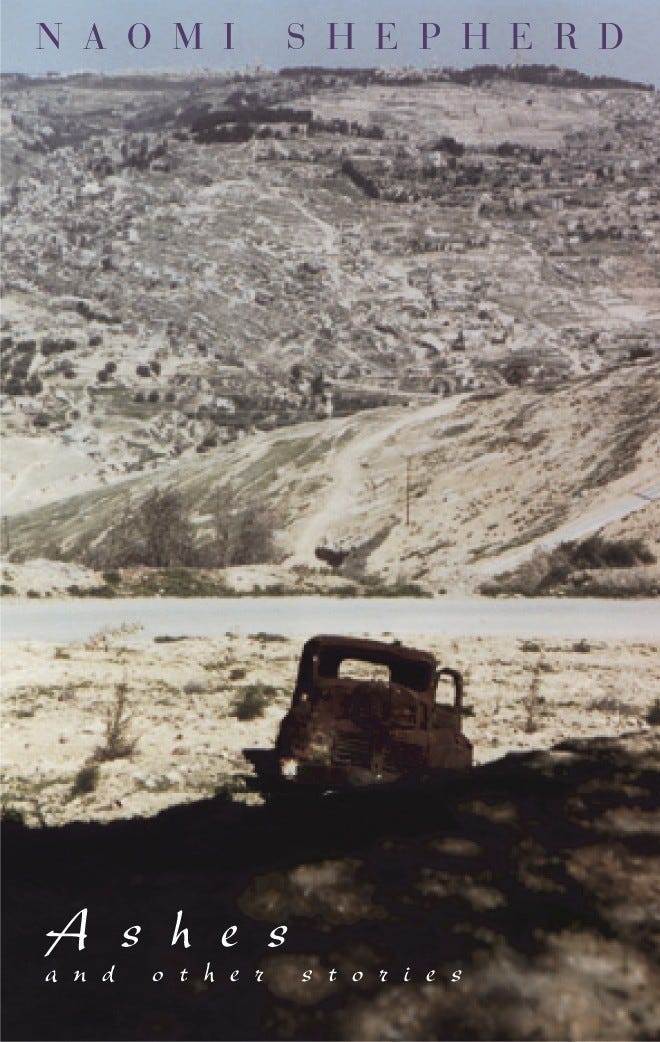
From Ashes and Other Stories, Halban Publishers, Copyright © 2001 by Naomi
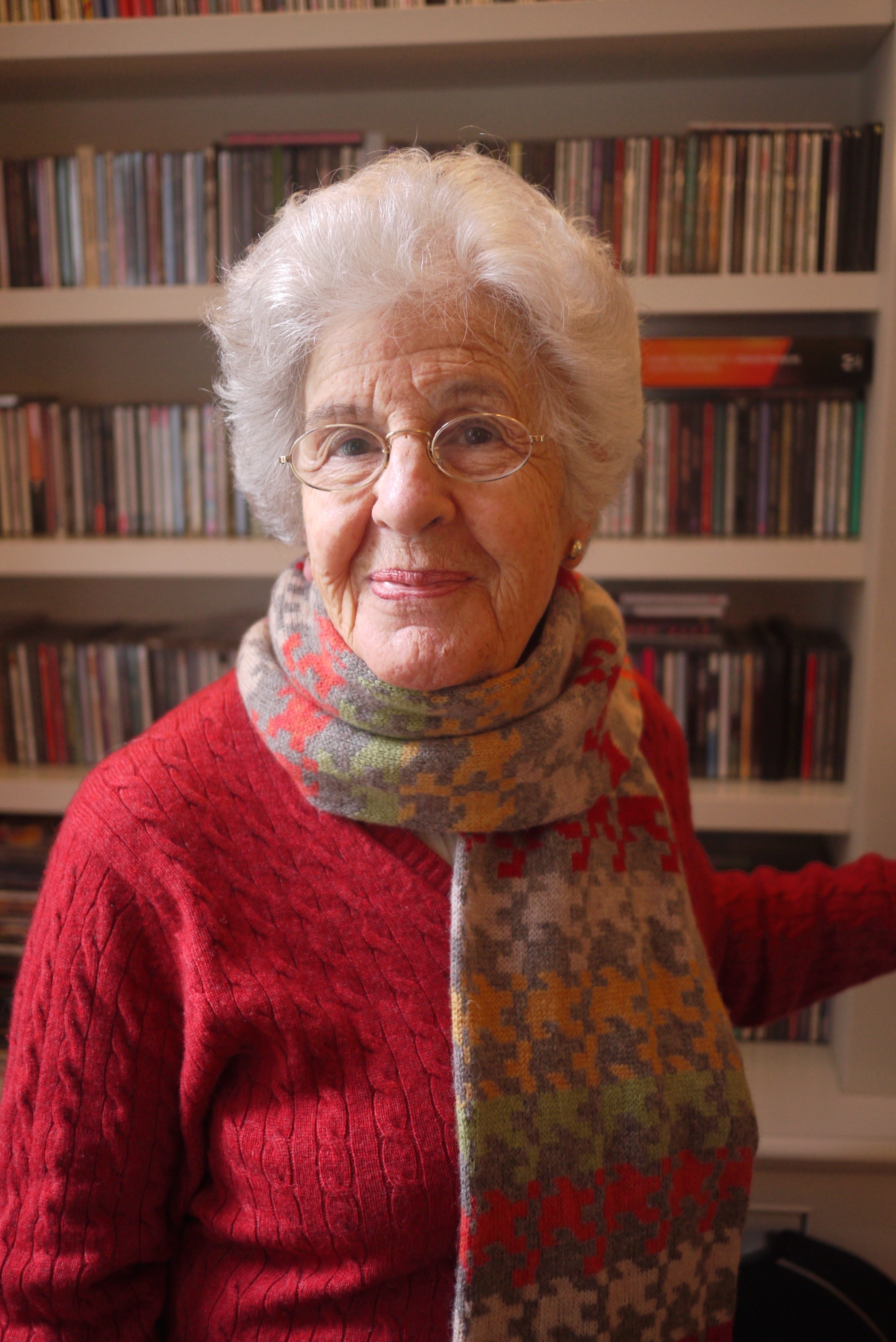
Naomi Shepherd was born and educated in Britain but has lived most of her adult life in Israel. She is a prize-winning historian, biographer, journalist, and documentary maker.
What five tiny delights lift your spirits and make you happy?
Walking on Hampstead Heath
Listening to bird song ditto
Playing the piano
Mozart’s operas
19th-century Russian fiction
What five tiny JEWISH delights lift your spirits and make you happy?
Watching the ark opened and the Torah displayed in synagogue
Isaac Babel’s Odessa stories
Mendelssohn’s compositions
The Jewish joke about the goat. (hope everyone knows that one)
Gefilte fish and horseradish
Painfully timely. The ending was not what I expected.
Absolutely riveting. And heartbreaking.