


Editor’s Note: For the past two and a half years, I've been writing about the marginalization of Jewish and Israeli authors in the publishing world. Now Teme Ring and Susan Blumberg-Kason turn our attention to what's happening in another traditional bastion of alternative voices: the local indie bookstore. The news, it turns out, is worse than even I had suspected. In this eye-opening piece, Teme and Susan tell their story of disappointment and betrayal by the very bookstores that had once brought them joy—and find that there's increasingly no room for Jewish voices on the shelves. — Howard Lovy
For decades, Chicago’s independent bookstores were our Gan Eden. As Jewish women, as readers, as feminists, we found in them a sense of community and possibility that felt almost sacred. One feminist bookstore stood out—its curated tables, its children’s section, its author events all felt like celebrations where every voice was welcomed and every perspective valued.
We were regulars through tight finances, city parking, COVID, and blizzards. What the bookstores gave in return was always worth the effort.
We never imagined that on a certain terrible day, we—and large swaths of the Jewish community—would be exiled from the garden.
That day came on October 7, 2023.
We are two Jewish women and book lovers in Chicago who, in the past two years, went from feeling welcomed and safe in our favorite bookstores to being ostracized, dismissed in person, and blocked on social media by our beloved feminist indie. One of us discovered she’d been blocked, ironically, on the first day of Banned Books Week 2025.
Why? They never told us, but the reason’s not hard to guess.
On October 7, 2023, before Israel even knew how many people were massacred or kidnapped, another of our beloved Chicago bookstores posted a photo on Instagram of its cozy shop with a Palestinian flag draped over a section of its shelves. Surely the management had flown this flag in the hope of peace and coexistence. But at a closer look, the accompanying poem by Mahmoud Darwish didn’t seem to memorialize the 1,200 Israelis who were brutally murdered that day.
“I see you standing like the cedars, standing/at the height of my memory, in the green of the moon./I see you coming like the wind, coming./The door falls beneath the wind and rain.”
The only images of anyone “coming like the wind” as “the door falls” were Hamas terrorists descending on paragliders and storming the gates of kibbutzim to massacre as many Jews as possible.
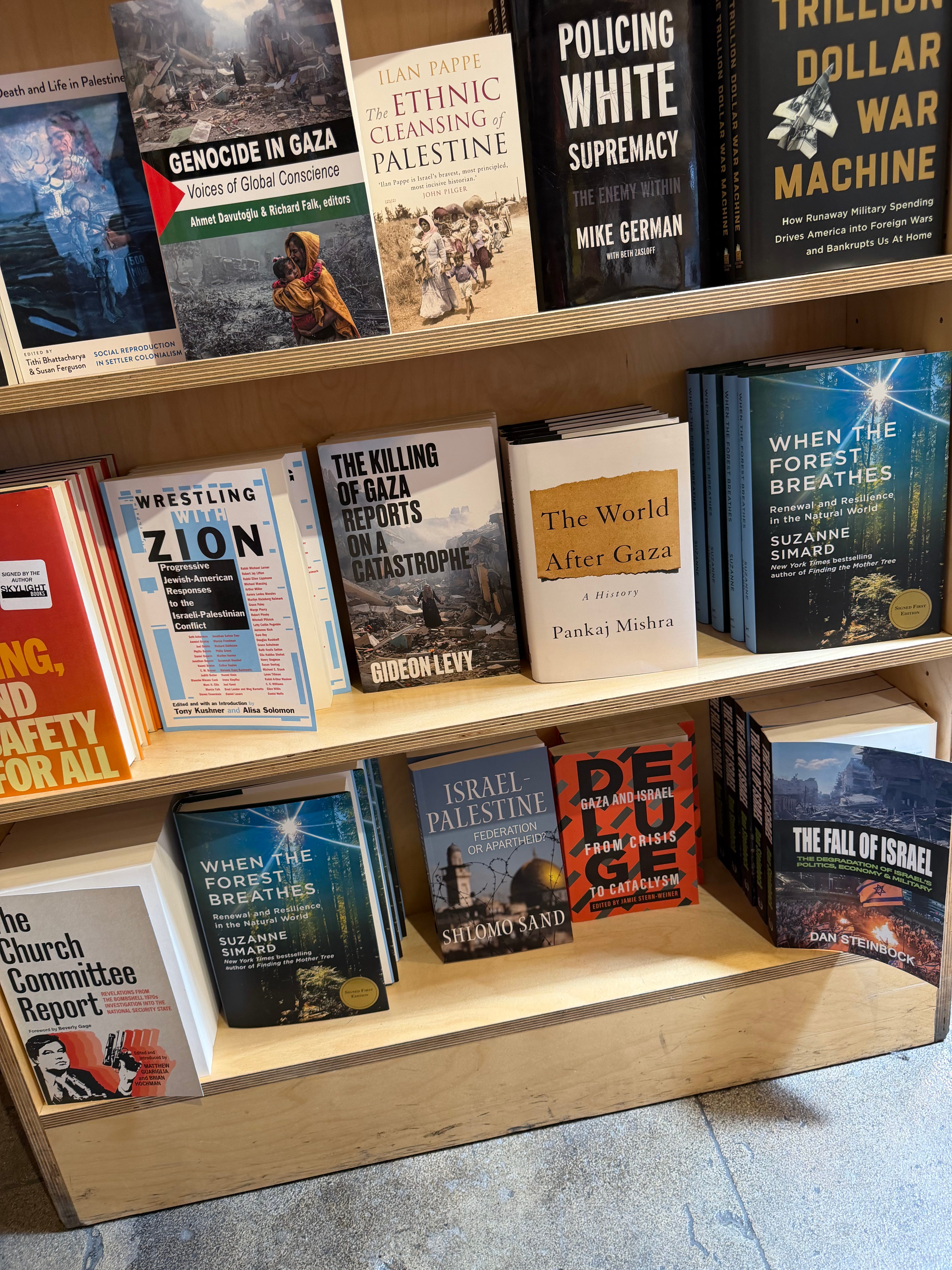
Surely we were reading into things, and the bookshop could not have been celebrating these murders, and as we would later learn, kidnappings of 251 men, women, teens, and young children into Gaza. But we started to wonder if they were indeed happy about the pogrom on October 7 because they turned off the comments for this post, and a couple of weeks later, that same store posted a stack of books with a one-sided perspective all pointed toward the destruction of Israel. It was as if the bookshop was condoning and cheering on this attack on Israeli and international civilians.
Soon after, this bookstore began advertising Palestine-centered “teach-ins” which continue to this day. We’re absolutely not saying that supporting the Palestinian community is problematic. What is problematic is that this bookstore’s programming demonizes Israel and Jews who support its existence. According to the store’s Instagram, Israel is accountable not only for the ills of Palestine, but also of Syria, Azerbaijan, and the United States.
The store recently advertised an event highlighting trans and queer Palestinians. We didn’t attend, but we guess that there was no positive mention of Israel, the queer-welcoming society next door, let alone of the oppression faced by these communities in Gaza. Would a Jewish customer who supports Israel’s right to exist feel welcome at any of these events? We don’t even have to guess.
And what of our favorite, safest space, the feminist bookstore?
We were not asking the bookstore to stop advocating for Gaza. We hoped only that this influential bookstore might also consider speaking up for the women and children harmed on the Israeli side of the border, and for the Jewish community, which was becoming increasingly targeted.
Teme takes it from here.
I gathered two friends and walked on a cold December day, while my husband waited at the coffee shop down the street—“in case you need someone for bail money,” he said.
Soon, one of the co-owners appeared. A cordial conversation followed, lasting about twenty minutes. She appeared warm and receptive but also explained that when it came to the Middle East, the bookstore took its lead from the teachings of Angela Davis, that is, centering the framework of oppressor vs. oppressed, empowered vs. powerless, people of color vs. the white community, colonialism vs. indigeneity.
We asked whether she was aware that the majority of Israeli Jews in Israel were MENA (Middle Eastern, North African), that is, non-white Jews of Color? Did she know that there had been a continuous Jewish presence in Israel for millennia? She expressed surprise. She had not been aware. We pointed out that the children killed and kidnapped could not be considered empowered in October 7’s murderous equation. We said that by disregarding the women who were assaulted, killed, and abducted, the bookstore’s silence amounted to erasure of their pain, a critical omission in feminist discourse.
Teme relayed some of the things she knew firsthand about Kibbutz Be’eri, facts gathered from friends who lived there. Before October 7, the kibbutz’s residents regularly drove into Gaza to bring Gazans to Israel for medical treatment. Every week, volunteers from Be’eri stood guard at checkpoints to make sure Palestinians crossing into Israel were treated respectfully. These friends from Be’eri all lost family members on October 7 in the most tragic and brutal manner. Not one of them was an “oppressor.”
The owner said we’d told her a number of things she hadn’t known and that she would bring them to her staff, several of whom were Jewish. We thanked her and then, to the relief of my husband, we walked peacefully back to the coffee shop.
A few days later, I emailed her. I thanked her for the conversation, pointed her to the New York Times investigation into Hamas’s use of sexual violence on October 7, and asked whether the bookstore might consider affirming the humanity of all victims — Israeli and Palestinian alike. I closed by wishing her a happy New Year and hoping for more dialogue.
I never received a response.
A few weeks later, my friend who lives in the bookstore’s neighborhood reported that a large Palestinian flag now hung in the bookstore’s front window. The store’s selection of books on Israel/Palestine remained unchanged.
Soon after, someone threw a rock through that window. It wasn’t long before the store covered the gash with plywood and painted a Palestinian flag overlaid with a map of Israel labeled “Filastin” in Arabic.
The months passed, punctuated by weekly—if not daily—accusations published in mainstream and social media against the Jewish community and Israel. Jews and Jewish institutions were targeted and attacked. Red Alert apps lit up our phones as we tried to keep tabs on our Israeli family whose days were punctuated by sirens, explosions, and funerals.
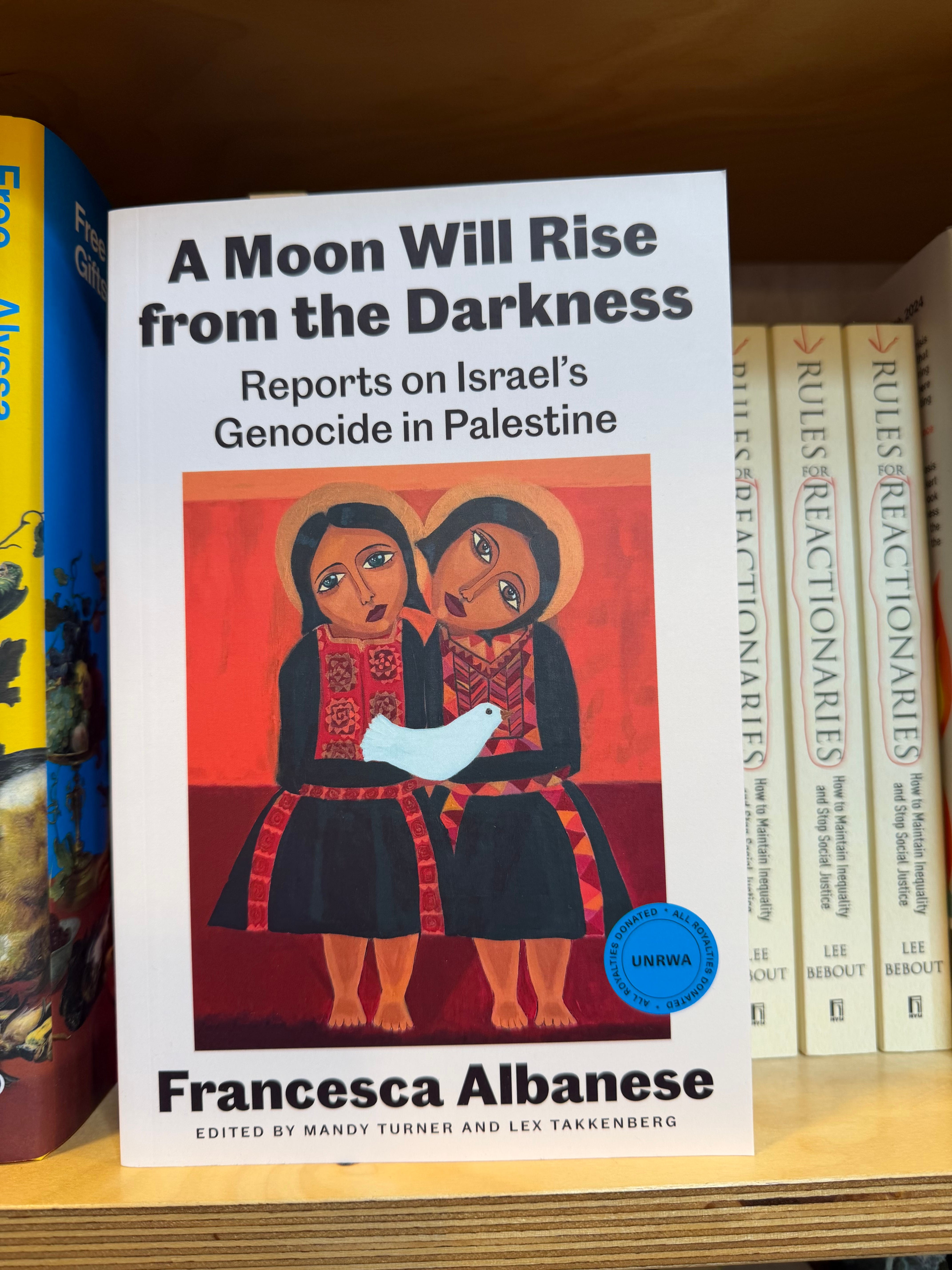
Spring arrived. I heard that the bookstore planned to host an event about antisemitism. Finally! Right?! Wrong. It turned out the evening was to be a book launch for two antizionist authors. Against my better judgment, I felt the need to show up and say … something. I asked my husband to go with me. He agreed, stating wearily, tongue-in-cheek, that he would only accompany me if I promised to make a scene. I had no intention of making a scene.
As we arrived, I noticed poems in the window dangling by threads. They were by Arab authors lamenting the human costs of war. This time, the other co-owner stood at the door. She is someone I’ve always liked and admired. She greeted me with kindness. “It’s been a long time since we’ve seen you. We missed you.” Somehow, this broke my heart even more. “Me, too”, I began. And then I just couldn’t help myself. I could no longer afford to care what anyone thought of me. “You know”, I continued, “there are many Israelis who write about the heavy toll of war. It would be great if you could include them in the window.” She looked at me but didn’t respond.
It seemed every seat was taken. We found space toward the front. It was announced that “the almighty Chicago Teachers Union” was a co-sponsor. Then we heard a land acknowledgment linking our presence on Native American ground to Palestinian liberation. A woman wrapped in an orange keffiyeh interviewed the Jewish co-authors who represented antisemitism as largely a right-wing problem. They referred to Israel’s actions in Gaza as genocidal.
Their argument, as I understood it, was that Zionism is fueled by certain Jewish organizations manufacturing trauma as a fundraising strategy. This fear drives a thirst for an oppressive militarized ethnostate (a/k/a/ Israel). Marjorie Taylor Greene and Jonathan Greenblatt were mentioned together as “part of a coalition rolling back multiracial democracy.”
The authors used seductive language: antisemitism needs to be addressed by minority groups banding together in an intersectional fashion. But, they suggested, this intersectional support is only possible if one decouples antisemitism from antizionism. Their exact words were “breaking the hegemony of Zionism will lead us into a better future.” Framed this way, defeating antisemitism actually requires antizionism.
As soon as the Q&A began, my hand shot up.
In my peripheral vision, I saw my husband shrink back in his chair.
But all I wanted to point out was that the definition of Zionism used by these authors did not reflect the way the vast majority of Jews understood it. I said that I was deeply concerned their framing could contribute to misunderstanding, hostility, and potentially more violence against the Jewish community. I tried to communicate that mainstream Zionism is a peaceful movement advocating for Jews, Palestinians and all religions to share the land and co-exist side by side. When a minority of Jewish extremists use Zionism as an excuse for violence and oppression, the vast majority of Jews view them as criminal outliers.
The authors disagreed with me, holding fast to their definition. They conceded that if Zionism actually meant what I said it meant, they would not be against it. But that is what it means, I said.
A woman in the back of the room began to shout. I was done.
Yet I wasn’t done. On Instagram, I messaged the bookstore articles about Israel’s diversity, history, and peace movements, hoping that as a bookstore, they would be open to reading. I soon discovered that I could no longer view the bookstore’s profile or content. It seemed that my favorite feminist bookstore had responded … by blocking me.
When bookstores accept only a controlled narrative—leaving no room for ideas and facts that complicate or challenge—they risk becoming exclusionary spaces. These bookstores may believe they’re demonstrating empathy or moral clarity. But their selective framing is a form of censorship, and it’s leaving large segments of the Jewish community feeling misrepresented and unwelcome.
If this one bookstore were the only bookstore turning its back on a sizable number of Jewish patrons, Dayenu. We would grieve the loss of our former haven and move on. Instead, we face an ever-expanding epidemic.
In the years since October 7, 2023, we’ve witnessed scores of troubling antisemitic events spearheaded by independent bookstores. Another Chicago store notoriously canceled its book club pick, the award-winning Tomorrow Tomorrow and Tomorrow, assuming that author Gabrielle Zevin is a Zionist (in the most perverse incorrect sense of the word). Apparently, she once appeared at a Hadassah event, and this was enough. This bookstore’s assistant manager is alleged to have written, “I am not comfortable … knowing people would buy [the book] from the store and she would receive monetary support from us.”
Bookstores in New York, Chicago, and Los Angeles repeatedly canceled or outright refused appearances by Israeli authors and authors who publicly supported Israel. Prominent bookstores in Los Angeles and Chicago displayed pro-Hamas books on their front tables.
Some of the bookstores, including the one that canceled Gabrielle Zevin, walked back their actions after the Jewish community expressed concern. Others never have.
It’s worth considering whether we’re seeing flickers and shadows of the way Jewish books and viewpoints were treated in Nazi Germany. Back then, the intelligentsia often led the burning and destruction of Jewish works. In 1821, the poet Heinrich Heine wrote, “Where they burn books, they will ultimately burn people, too.” Are we seeing echoes of this history when bookstores take on the role of banning and vilifying certain Jewish voices?
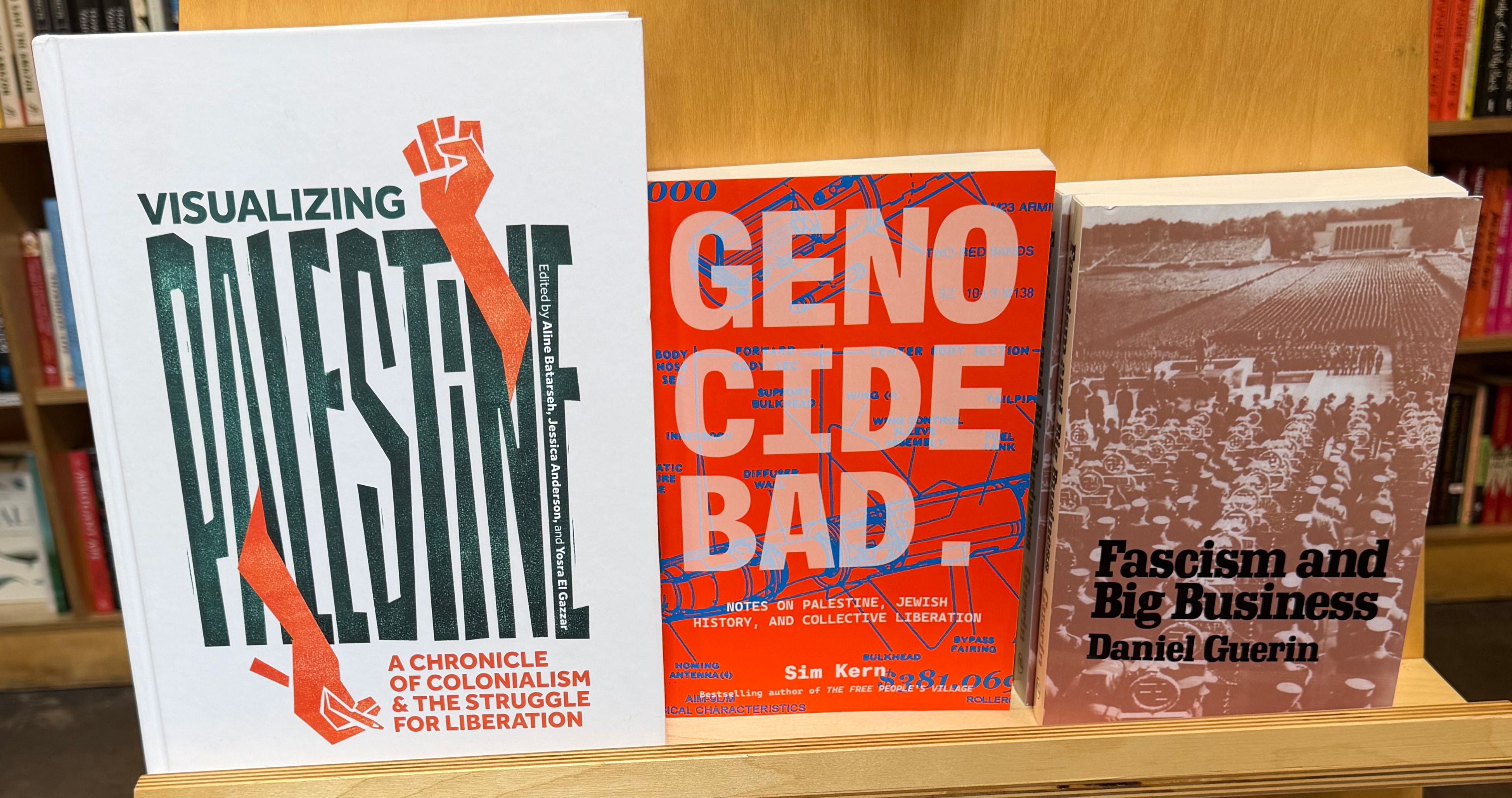
If bookstores were transparent on social media and their websites about where they stood on Israel and Palestine, Jewish customers who support peaceful coexistence would at least know what they were walking into before spending their money there. Yet, as Susan has found to great frustration, some indies seem impartial or completely removed from the conflict in their online presence, while their shelves tell a different story. It would be one thing to have a balanced selection of books that might include dogmatic titles that call for the destruction of Israel, but also side by side others like Yardena Schwartz’s Ghosts of Holy War or Amir Tibon’s The Gates of Gaza. Eli Sharabi’s Hostage or Noa Tishby’s Israel. But these balanced books based on historical facts are nowhere to be found in some bookstores, so a reader will only have a selection of books that promote destruction. No wonder the average American feels confused about the conflict.
We want to be clear: we love independent bookstores and want them to survive. Which makes it all the more frustrating that on this issue, Amazon and Barnes & Noble are doing a better job. Both carry balanced selections on Israel and Palestine, and Barnes & Noble regularly features Jewish authors that many indies won’t touch. We’d rather shop local. We hope the indies will give us a reason to.
Bookstores staying true to principles of open dialogue and inclusion are, these days, alarmingly few and far between. But exemplary independent bookstores still exist. We’ve gone to Children’s Book World in Los Angeles and seen tall bookshelves prominently displaying Passover and Ramadan books side by side. Zibby’s Bookshop in Santa Monica champions Jewish authors along with writers from every diverse community. Other stores have stepped up to support Jewish author appearances and writing conferences, including Park Books in Maryland and The Pile in Berwyn, Illinois. Do you know a bookstore that deserves a shout-out? Let us know.
Here’s another way to take back the narrative. Become a mini bookstore acquisitions manager. We have taken on that role. Purchase books you would like to see in bookstores and distribute them to Little Free Libraries, especially in neighborhoods where bookstores undermine the true messages of Judaism—inclusion, dialogue, cooperation, peace, and respect for history and fact. It only takes a look at the nightly news to see how misinformation, biased history, and demonization of Jews lead to acts of violence in the United States and around the world.
While we are both board members of The Artists Against Antisemitism, we are not writing here as board members, but rather as book lovers who want to support independent bookstores. Thanks to The Artists Against Antisemitism, there is now a Bookstore Guide that can help bookstore owners make their spaces safe for Jewish patrons and anyone who believes in critical thinking.
Teme Ring has interviewed comedians for the Chicago Tribune, Tribune Media Group's ChicagoNow, The Patch, and her own site, Comedians Defying Gravity. She has earned multiple awards for excellence in journalism.
Five tiny delights
Genuinely inclusive bookstores
Cyndi Lauper in concert
Plane-spotting
Sumo oranges
Surprisingly kind encounters with strangers
Five tiny Jewish delights
Israeli & Jewish comedians keeping laughter alive in impossible times
Hebrew class
Street artists of Florentin, Tel Aviv
Jesse Eisenberg & Kieran Culkin in A Real Pain
The Jewish Community Mental Health Initiative — reach out to JCMHI to find support groups and therapists
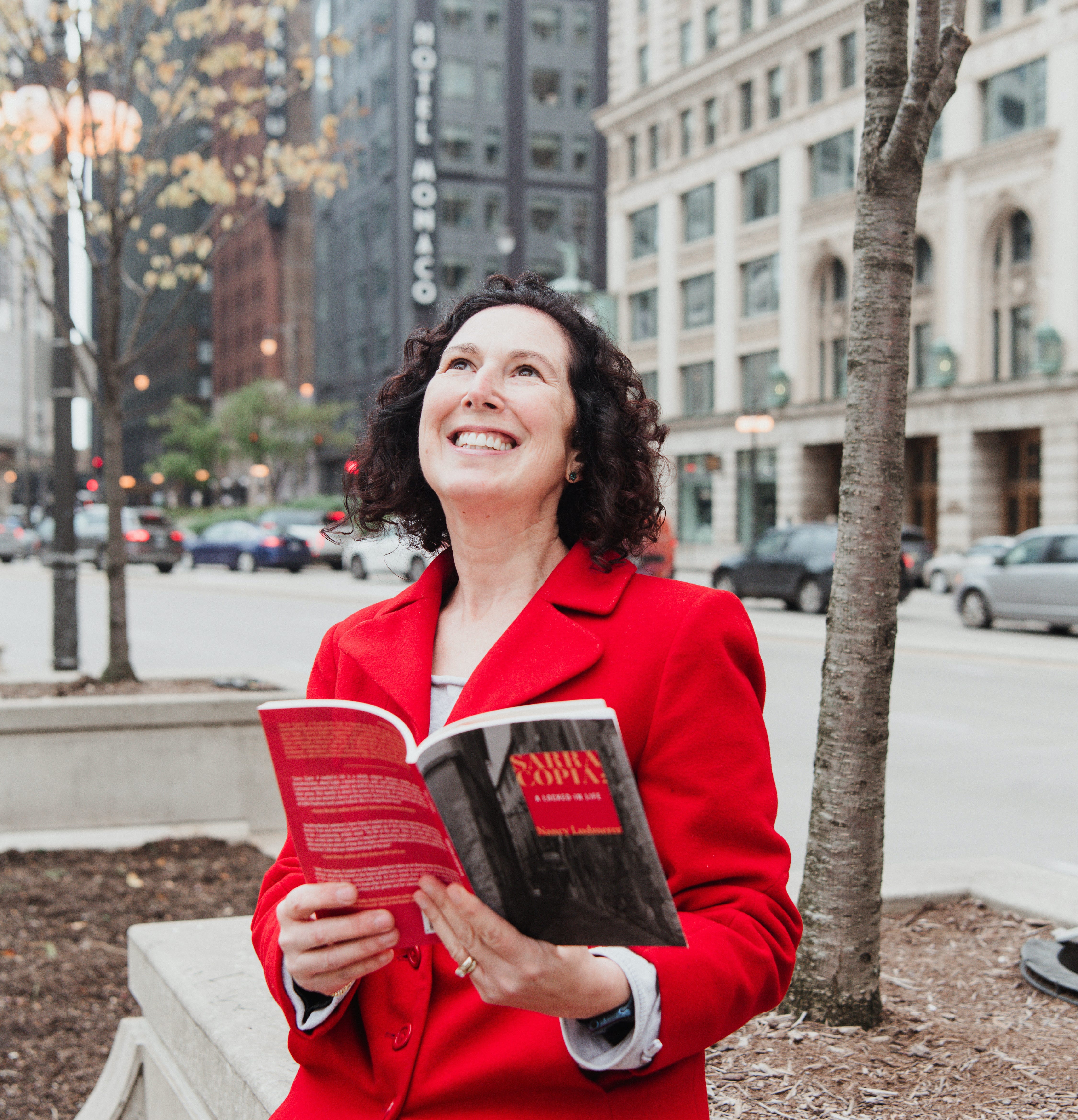
Susan Blumberg-Kason is the author of Bernardine's Shanghai Salon: The Story of the Doyenne of Old China (Post Hill Press, 2023), a 2023 Zibby Awards finalist; Good Chinese Wife: A Love Affair with China Gone Wrong (Sourcebooks, 2014); and When Friends Come From Afar: The Remarkable Story of Bernie Wong and Chicago's Chinese American Service League (University of Illinois Press, 2024), winner of the 2024 Zibby Award. She is the co-editor of Hong Kong Noir (Akashic Books, 2018) and a regular contributor to the Asian Review of Books, Cha: An Asian Literary Review, and World Literature Today. Her work has also appeared in the Los Angeles Review of Books and PopMatters. She is currently working on a biography of Golda Meir's childhood and teenage years in Milwaukee and Denver.
Five tiny delights
My first cup of tea in the morning
Out-of-town day trips
Giving away books I received for free
Long walks
Saying no
Five tiny Jewish delights
JBC’s NuReads
Adeena Sussman’s cookbooks
The Five Books podcast
Reviewing Israeli books in mainstream publications
My Jewish writing group
As a Jewish writer with a memoir publishing later this year, I want to know the name of the Chicago bookstore described in the piece (although I have a pretty good guess.) I'm not sure why the authors decided not to name the store - while I'm sure the store certainly would have no trouble naming the authors it would eschew. I have a hunch it's been on my list of possible outlets for a reading. I am planning my book events and while my book is not particularly Jewish in content, it is clear from the story that I am Jewish, my family has spent a great deal of time in Israel, and if anyone were to google me they would see that I have worked for organizations in the progressive Israel space. This piece reminded me of what I'm up against.
We have a local indie bookstore that one of my kids used to love to visit. (I even did an event there in August 2023 for my anthology Jewish Futures.) After October 7, the store signed onto an anti-Israel statement, and many of the booksellers began wearing pro-P flag pins. My kid stopped feeling comfortable in the store and has basically stopped going there. (I've followed her lead; I would love to support the store, but I too feel uncomfortable now even thinking of visiting it.)