


Editor’s Note: An excerpt from Walter B. Levis’s new novel about the uneasy boundary between visible and invisible crimes —David Michael Slater
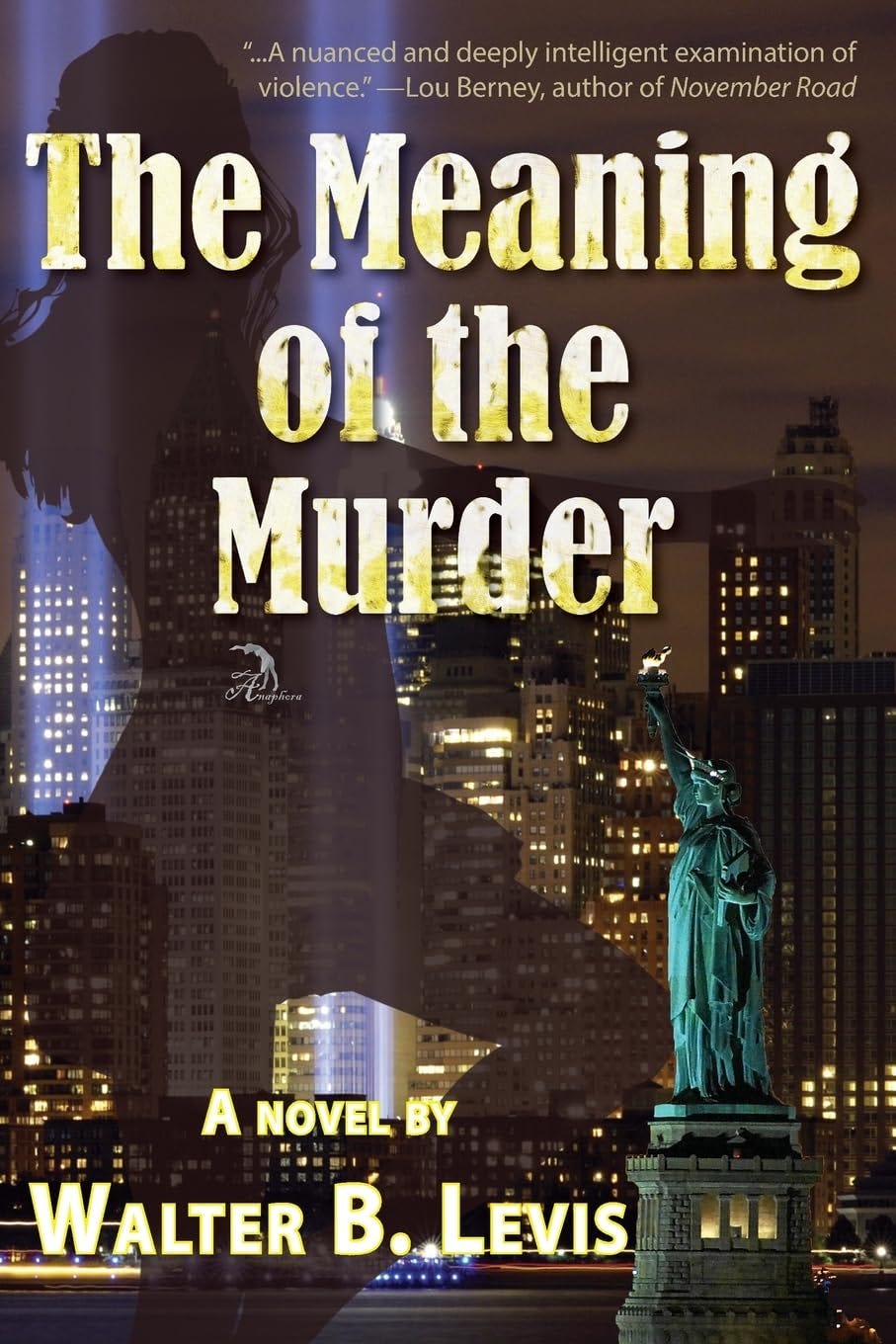
The 34th Precinct, serving the Upper Manhattan neighborhoods known as Washington Heights and Inwood, north of West 179th Street, covers two square miles, with 500 acres of parkland, including Inwood Hill Park and Fort Tyron Park. It’s also home to the NYPD Cold Case squad. Eliana’s former training officer runs the unit. Years ago, a large operation. Now, a total of about twelve detectives for almost nine thousand unsolved murders. That’s dating back to 1985 when the records went electronic. Count the paper files and the Missing Persons and... well, nobody counts all those.
“Knock-knock,” Eliana smiled, walked into the office.
Sergeant Jack Bayer, old enough to be her father, stood leaning over a big grey file cabinet drawer. When he looked up, Eliana realized she should have changed her clothes. The hooker costume: gold stretch sequin mini-skirt, scoop-neck fitted see-through top, her long, thick, dark auburn hair pulled and tied, but ready to drop as a prop, complementing the red eyeshadow and rouge accenting her already-high cheekbones. A naturally attractive face made gaudy for the streets. A good cover. An excellent cover, Kitty’s critique of her muscular arms notwithstanding. The heels too, though she hated the damn heels. She’d dressed and raced out to Queens and—well, nearly twisted her ankle getting out of the car at that diner. Crazy fucking hooker boots. But it had been worth it. The breakfast with Kitty. The intuition—the gift of the gut. This could work. Especially with Jack’s help. Always there for her. A cop’s cop—thirty years on. Sergeant Jack Bayer knew how to take care of himself, how to balance the job and the rest of the world. A solid family—his wife, a nurse, two kids in college. He coached girls’ softball. Yes, Eliana respected not just the stripes, but the man. Though she thought his office smelled right now like gym shoes.
“Good morning, Detective,” Sergeant Bayer said, and Eliana heard a forceful ahem in the older man’s voice. “Or maybe not so good—I have bad news.”
“I just talked to her, Jack—we had breakfast, and—”
“I know.”
“You know?”
The file cabinet drawer slammed shut. Bayer stepped forward and dropped a thick manila folder onto a scratched-up metal desk cluttered with pens, folders, blank incident reports, a stack of exercise DVDs, and two empty coffee cups. Then he went to the window.
“What do you mean—you know?”
Bayer didn’t answer. He muttered something about climate change and the scorching June heat and angrily pushed buttons on an air conditioner missing its plastic cover. The coiled metal insides were coated with grimy dust. When the unit finally rattled to life, he brushed dirt from his loose-fitting brown pants and white shirt. Built like an oversized teddy bear, a big firm belly, large thick arms, he stretched his thick, six-foot frame with a groan and reached to smooth a strip of grey duct tape running down the center of the windows cracked glass pane.
“Listen, Elly,” Bayer turned now with his eyes carefully lowered. “This case isn’t just cold, it’s frozen.”
He motioned to a metal folding chair in front of his desk. Eliana sat. The seat’s hard cool metal stuck to her bare legs. The black lettering on the outside of the manila folder read: NEIL GOLDEN.
She knew the folder’s contents, the dried-out, old-paper feel of every page, the excruciating dead-end emptiness of every investigative detail. Year after year, she’d checked and re-checked it all against the computerized Missing Persons records at 1 Police Plaza. Age of victim: 48; background: compliance officer at USBC bank; resident of Teaneck, N.J., married, three children; reported missing by wife; last seen March 1, 1994; according to canvas: faithful husband, devoted father, hard-working employee, synagogue board member, etc. Medical records, wills, insurance policies: nothing out of the ordinary.
Conclusion: triple zeros. Witnesses, none; body, not found; suspects, none.
The case: the disappearance eighteen years ago of Eliana’s father.
“You’ve got to stop this poking around,” said Bayer, his voice rising
over the noisy air conditioner. He was still standing, his back turned to Eliana. She watched him adjust a two-year-old bird calendar on the wall near the windows. “We’ve been over this a million times,” Bayer said, “the job’s never going to permit you to investigate this case. And the on-your-own-time stuff—”
“Who told you I—”
“OCCB is set up out there.”
“Oh, shit. Did I screw them up?”
Metal scraping grimy linoleum—there was a screech as Eliana drove her chair back from the desk, trying to face Bayer, who moved slowly from the out-of-date bird calendar to a dusty poster of the New York Yankees, a home-plate shaped pentagon of smiling players tacked to the wall with pushpins. Eliana recognized nobody, though she knew the adorable Derek Jeter was in there somewhere. To her, the headshots looked more like a group of uniformed, smiling salesmen than elite, world-beating athletes.
She waited in silence. Bayer continued to avoid looking at her. He pulled a pin from the wall, smoothed a corner of the poster, then pushed the pin back into the wall with a small grunt. He stepped back, examining his work, and without turning around said, “Doesn’t matter.” Now, finally, Bayer turned, and Eliana felt his eyes lock with hers. That old contest: who’ll blink first? She always loved this game. Always won. Except against Charlotte, her little sister. Can’t defeat Charlotte’s spooked-out stare. Radical politics glaze the eyes like—well, like Char’s time in the psych ward. The gaze of the crazy.
“Eliana,” Bayer said, lowering his voice. “I’m worried about you.” She met his eyes and—game on—focused, not blinking, not moving. Until she saw a flash of light in her right eye and felt a bolt of pain shoot through the side of her head. A moment, a breath—then the throb. Pain on the pulse. A migraine. Four hours’ sleep—she’d asked for it. Still, she swallowed hard, trying to conceal. Nobody on the job knew about her headaches. Except Danny, of course. But ex-husbands don’t count.
Bayer abruptly tugged on his tie, then turned and stepped out of his office. It caught Eliana off guard. Had he somehow read the pain on her face? Was she slipping? No, no—inhale, two, three, four, pause; exhale, two, three, four, pause. And again... grateful to be alone, she massaged her temples as she breathed.
The door cracked open, and Bayer started to step back inside. She forced herself to stand up. Strong posture, shoulders back, weight
centered. She leveled her eyes on Bayer, who angled himself in the doorway and, one hand on the knob, tossed her a sweatshirt. He looked at his shoes, boyish, and Eliana appreciated the sincere, old-guy embarrassment in his lowered gaze. “You still take your coffee extra-light, no sugar?”
“Good memory,” she said, holding up the sweatshirt, a faded grey, long-sleeve hoodie with an NYPD logo on the front.
“You mug a tourist?” She sniffed, noting a smell like Indian spices. “Or—decoy squad, right? One of the cabbies?”
Bayer smiled. “You’re good! Must have been that great training officer you had.” He winked—his familiar, friendly, old-guy wink punctuated by that sharp clicking noise he made somehow in the back of his throat. Signature mannerism. Everyone knew Jack’s wink-and-click. Even perps. Like a street tag, he’d arrest someone and the guy in cuffs would plead, “Yo, Winky, how £bout some slack here?”
Eliana put on the sweatshirt slowly—head throbbing, even her hair seemed to hurt. She pulled the fabric carefully over her head. Then she sat and breathed into the pulsing pain, fighting the feeling of a metal hook stabbing her right eye. Re-image, she told herself, visualize: brain waves pushing across the cortex, neurons firing, nothing but chemistry. No metal hook, nothing jabbing, just tiny muscles and cells tensing— breathe. What’s a headache, right? Hell, she’d taken a bullet. The three-inch scar on her right thigh always there to remind her. A headache, no big deal.
Bayer returned, opening the door with a burst of energy. He leaned over her to clear an open circle in the clutter of his desk, then set down her cup of coffee with an under-his-breath, “There ya go...”
“Sorry about the outfit—I should have changed. You know, all I did out there is talk to—”
“Without backup at three in the morning. You ever hear the phrase officer safety’?”
“I get it, Jack. I fucked up. I’ll reach out to somebody in OCCB.”
In her mind, she spelled it out: Organized Crime Control Bureau. Police jargon. She deeply resisted it, even now, after making detective. But she understood that her problem with cop-speak involved the question of whether she really fit in. On good days: protector of the social order; icon of justice; expert at the use of “legitimate force.” Yes, on a good day she believed in being a cop. But on bad days she was just the crazy Jewish girl with a secret—that she became a cop because her father disappeared. On those days, the lingo felt like something she’d learned the way a tourist picks up a few phrases of a foreign language. Which made her no more authentic than a souvenir shop.
Bayer moved around to his side of the desk, then sat in a high-back swivel chair with a rip down the center of its black fabric. The way he settled in—Eliana knew: big daddy speech ahead. She swallowed a few gulps of the hot coffee. The burning in her throat soothed the pounding in her head.
“So... I know we’ve talked about this—”
“Nine hundred and forty-seven times, I think.”
Bayer ignored her. “I’m worried about you.”
“Copy that. I mean, ‘10-4.’”
Bayer smiled. “I’m serious, Eliana.” He cleared his throat. “A lot of very smart people have already banged their brains against this case for a lot of years. And across divisions—Narcotics, Homicide, a Joint-Terror Task Force. And more than just our guys. Fed badges, too. And now? You’re pissing people off acting like you’re going to find something everybody else missed. Last month—cold calls to folks interviewed eighteen years ago? Showing up at people’s doors?”
“That was one lady, and she was in the grocery store where my dad was last—”
“No—no. Don’t explain—stop. Just stop and listen to me: you’re chasing a ghost. And I’ve seen it before. A cop gets haunted and—” Bayer hesitated, mouth open, his eyes swollen with emotion. “Look, you’re... what—thirty-five?”
“Thirty-six.”
“OK, thirty-six. With a terrific future ahead of you, but if you don’t believe in the future—the past will destroy you.”
Good line, Eliana thought, but said nothing in reply. She didn’t know how to reply. He was right... period.
Except for the dream—fourth time, same dream. Could she tell dear Jack about her dream, her intuition?
Bayer shook his head, swallowed, and opened his mouth again, as if to say more. But nothing came. She looked at him closely, noticing the way he’d aged. Only fifty-five, Bayer looked like a man close to seventy. Shoulders sagging, a wrinkle of skin flapping under his chin. His face, too. Cheeks drooping, loose, like a puffy sail lacking a strong wind. And his thinning, gray hair revealed a brown liver spot at the top of his narrow forehead. But his eyes—the bulging bags failed to diminish the power of his eyes. Large, dark, gleaming alertly.
Finally, he waved his hand, almost knocking over his coffee cup, which Eliana noted was balanced precariously on a stack of DVDs with the title “50 Days to Flat Abs.”
“You’re too good a cop—that’s another thing,” he went on, his voice raspy with emotion. He was trying to control—contain—his feelings. Eliana appreciated it. He cared about her—it was that simple. “What you should do is give up the street crap and get your stripes. Sit behind a desk for a while. Boss people around, work regular hours. Hell, get married! Once you’re off the streets, it’s—”
He stopped mid-sentence, catching himself. Eliana knew he’d realized his blunder, and she wanted to say something about it. But the squeezing, pulsing migraine deepened suddenly like a nail hammering into the side of her head. She flashed on a famous homicide of a woman who’d been stabbed in the ear with a sheetrock saw.
Stop. Re-image, she told herself. Breathe. Feel the blood flowing, carrying nutrients, red cells. Healthy red blood cells, like the cavalry arriving to save and soothe. She fought the urge to lean forward, imagining, absurdly, that if she could press her head against the cool metal desk, she’d control the throbbing. Bayer, she could tell, was still feeling like a jerk for his memory lapse. He knew the story of her cop-crap marriage. Better than almost anyone. Hell, she’d cried on his shoulder.
“How is Danny anyway?” asked Bayer, trying to recover. He glanced at a pile of pens on the corner of his desk, picked one, checked to see if it worked.
Eliana just sat there. These migraines sometimes slammed her with such exhaustion blinking could be an effort. Keep punching, she told herself. Fight the fatigue.
She watched Bayer working the pens, scribbling on the corner of a blank incident report. If the pen wrote, he set it to one side. If broken, he threw it with a twist of anger into the green metal wastebasket across the room. The metallic ping of the pens hurt. Another symptom: heightened sensitivity to sound. Eliana concealed her wince. After firing off three rounds of bad pens, Bayer paused and looked up, waiting for Eliana’s reply about her ex-husband.
“Sober,” she said. “As far as I know, Danny’s sober. Although...” Her voice trailed off. No energy for all that right now.
“I know your theory,” Bayer nodded. “Still, if Danny’s sober, that’s good.” He went back to the pens. Click, scribble, ping! Click, scribble... “All I’m really trying to say here, Elly, is that with your case record,” he paused and put down the pens, looking at her now directly. “Your clean-as-a-whistle reputation, your ability to articulate yourself—”
“How about my legs?” She managed a small smile, though her voice lacked the force of sarcasm with a bite. Too tired.
“I’m being serious here—a few months studying, then start taking tests and talking to the right people—”
“Goddammit, I don’t want to make rank—I want to make cases.” She slapped the edge of his desk hard with the palm of her hand. A loud clear thwack. Her palm tingled, and she realized the outburst of anger unlocked the grip of her headache, a shift like the small adjustment of loosening a too-tight bandage. She inhaled, focusing her attention— micro-focusing. She felt the small steady stream of breath at the tip of her nose.
Bayer’s eyes lifted—the desk-slap had gotten his attention.
“You know me, Jack,” she went on, holding her voice steady. “Crime stat analysis, predictive modeling—fine, helpful. But look, this girl—”
He interrupted. “A hooker buying cop-love.”
“She wants slack, yes, but—"
“Some guy gets his dick hard bragging about killing—nothing new there.”
“It’s not just—look, Jack, I’ve talked to her three times now, including this morning. You know how all this goes. Six weeks ago, we sweep up her block and I say, ‘You help me, I help you.’—”
“Eliana—"
“I ask about guns or drugs—"
“Elli, you’ve told me all—"
“—and she says she knows about a murder. Her john told her he once killed a Jew-banker from Jersey who—”
“Detective Golden!” Bayer barked, and Eliana felt the shout like a slap on her head. “Pay attention here.”
She watched him lift his hand, then slowly spread three fingers across the upper sleeve of his shirt, tapping the spot where a uniform would show sergeant’s stripes. “Chain of command,” he said, in a low tone. “You understand?”
“Yes, sir. I understand, sir.” She swallowed hard, forced herself again to lock eyes with Bayer. She wanted to tell him that she understood, sure. But she didn’t believe. Not anymore. Chain of command, police work, street crime—vice, narcotics, the hell with it all. Let the prostitutes earn a living and legalize the fucking drugs and you could send home half the cops on the force. Everybody hates cops anyway. And the haters have a point: until this country starts to care about equality and take care of its poor—fuck it. Arresting people is like squashing roaches. The truth—no matter what detail she worked—only one crime really mattered to Eliana. Homicide. Her father’s killer. And this time, in her gut, the dream...
But could she say all this to Jack? She kept her mouth shut and stared at the big teddy-bear man across the desk until, finally, she couldn’t take it. The pounding of her headache returned—she needed to massage her temples. Blinking, looking away, she brought her hands to the sides of her head and said quietly, “She’s gonna see the guy next week. I just want to follow them, then talk to him.”
“You got a murder—bring it to homicide.”
“I want to work it myself.”
“Fine. Talk to your—”
“Jack, you know what they’re doing to me in Vice—I’m the permanent high-priced working girl. Anytime there’s an investigation anywhere in the five boroughs, I’m putting on the makeup.”
“Hey, they call those details 'special’ cuz they’re citywide. And you wanted to be a detective.”
“I’m not a detective—I’m a piece of ass.”
“You want off the unit? I can get you back into a precinct.”
“Right, the Five-O—I mean, Five-Slow, back up in Riverdale with the ‘my people’? I just want—"
“All of a sudden prostitution isn’t important? Trafficking, human rights. And with what’s going on in the news these days? These people need—”
“You know what I’m saying, Jack. What I want—”
“I can’t do it, Eliana. I can’t take this hooker tip and open up a cold case, especially your dad’s. It’s not happening. You want to work your own homicide—great. Go above your lieutenant and talk to your C.O.”
“He’s a bigger jerk than the L.T.”
“Hey, listen to me. We’re playing cops-and-robbers here. And if you don’t follow the rules, you can’t play.”
Eliana felt a strange moment of clarity—an intuition, like the feeling about her dream. The message. She knew, she understood, she grasped what needed to happen next: ignore chain of command, ignore Big Daddy Bayer, ignore the rules of the game. Get off the grid and take care of business—her own way.
All of this in a gut-flash, a break in the pulsing pain of her headache.
She sat there—calculating, strategizing, concealing her thoughts. She suddenly felt strong, insanely alert. “You’re right,” she said, “I really don’t know what’s wrong with me. I—I appreciate your concern, Jack. I really do. I’m—overworked. Cooked. I just need—” She broke off and gulped the rest of her coffee. “Could you get me another cup?”
“You need to sleep.”
“I know, but—”
“All right.”
He picked up her empty cup and left her in the office, where she quickly leaned over his desk and rifled through the folder of her father’s case. Not sure exactly what she was taking, she grabbed a handful of the top pages, folded them into a small tight square, and stuck it into the top of her boots. A moment later, Bayer returned with her cup of coffee.
“Here ya go.”
“Thanks.”
He nodded. “Fresh pot.”
She smiled, drank. An awkward silence. Deceiving Jack, stealing pages—Eliana wanted nothing now but a quick getaway.
“You working a four-to-twelve today?” Bayer said, finally.
“Yeah. And I really should get home so I can grab a few hours of sleep.” She stood, took a deep breath, then couldn’t help sniffing the air.
Bayer laughed, a throaty chuckle. “Smells like a goddamn locker room in here, doesn’t it? That fat beast O’Malley. Was in here for ten fucking years—with some cops you never get the stink out.” He laughed more loudly, then got up from his chair and went absently to the air conditioner, as if the problem were there.
Eliana started for the door.
Bayer went on, “Anyway, shithole facilities, right? But—”
“—but glorious job.” Eliana jumped in. Old line between them. Shared joke. “Hey, can I keep this?” She pulled on the sleeve of the heavy cotton sweatshirt.
Bayer nodded.
“Thanks. For everything. I needed a talk like this.

Walter B. Levis, a former crime reporter, lives in New York City. His articles have appeared in The NY Daily News, The National Law Journal, The Chicago Reporter, The Chicago Lawyer, The New Republic, Show Business Magazine, and The New Yorker, among others. He is the author of the novel Moments of Doubt. His short stories have appeared widely and have been chosen for a Henfield Prize and nominated for a Pushcart Prize. For more information, visit walterblevis.com.
What five tiny delights lift your spirits and make you happy?
Soft jazz
Strong coffee
Folded socks and underwear
A very hot shower
A sentence that feels just right
What five tiny JEWISH delights lift your spirits and make you happy?
My laminated illustration of Jacob wrestling with God
My father’s yarmulke, the one he wore at his bar mitzvah in 1936
My Star of David that hangs on a toy figure of a police officer
My shelf of books on Jewish history
My wife’s smile—she’s the only Jewish girl I ever dated