

The Secret Buttons
Uncovering Hidden Diamonds in Holocaust Storytelling

Editor’s Note:
The Secret Buttons, by Ellen M. Shapiro, tells the story of 12-year-old Anni and her 7-year-old sister Rosie and their journey from Austria to England to escape the Holocaust. Both girls prove to be extraordinarily resourceful as they navigate their new reality and learn to adapt. Their resilience and ingenuity help and inspire others. Readers will find heroes in both of them.
The rich and beautiful illustrations, by Caterina Baldi, are a wonderful addition to the story. Even more moving is the fact that this novel was inspired by the author’s mother’s memories of the Holocaust in Vienna and life in wartime England, as well as her skill in needlework.
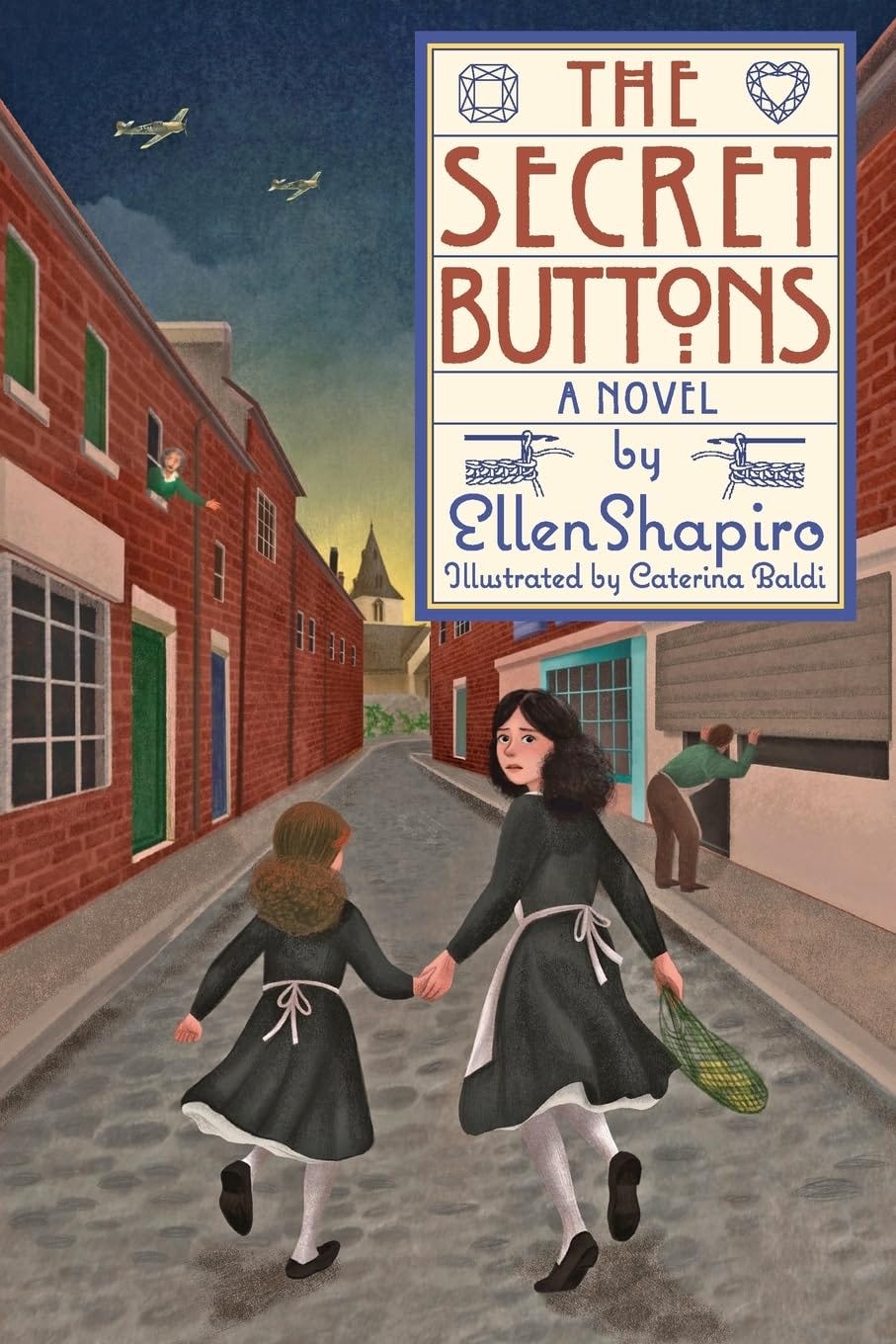
The Secret Buttons by Ellen M. Shapiro and illustrated by Caterina Baldi, Visual Language Books, September 4, 2025 (new paperback edition).
Excerpt:
From The Secret Buttons © 2025 by Ellen M. Shapiro
Chapter 8
All Who Are Hungry
UNCLE B pLACES two booklets on the kitchen table in front of Rosie and me. The words Passover Haggadah are printed on the covers, plus some Hebrew lettering. “Are you familiar with this book?” he asks.
We shake our heads. “No, not really.”
“Hmm. You must know the Passover story, how the ancient Israelites, the first Jewish people, were freed from Egypt after being slaves to Pharaoh.”
“They were?” I ask.
“Is that story true?” Rosie asks.
“Hmm.” Uncle B rubs his chin.
“We loved to visit the Egyptian room in the Art History Museum,” I tell him. “I studied all the signs about the artifacts and the hieroglyphic writing, and don’t remember anything about Jewish people being slaves there.”
As I tell him that, the birthday walk I took with Papa two years ago comes flooding back.
“Do you think we’ll be able to go to museums again, Papa? I want to visit Herr and Frau Pharaoh. Do you remember them?” “I remember them perfectly,” he said, eyes twinkling. “The Natural History Museum is closed to us, but we will have cake and hot chocolate at Egon’s Konditorei, the best café that will welcome us. As soon as things are better, we will go to all the museums.” I teased him a bit: “Remember how Mutti always says that Frau Pharaoh has been holding on to Herr Pharaoh’s arm for more than five hundred years and they haven’t gotten tired of each other?” “Isn’t she clever, your mother? We will visit as soon as we can and see what they’ve been up to,” Papa promised. “Maybe they’ve learned to wear more clothes,” I said. “You can teach them what’s in fashion.” “Will they want to learn?” “From you, of course. But listen, Liebling, I know you’ve been sneaking away to places you shouldn’t be. I would do the same myself. But your mother is starting to catch on. Be careful. And never take your sister with you.”
Uncle B breaks into my thoughts. “Did you celebrate Passover at home?”
“Well, yes. There was wine, and grape juice for us. Grandma Lilli always brought a compote of apples and nuts to spread on matzoh. Granny Sarah brought her sweet vegetable kugel. Mutti would make a brisket and her famous sponge cake. Papa would lead us in talking about freedom.”
“That’s excellent. At our Seder, though, we go around the table and everyone reads from the Haggadah. I’m hoping each of you will have a significant part.”
Sig-nif-i-cant? I try to figure out that word in context. Big, or important? “Oh no. Not us,” I tell him.
Uncle B hands us the booklets. “We try not to use the word ‘no’ here without good reason.”
I open mine. He takes it out of my hand and turns it in the other direction. “Although we mostly read the English parts, these are Hebrew books, so we read from right to left,” he says.
I open the booklet again, my face burning. On the top of every page is a column of Hebrew. On the bottom is English. I should have known better. I did know better. I’d seen books like this before and just got confused.
Rosie opens hers the correct way.
“Read them through and let me know if you have any questions. We’ll talk tomorrow,” he says, turning to return to the sitting room, leaving the booklets with us.
“I guess we have to read some of this.” I read the first sentences out loud: “Blessed art Thou, O Eternal, our God, King of the Universe, who selected us from among all peoples and exalted us among all nations and did sanctify us with His commandments.”
“Selected us,” Rosie asks, in German. “What does ‘us’ mean? The English people?”
“I think it’s the Jewish people, but I don’t understand.” I search for the correct page in my German-English pocket dictionary. “’Exalted’ means ‘held on high, elevated.’ That does not make sense.”
I try another sentence: “The God of our fathers heard our voice, saw our affliction, our sorrow and our oppression.”
“What do all those big words mean?”
I look up ‘affliction,’ ‘sorrow,’ and ‘oppression’ and read the definitions out loud, in German.
“This booklet is ridiculous!” says Rosie. “Ridiculous! Where was God when Papa was taken away? Did God hear his voice saying ‘No, no’?”
Oh. She’s not a silly little girl anymore. She must think about all those things. The memories that won’t leave my head are in hers too.
I read a few more paragraphs. “And look what it says here about God reaching out an outstretched arm to rescue us.” I point to the page. “If that were true, God would reach out and rescue Papa. And bring Mutti and the grannies here.”
With booklets in hand, we walk into the sitting room. Uncle B is going through some important-looking papers. “Finished so soon?” he asks.
“We do not believe this story and are not going to read it.” Rosie announces.
“You couldn’t have read more than the first few pages of the Haggadah.”
“A few pages was enough,” I tell him.
“You’ll be the youngest at the table, Rosie. Will you at least do us the honor of reading The Four Questions, about why this night is different from all other nights?”
Rosie crosses her arms in front of her chest. “No.”
Uncle B raises his caterpillar eyebrows and rubs his chin. I’m getting worried. Are we being too bold? Is he upset with us?
“Well then, I’ll tell you what,” he says. “I’ll bring you a few books about the meaning of Passover. Before you came here, your mother wrote that you are both excellent essay writers. I would like you to write an essay, like a school paper, about your experiences coming here and how they relate to the Passover story. In English. You can read the essay at the table, instead of reading from the Haggadah. Will you do that for me?”
He looks so sincere we can’t say no.
At tea-time the next day, five books are on the table. Two are seas of words. One has interesting drawings. One is for children. One is a big, fat English-German dictionary.
“Are we really going to do this?” Rosie asks, flipping through The Children’s Haggadah, with pictures of parting seas and dancing women playing tambourines.
We sit and read quietly. “I’ve been thinking,” I say, looking up from a page with woodcuts of dead cattle and jumping frogs. “We studied Greek mythology in the fifth form. The Passover story must be a myth. Myths aren’t true, but they can teach us important things. Besides, I’m beginning to like the story. Let’s see what we can come up with.”
“We have to, don’t we?” she says.
“Um-hmm.”
Every day that week we spend a few hours diving into the books, trying to understand what they’re saying. The big dictionary is our new best friend. We write. We cross out. We crumple up paper. We go to the library and check out a book about the meaning of the foods on the Seder plate and for the Festive Meal. Mrs. Coldfield, the village librarian, tries to be helpful.
It takes a while, but I’m proud of what we’re coming up with.
Sunday is the big day, the big evening. The morning begins with peeling and grating lots of potatoes and carrots for the kugel, the way Granny Sarah always made it. Aunt V’s family loves kugel too, she told us.
Ronald sits himself down in the kitchen, picks up a potato, and starts peeling it. Amazing! As he peels, he tells us funny stories about London. He’s acting out how he made the Buckingham Palace Guards laugh when Rosie starts jumping up and down and pointing out the window.
“Look! The eggs have hatched,” she shouts.
The three of us stand on tiptoes to get a good look. All week, while we planted vegetable seeds and did the washing-up, we watched two sparrows build a nest in the tree outside the kitchen window. And now the birdie mum is feeding her babies!
Aunt V comes in and watches too. “We could watch them for hours, but there’s too much to do today,” she reminds us. “We need to press the tablecloth and napkins, polish the silver, set the table for thirteen, and pick and arrange the flowers.”
“Yes. We know.”
“Why don’t you two go out to the front and cut some daffodils? Ronald can finish grating.”
“What’s going on?” I hear her ask him. “You’ve never done a spot of kitchen work before.”
“Girls are nice, actually.”
The minute we come back in, we lean out the window to see what’s happening outside. No. A hawk! It looks like he’s ready to swoop down and enjoy a festive meal too. Of baby birds.
“Help! What do we do?” Rosie cries.
“Hawks hate loud noises,” Ronald says confidently. He grabs frying pans and metal cooking spoons from a cabinet and gestures for us to follow him.
The three of us run out the back door with the pans and spoons, stand next to the tree, jump up and down, bang as hard as we can, and scream “go away” and “scram.” The hawk turns and makes for the hills. Of course, we scare the sparrows too, and the two grown-up ones fly off to another tree.
When the excitement is over, the sparrow parents are back with their young and the hawk is nowhere to be seen, we truss two big chickens. Mr. McCormick, who now calls the back of his shop “the black market” — though the walls are green — had nice plump ones for us.
“Some birds live and others die,” says my philosophical sister as she puts the roasting pan in the oven.
We set the table with Aunt V’s best china and goblets. The centerpiece is the Seder plate of ceremonial foods. We know all about them now. As we arrange them, Rosie reels off explanations: “The lamb bone is for animals the priests sac-ri-ficed in the ancient Temple in Jerusalem. The charoses, the yummy fruits-and-nuts compote that Grandma Lilli always made — and now we made — stands for mortar the Hebrew slaves used to build pyramids for Egypt. Horseradish is the bitter herb of slavery and salt water is tears of the slaves,” she chants. “Matzoh is the bread that did not have time to rise when Pharaoh let the Hebrews go.”
Myth or not, we try to make the plate look like an art museum still life.
At half past six, the doorbell rings. Rosie and I are ready in the silk dresses we wore on the train, cleaned and pressed. On this night, we are excused from wearing pinnies. I hope nobody notices that the dresses are a bit tight. After hellos and introductions, Uncle B takes his seat at the head of the table. Besides the five of us, eight guests are crowded around the table. There’s Claude, the French artist, and Professor Nelson in his paisley ascot. Next to them are Dr. and Mrs. Perlstein, Aunt V’s parents, here from Birmingham. Across the table, Mrs. Coldfield is seated with her daughter Francie. (Aunt V told us that it’s nice to invite townspeople.) And — finally we get to meet him — there’s the Ashers’ older son William, handsome in his R.A.F. uniform. He’s brought someone even more special and new to us, his fiancée, Judith, looking sensational in dark green velvet.
Uncle B pats the pillow we’d placed on his chair. “This cushion represents the concept of freedom from slavery,” he says.
Professor Nelson raises his glass and says, “I’ll drink to that.”
“Not yet,” Claude says.
Everyone laughs politely.
Uncle B recites, “Let all who are hungry come and eat.”
After Dr. Perlstein holds up a silver goblet and leads the blessing over the wine, Uncle B taps his glass with a spoon. “Hear, hear,” he says, “we have the honor of having at our table our young cousins Annegret and Rosamund from Vienna, Austria, who have spent the past year with us. Before we begin our Seder with the dipping of bitter herbs, we will hear a few words about their recent experiences.”
He taps the goblet again. Everyone quiets down and looks at us.
Rosie is first. She takes a gulp of water and unfolds the papers with our handwritten essay. There are scribbles and erasures, but my fingers are crossed that we’ll get through it without making fools of ourselves.
“Why is this night different from all other nights?” Rosie reads in a strong, clear voice. “Because on this night we make our dinner with our story. With un-leaven bread, bitter herbs, salted water, and a fruits and nuts compote with wine, we tell of the freedom of Hebrew slaves.”
Uncle B nods, looking pleased.
Rosie continues, “The escape the Hebrews made from Pharaoh in the Bible book of Exodus is a meta. . .” She stops and takes a long breath. “A met-a-phor for making freedom from slavery. For many centuries, this story has brought hope to many people all around the world.”
“A metaphor?” Dr. Perlstein frowns. “We were always taught that it really happened.”
“Please, Dad,” says Aunt V, winking at Rosie. “Go on, Dear.”
“But the picture of God with stretched-out arms is too hard for my sister and for me to agree with.” Rosie clasps her hands over her heart. “Our Papa was taken away. He is in a work camp called Dachau, by Munich. Our mutti, our mother, gets postcards from him on some weeks.”
Mrs. Perlstein looks like she’s going to say something, but Professor Nelson squeezes her shoulder. Uncle B rubs his chin with a big “hmm.” I guess he didn’t expect our essay to be quite like this. We gave him pages to read, but then we changed just about everything.
Rosie clears her throat. “Our two grannies were sent away from their nice flats and are living in a bad district. Mutti is waiting at home, all alone, hoping that we will all again be together soon. With very many thank-yous to a friendly man my sister met at the post office and to Cousin Ronald” — he’s grinning like the Cheshire Cat — “we learned how to get letters to and from our mother. We use a helpful man in Spain. We make up a code to get past the censorship. We write about the gardens and dogs when we want to tell her about the bomb shelters and blackouts.
“Fantastic,” the professor says. “How clever!”
“Nicely done,” William agrees.
With a sigh of relief, Rosie hands the pages to me, saying, “It is now Anni’s turn.”
I swallow hard and begin: “This year, the stretched-out arm is reaching us in a sub-tel way,” I read, hoping that I’m pronouncing ‘subtle’ correctly. “Thanks to Uncle Benjamin and to our library” — I nod to Mrs. Coldfield — “we studied books and learned that two themes have defined the Jewish self-knowledge. . .” — that is a really hard one — “naw-ledge — in the 2,000 years since the first Seder was held.”
“Quite the scholar,” the professor says.
“Eh bien!” Claude adds.
“Sha!” Uncle B pounds the table. “Let’s listen.”
“The first theme welcomed you here,” I continue, less nervously. “Let all who are hungry come and eat. That is voice of com. . . of com-pass-ion. We welcome you to this table and ask you to enjoy foods we have prepared. And we have been preparing very much.”
Everyone laughs. Even shy little Francie.
“The second theme is from plague number ten, the death of the Egyptian first-born babies. That plague made Pharaoh let the Hebrews go. But not for long. The Haggadah says, ‘In each and every generation they rise up against us to destroy us, and the Holy One rescues us.’”
I take a breath. The big words are hard, but I’m doing it. “I hope you understand that Rosie and I are waiting for the rescue of our Papa and of many others. We wonder when we will see our Papa again. We were sent here because Adolf Hitler is trying to make the Eur-o-pee-an con-tin-ent Judenrein, free of Jews.”
Every mouth around the table opens. They’ve never heard that word before, have they?
“Here in England you are busy making ready for the war, and the news from Germany and Austria is not getting through,” I go on. “Some news is coming to us from our mother, and it is not good.”
Mrs. Pearlstein and Judith nod their heads up and down as if they agree and want to hear more.
“We learned the Hebrew name for ancient Egypt. It is Mitz-ray-im. That word means ‘narrow place.’ We came to England from a too-narrow place where the people and our Anführers, our former leaders, did not understand what was to happen. They let our country, Austria, be overtaken and its name changed to Ostmark, and all the Jewish people’s regular names were changed to Sarah and Israel.”
The table lights up with a buzz.
“Yes, our names were changed.” I stop reading and look up. “All the men and boys became Israel,” I improvise, spreading on the emotions like buttering bread. “And the women and girls became Sarah. I became Sarah-Annegret and my sister” — I pat Rosie’s shoulder — “became Sarah-Rosamund. Our parents and grandmamas became Israels and Sarahs, too. Granny Sarah was already Sarah, so she became Sarah-Sarah.”
It looks like the people around the table don’t know whether to laugh or cry.
“When we came here,” I go on, “it was to a wider place. Right away we see how everyone works to stop the same things from happening. Now, the Phoney War, as you call it, is on. But when the Real War comes, England will be prepared. Now, we are in the narrow place of fear of war coming. In conclusion, next year, may all people in Austria and in England and everywhere have a new Exodus to freedom.”
“Chag sameach.” Rosie and I say that memorized Hebrew phrase — “happy holiday” — together. We did it!
Everyone starts to applaud, but I can’t stop talking. I hold my hand up like teachers do to quiet the class. “Today we rescued a mother bird and her baby birds from an, um, a pre-da-tor, a big hungry hawk, by jumping up and down and making a lot of noise. It was fun, but I also learned something big. We can make things happen. Uncle Benjamin’s books say that God does not always do what we expect and hope for. Yes, our Papa and Mutti and grandmamas have not been rescued, yet. But Rosie and I are here. We got rescued, and now we will do what little we can to help.”
Everyone applauds and taps their spoons against the wine glasses.
“Careful” warns Aunt V. “Those are our wedding goblets.”
“Brava!” cries Uncle B.
“Bravissima!” shouts Claude.
“Kol ha-kavod,” says Professor Nelson.
“What does that mean?” Rosie asks.
“It’s Hebrew for ‘All the honor to you.’ To both of you.” Uncle B and Professor Nelson say, in unison. They clink their goblets together.
I feel myself blush down to the tips of my toes.
“So meaningful,” Miss Coldfield says. “So well researched and written. Your story about the baby birds is brilliant, just perfect for a spring festival. And you girls have such charming accents.”
Really? Still?
“But about the birds, it wasn’t a story. It was true,” Rosie says.
“And now for the karpas,” Uncle B says proudly. “Will all of you please turn to page seven, pick up some parsley, and recite with me:
“Blessed art Thou, Oh Eternal, our God, King of the Universe, Creator of the fruits of the earth.”
This time, those words do not sound ridiculous.
Rosie and I get up, curtsy, and go to the kitchen to get the bowls of matzoh knödel soup.
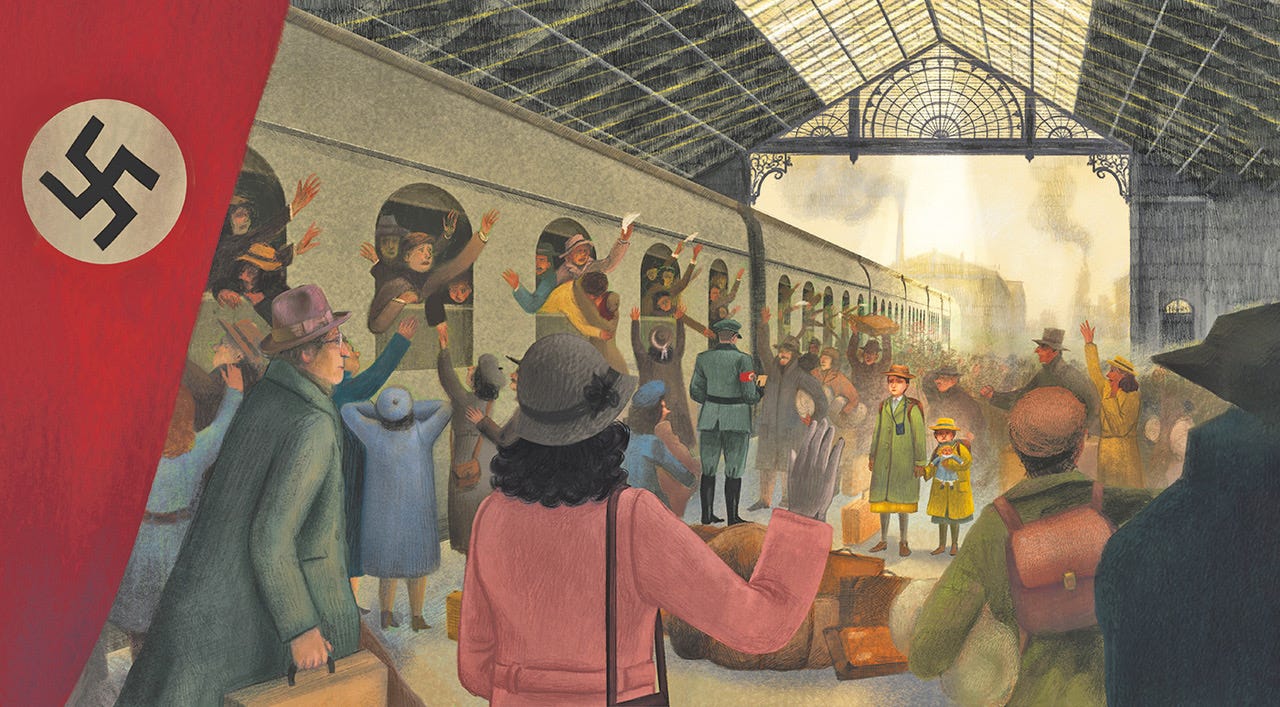
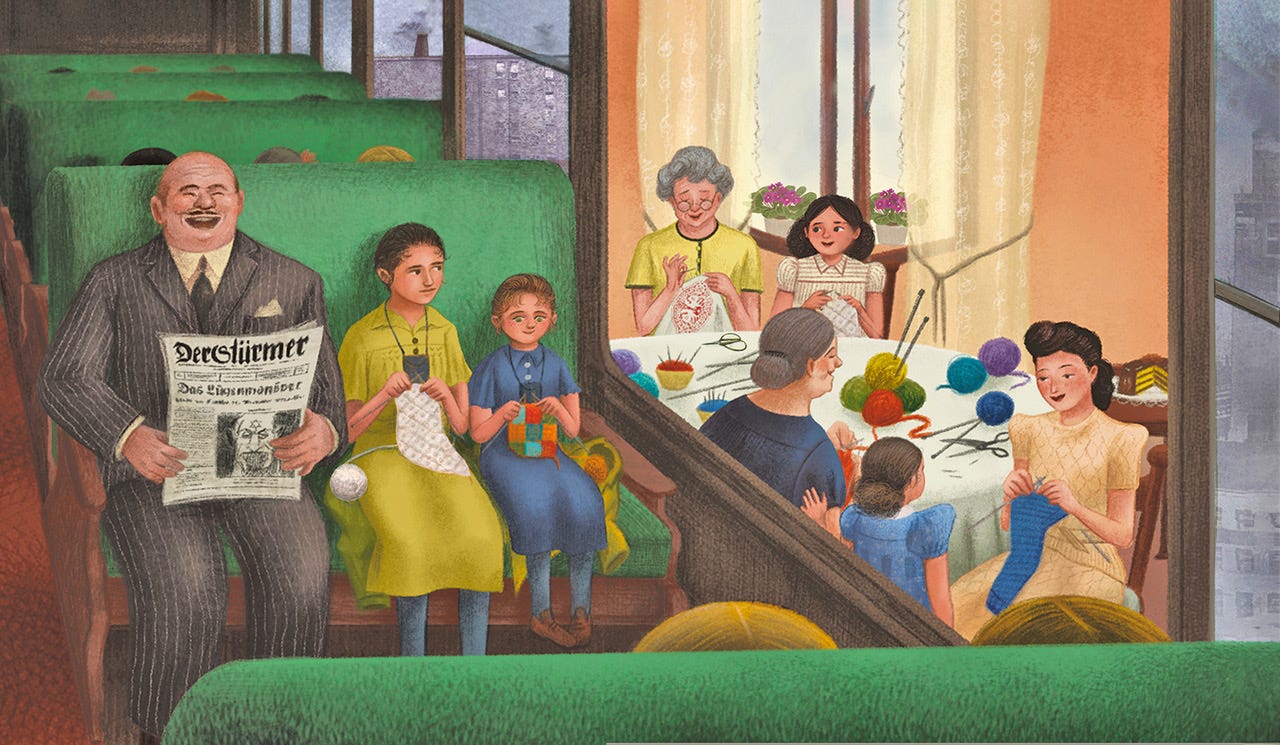
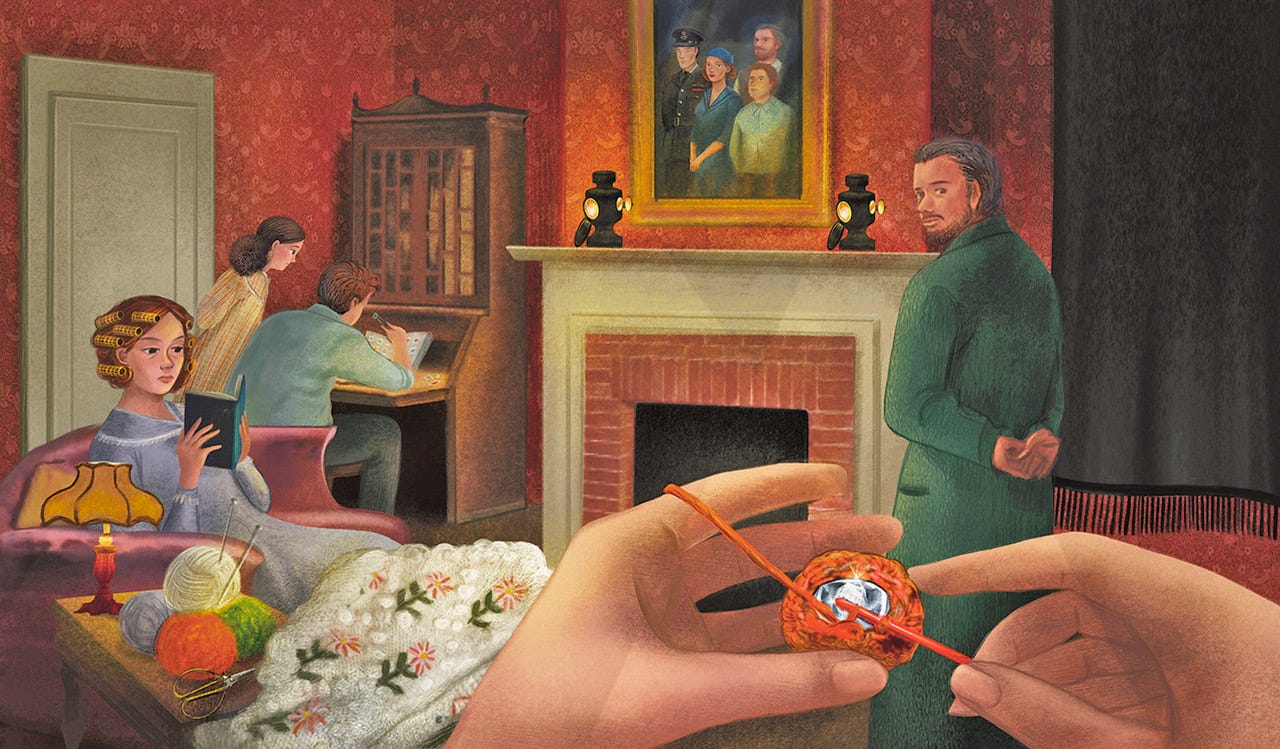
Ellen was the art director, providing creative direction, a description of the scene, and detailed descriptions and 'scrap' photos of interiors, furniture, exteriors, plants, clothing, vehicles, boats, planes, hairstyles, dishes, kitchen tools, foodstuffs, the Tyrolean sweater, and much more. The illustrator, Caterina Baldi, created the compositions and worked with Ellen from sketches through revisions.
✡️
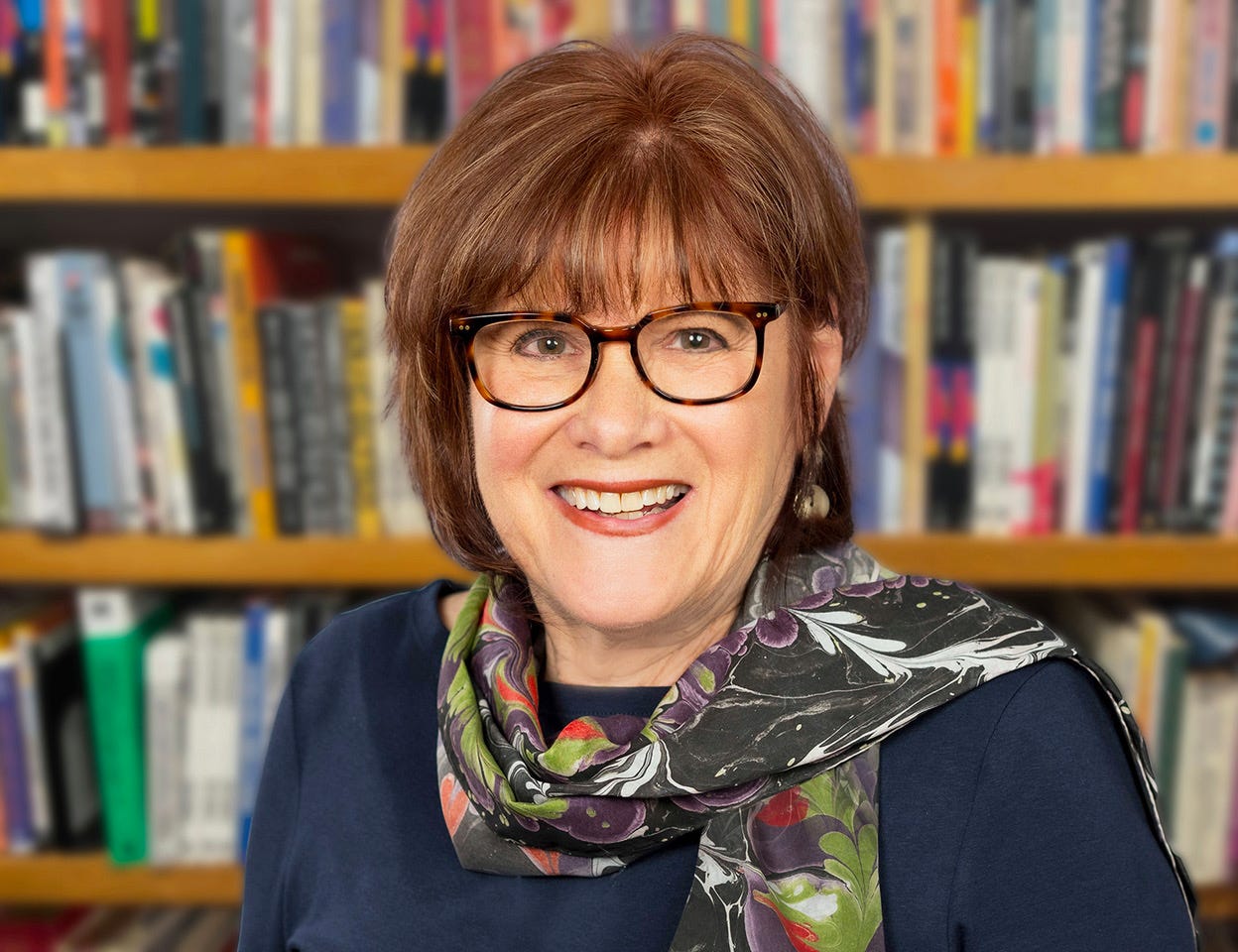
(Photo credit: Margaret Fox)
Ellen M. Shapiro is a graphic designer and writer. A graduate of UCLA’s College of Fine Arts, she has headed a graphic communications firm for over 20 years and taught at leading design schools, including the Designer as Author MFA program at New York’s School of Visual Arts. A contributing editor for Print Magazine and writer for Printmag.com, she has published hundreds of articles and posts and two nonfiction books about visual culture around the world. Inspired by her mother’s memories of the Holocaust in Vienna and life in wartime England, The Secret Buttons is her first novel.
✡️
Five Tiny Delights:
1. Drinking fragrant coffee on the deck, watching the pond behind our house, and listening to the birds singing and calling to each other.
2. Coaxing my plants to bloom with just enough water and sunlight.
3. Playing kitchen with my four-year-old granddaughter, writing imaginary recipes, cooking them on her play stove, and pretending to eat them.
4. Listening to my nine-year-old grandson play the piano (he’s good)!
5. Applauding to the TV when a young immigrant chef beats Bobby Flay.
✡️
Five Tiny JEWISH Delights:
1. Playing percussion in synagogue bands and klezmer bands (that’s actually one of my biggest delights).
2. Going out for meals with our relatives in Israel; being introduced to out-of-the-way places with spicy, unusual, delicious foods.
3. Being among the women and men on Shabbat mornings wrapped in striped and flowered and embroidered tallitot.
4. Seeing and hearing the young children up on the bimah singing, playing instruments, and helping lead services.
5. Visiting my niece on “special friends’ day” at the 92stY nursery school and enjoying being taught their songs, watching her play learning games, and eating the muffins the children made for us.
✡️