

The Women's Circle
After October 7 left her feeling isolated and without allies in Australia, Sharon Sztar finds renewed belonging and shared purpose in a Jewish gathering rooted in sisterhood.

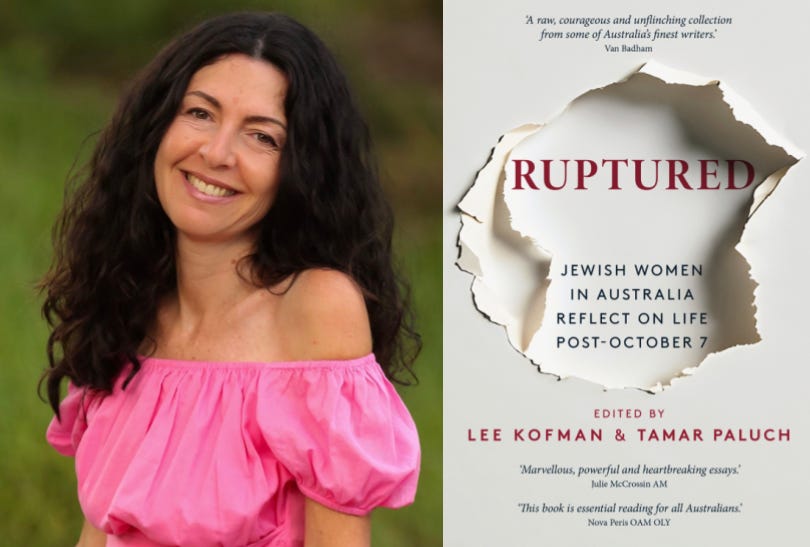
Editor’s Note: I’ve been reading so much over the past couple of years about the sharp rise in antisemitism in Australia, and I jumped at the chance to include Jewish Australian voices in Judith. This essay by Sharon Sztar is one of many in Ruptured: Jewish Women in Australia Reflect on Life Post-October 7, a powerful collection of personal pieces by thirty-six Australian Jewish women writing in the wake of October 7. Together, these essays capture how that day upended lives and relationships, and how Jewish women are trying to make sense of what followed. I’m grateful to be able to share one of those voices here. — Howard Lovy
We gathered in circle under a clear sky in the Byron Bay hinterland. Our chosen meeting place, an outdoor temple rotunda set against the majestic Mount Jerusalem. It was there that we wept and prayed, paying homage to our murdered and captive sisters. As the sun made its way to the horizon, we lit Shabbat candles – a symbol of our trust in the light, even in the darkest of days – just like the women of our kin have done for over 4,000 years. One of us began to sing the uplifting psalm Shir Hamaalot to close the ceremony, and when our twenty voices joined her, something primal awakened in me.
In the preceding six months, I’d felt rattled and isolated. I’d been filtering my words at local Northern Rivers women’s get-togethers, because I no longer felt safe to speak freely and openly. The global silence about what happened to the women of my tribe on October 7 had permeated these spaces that I had belonged to for more than a decade. Whenever I had tried to challenge it, I was met with disinterest and, in some cases, explicit disregard. Where were the strong feminist voices? Why weren’t they demanding our girls be released from captivity? Where was the outrage about the desecrated bodies of the Nova festival’s young partygoers?
I invited the women in our local Jewish and Israeli network to come together on International Women’s Day 2024, to honour our mixed feelings about the day and the movement that no longer seemed to represent us. Huddled together in that beautiful hinterland setting, a vital conversation about what it means to be a Jewish woman at this juncture in history unfolded. I felt a grounding and belonging I’d not sensed for a long time. It had been so easy, so very easy, to create this safe haven because, even before we met, we were bound by a bloodline.
To continue nurturing our sisterhood, several of us committed to holding regular gatherings, aligned with the Hebrew lunisolar calendar. Given my significant experience running women’s lifecycle circles, I offered to facilitate the sessions. Our early events were small and intimate, but as word spread, the group grew to more than forty members – aged from eighteen to eighty – from within and beyond the Northern Rivers borders.
These monthly circles have helped me navigate the hurdles of life post-October 7 and provided much solace. I have had nowhere else to take my rising angst, resulting from what has felt like a barrage of bullets as I go about the routine of daily life. It isn’t just women’s groups where I have felt like an outlier since the war began. A simple walk down the street, an overheard conversation at a cafe, my social media or Substack feed – everywhere I turn, old allies with whom I used to share confidences and sit in peace-loving workshops, now speak with contemptuous zest against Israel and Zionists. Shortly after October 7, at a local kirtan (chanting festival), half the audience chose to stop dancing when the musicians sang in Hebrew.
One of the bullets that struck most deeply was the 2024 Byron Writers Festival. This time I turned up as a cautious observer, rather than the keen participant of previous years. Before I even arrived, I felt unwelcome, knowing that no Israeli or Jewish voices were being represented in the scheduled sessions about the Middle East conflict. Rather, John Lyons, a non-Jewish Australian foreign affairs journalist, took the stage several times as the lone expert. Well-known for being critical of Israel, he was invited to discuss his book Balcony Over Jerusalem, which had been published seven years earlier. When he received a standing ovation, I was crushed to see people I knew clapping and cheering. Then, there were sessions where the history of Indigenous Australians was conflated with that of the Palestinians, while the speakers ignored Jewish indigeneity to the land of Israel, and the audience was encouraged to chant From the River to the Sea, Palestine will be Free alongside the Acknowledgement of Country. At that festival, my feelings of being ostracised from a community of fellow creatives and artists – those I once believed were the truth seekers of society – were cemented.
Ironically, one of the reasons I moved to the Northern Rivers twelve years ago was because I assumed – as many of us freedom seekers, nature lovers, refugees of the busy modern world did –that this community was all-inclusive. Up until October 7, I had never specifically sought the company of Jewish people. On the contrary, I lived what one could call an assimilated life. My circle of friends included Aussies, Greeks, Italians, Poms, Germans. It didn’t matter, did it? We are all human beings, aren’t we?
But had I only been accepted into diverse groups in the past because I blended into the crowd, straightening my dark curls so that those who knew me could forget who I really was? And did I camouflage so well that I sometimes ‘forgot’ to tell new people I met that I was Jewish? I have asked myself these questions time and again this past year. Did I do it wrong?
Some time ago, I heard an Aboriginal elder speak about self-preservation. She told the audience how after challenging events, her community would often retreat into their own Mobs to nourish, recover and rebuild before facing the wider public again. Perhaps that was what our Jewish women’s circle was becoming too – our place of sustenance. A place where we could tend to our roots to grow healthy branches.
To honour our connection to the land and lore of Israel, we have tracked the motifs of the Jewish calendar months from the darkness of Av to the trust and faith of Elul, to the birthing of a new year in Tishrei. We have remembered our foremother Rachel and the mother energy of Cheshvan, and have spoken to the powerful attributes of Miriam the Prophetess in the month of Nissan. We built a wailing wall with large stones from a local river, danced to the divine, planted seedlings in pots. We open and close each circle gathering with a psalm or traditional song. Singing in Hebrew has been an essential element of our healing. I’ve noticed it’s irrelevant if my mind doesn’t understand all the words, because my body still feels the beat and my heart recognises the melody. Through this circle, we tap into something ancient, mysterious and comforting.
Half-way through the year, we began to reconnect with the non-Jewish community. As part of a broader Northern Rivers Jewish community event, I designed a panel discussion, Healing the Sister Wound, with the intention of building a bridge with the wider sisterhood by sharing our history, customs and current emotional landscape. My fellow speakers and I told the story of our four Jewish Matriarchs and discussed what it was like growing up in both Israel and the diaspora. When we opened the floor to the audience of more than a hundred people, one non-Jewish woman cried: ‘I’m sorry!’ Tears fell, hugs were extended, hands were offered. I left feeling lighter – seen and heard.
As often happens with circles, the ripple effect has generated more of them. Soon, one of the non-Jewish attendees reached out with a request to expand our outreach initiative to some of her female friends. On a warm spring Friday night and new moon, eleven of us gathered in her home to conduct a Sister Shabbat ceremony followed by dinner. We were nervous at the start, as we’d never shared our spiritual rituals in such an intimate manner with those outside of our cultural circles. But our hostess and her friends engaged generously and deeply with our candle-lighting, wine and challah ceremony as part of welcoming the Shabbat Queen. For the first time since October 7, I felt at ease again in a diverse women’s group.
That initial circle on International Women’s Day, and all that has grown from it, has given me the confidence to walk differently in the world, and specifically in the Northern Rivers, as a Jewish woman. I’m no longer a camouflaged Jew; I’m all of me, intact and on display. Even though the anti-Israel and anti-Jewish sentiments still live on in the region, my newly embraced acceptance of who I am, together with the blossoming of new friendships and collaborations, has provided me with a strong and solid backbone. I appreciate that my tenacity—and our tenacity as a people—comes from knowing we may fall, but so too do we rise. Over and over—just like the moon we gather around each month.
Sharon Sztar is a contributing author to Ruptured: Jewish Women in Australia Reflect on Life post - October 7. An ex-corporate communications executive turned writer and women's wellbeing advocate, twelve years ago she swapped big city living for the small but beautiful Byron Bay Shire in the NSW Northern Rivers. Using her own unconventional story as inspiration, her work and writing explore and challenge the narratives about what it means to be a well woman across all seasons of life. More recently, she has begun delving into her Jewish roots, the stories of our matriarchs and heroines and how we can live as modern Jewish women in a post-October 7 world. One of her passions is bringing women together in circle and ceremony, which is also the theme of her essay in Ruptured. Find her online at Substack, Instagram and www.sharonsztar.com.
Five tiny delights
The rhythm and ritual of tea ceremony
Salty water encasing my skin on morning beach visits
Massaging words into sentences
The drifting scent of frangipani, blue lotus and roses
Turning clay into a piece of art and heart
Five tiny Jewish delights
The circular movement of my hands taking in the light of Friday night Shabbat candles
Finding Hebrew chants to use in meditation practice
Opening one of the leather-bound Soncino set of books my Zaida bought me over 40 years ago and knowing his teachings and dreams for me live on
Adding new songs to my Hebrew-only Spotify playlist
Knowing I’m part of a 15-million-strong global family
 | A guest post by
|
That sense of profound isolation, as a secular Jew, resonates hard. But unlike Sharon, I haven't found my way through to a community.
But I recently found my voice, writing here on Substack and on FB about my own experiences and unpacking complexities as I understand them.
I hope in using my voice, I find "my people".
How wonderful to see this piece, here. And, in turn to find Judith. Thanks for your magazine; and your strong, interesting and uplifting pieces here in these pages. It's a very fine addition to my sense that there is still light shining; there's a lot of darkness that needs illuminating and so the work to light things up... that goes on. How lucky we are to have these resources to do just that. Love Sharon's article. Thank you.