

Watching Deni
For Andrew Cohen and his family, the success of an Israeli NBA player carries weight far beyond the court

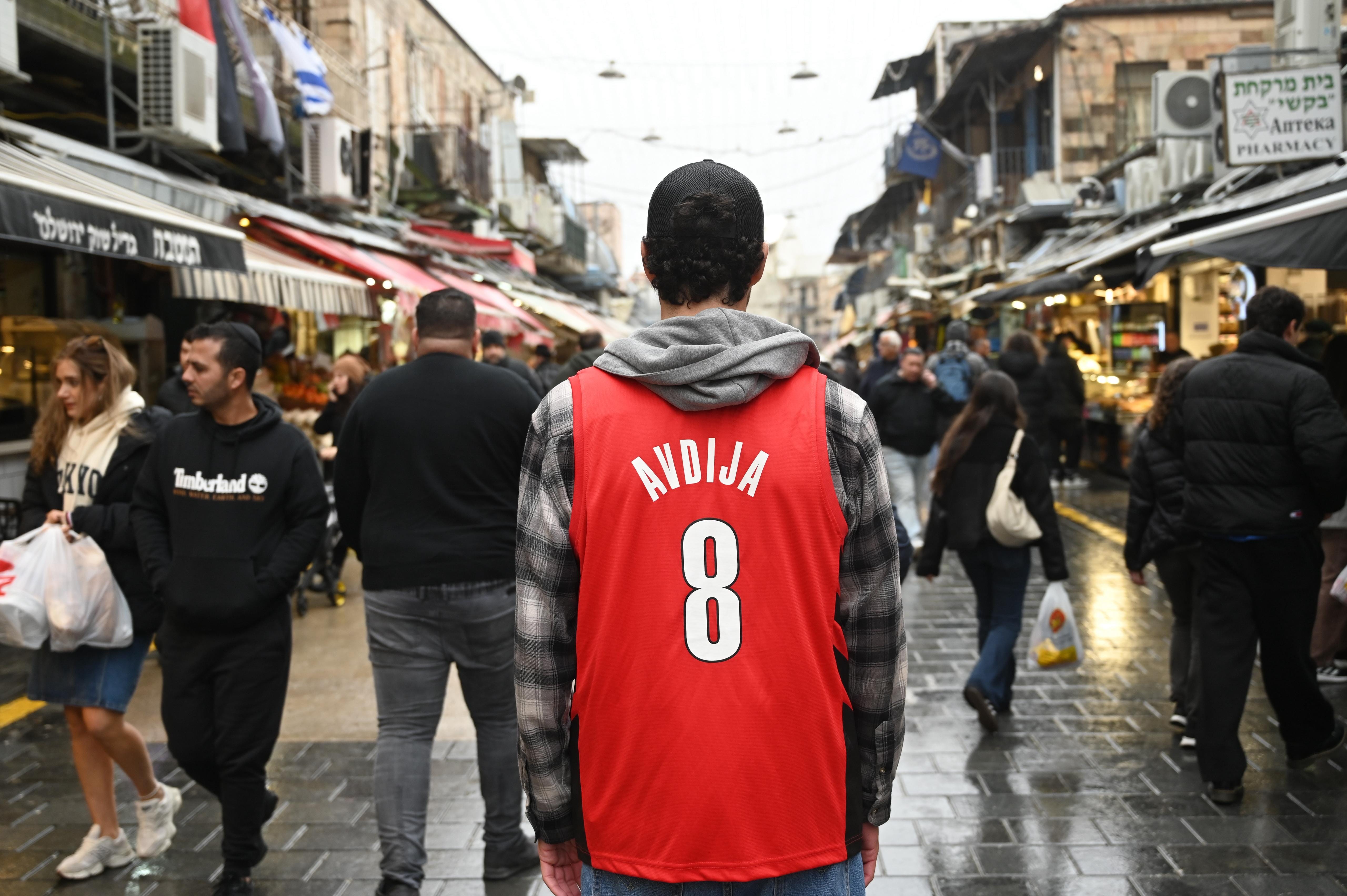
Editor’s Note: I grew up on stories about famous Jewish athletes. Being from Detroit, I heard plenty about Hank Greenberg and how he refused to play in a pennant race on Yom Kippur. That was the standard in our house. I’ll admit my knowledge of Jewish sports heroes doesn’t go much beyond that era. Andrew Cohen brings us up to date, reminding us that today’s Jewish athletes can inspire pride—and, at times, something closer to worry. — Howard Lovy
What are the odds that at the exact moment in Jewish History when synagogues across Europe are burning again and Jews are being murdered on beaches of Australia; when hatred for the Jewish state and anyone associated with has become more pervasive, more vitriolic, more deadly than at any point since its reestablishment in 1948; when the Jewish People are collectively having their, our, very worst moment since the Holocaust, there would arise in our midst a big, strong, handsome, eminently likable, Israeli basketball player, who, after four fairly unremarkable years in the NBA, would be putting up numbers on par with generational talents like Luka Doncic and Lebron James, lifting his bottom-feeding West Coast team into the playoff picture, and even securing himself a spot in the NBA All Star game?
Could we have come up with a more fantastic, improbable yet perfectly Jewish story if we tried?
We’re not talking about the Nobel Prize for Physics or a headline at Carnegie Hall after all. We’re talking about the NBA, where Jews haven’t had a meaningful presence on the court since Adolph Schayes helped the Syracuse Nationals win an NBA title in 1955, where a grand total of seven Israelis have played 1299 games over the last seventy-five years as of this writing.
Is it any wonder that my sons and I, rabid Portland Trail Blazers fans, are nearly delirious with Deni Fever, that we find ourselves musing whether there really is some kind of Jewish cabal or Zionist conspiracy out there, that when we talk about Deni over dinner, we use terms like bashert, mazal, the hand of God, joke that maybe some rabbi conjured him from clay in the attic of a shul in Prague?
Every sports fan has moments when the ordinary becomes epic, when the Heavens seem to open for a moment above us, when you can’t help but wonder whether there really is a God.
But as my older son Ezra put it, “Deni is entirely different.”
***
You should see us sitting on the couch on game nights in our bright red number 8 jerseys watching Deni, my sons and I and even my wife, whose feelings for basketball are a lot like my feelings for gardening (Nice activity, but what’s the fuss?), cheering and clapping and hooting and high-fiving as Deni grabs another rebound, barrels down the court, makes a power move to the basket, probably drawing an and-one as he does, on his way to another thirty point night, knowing as we do how it must gall all the haters out there that this Jew, this Israeli Jew, is not only having his way on the court but also being cheered for it—though it’s not just what he does on the court, but how he does it, the confidence, the swagger, the exuberance, the boyish fun with which he goes about it all, his crazy hustle, his relentless defense, his endless jawing at the refs, the way he throws himself so completely into the undertaking, and too the way he comports himself on the sidelines, laughing and high-fiving with other players, chit-chatting on the bench as though he were holding court. “Deni has rizz,” shouts my younger son, Reuben. “Deni has aura,” says Ezra. “Look how handsome he is,” my wife kvells as though he were our child or grandchild.
Which is to say nothing of the pride we feel when the announcers mention that he grew up in Israel or that he played for Maccabi Tel Aviv, or when we watch his post-game press conferences and he moves seamlessly between American and Israeli journalists, speaking English one moment, Hebrew the next, as if were the most natural thing in the world.
In another era, at another time, newspaper articles about Deni would be plastered across the walls of our kitchen and bedrooms. Now, our texts are filled with Deni headlines and Deni memes and Deni reels and Deni photographs and quotes and articles. His presence right here in Portland finds him an endless source of our fantasies and imaginations—how we might cross paths with him at the mall or could invite him over for Shabbos dinner or even rent a boat and go out on the lake where he loves to fish—though it’s when we get to see him live at the Moda Center that we really lose our minds, cheering and screaming in a kind of primal eruption fueled by two-and-half years of worrying and bracing and waiting and lowering our voices and looking over our shoulders, a cathartic outpouring if there ever was one, during which we periodically look over at each other with disbelief—“Are we even allowed to do this?”—that we can be so loudly, proudly, unabashedly Jewish in public.
Can you blame us for wondering whether there’s ever been a bigger, better, more consequential moment in Jewish sports history?
***
Of course, we Jews have had our epic moments on the athletic field, moments when a Jewish sports hero has seemingly dropped from the Heavens, captured the hearts and minds of Jews around the world, hoisted Am Yisrael onto his or her back and done the unthinkable, including Hank Greenberg, who won the first of his five MVPs on his way to leading the Tigers to a World Series Championship in 1935, who almost broke Babe Ruth’s single season home run record 1938, who, after fighting in World War II, returned in 1945 to hit a ninth inning grand slam in the final game of the season enroute to helping the Tigers win another World Series—all while the Jews of Europe were being wiped off the face of the earth; Mark Spitz winning an unprecedented seven gold medals, and setting or helping to set seven world records in the process, at the 1972 Olympics in Munich of all places where eleven Israeli athletes were gunned down by PLO terrorists; gymnast Ally Raisman performing to Havah Nagilah in the 2012 Olympics—and then dedicating her gold medal to the murdered Israeli athletes of Munich; and of course Sandy Koufax, who won an unprecedented three Cy Young Awards, who after an unbelievable 26-8 season with an ERA of 2.04, sat out game one of the 1965 World Series against Minnesota for Yom Kippur, only to return and win games five and seven in shutouts.
I mean, talk about awesome. Talk about transcendent. Talk about supreme strength of character. Talk about heroic.
Which is to say nothing of the real, virulent Jew hate that some of these athletes faced, particularly Hank Greenberg—from teammates, competitors, the media and culture at large—along the way.
And yet: in every one of those instances, we Jews were, relatively speaking, in the grand sweep of history, more or less, whether we realized it or not, on the upswing; our present may not have been perfect, and our future may not have been guaranteed, but the horizon, at least here in America, certainly seemed bright or at least brightening. In this context, these athletes were emblems of our ascendence, of our growing sense of belonging, of everything that was becoming possible for Jews then, and, presumably, long into the future.
Deni, on the other hand, has arrived at a moment of deep peril and collective anxiety for Jews, of widespread hate and violence, a moment when Jews across the globe and even here in America are reeling, running, retreating, staring into the abyss again, worrying only about how bad it might get. In this regard, Deni is less an emblem of possibility, of a brightening future, than of sheer grit and perseverance and survival, the willingness to stand tall in a very bad storm, the insistence on being who we are come what may. In this context, Deni seems less like the typical Jewish sports heroes and more like the great Jewish heroes of History—Rabbi Akivah, Queen Esther, Judah Maccabee: heroes who stood up in the face of real threats and violence, who put everything on the line for their people the consequences be-damned
***
Is it any wonder that beneath our delirium, our nearly insane pride, lie deep and dark and almost unspeakable anxieties, Old World anxieties of the type I used to associate with my shtetl-born grandparents, a waiting and watching and bracing for something, everything, that could possibly go wrong?
Is it any wonder that even as I write these words, I’m tempted to spit three times?
It’s not just that Deni could get an injury, God forbid, though I kid you not we’ve been in a panic since he tweaked his back a few weeks ago and has had to miss some games. Nor is it that his performance could decline, though the fact that he’s cooled off some relative to his early-season heroics has us concerned. No, it’s the fact that he’s so exposed. It’s the fact that he’s out there by himself facing down all that hate. It’s the fear that with each passing day, with every new success and accolade, he grows increasingly vulnerable to the Evil Eye and the Forces of Darkness surrounding him.
When Tari Eason of the Houston Rockets talks in a post-game interview about “Zebras,” suggesting Deni somehow manipulated the game to his advantage, getting unfair calls from the refs, we don’t just worry that his comments are laced with libels of Jewish conspiracy, but that he is opening the door for people around the league to pile on. When the wife of former NBA player, Al Horford, accuses him of “proudly defending a country that has proudly slaughtered hundreds of thousands of Palestinians—most of them children,” we fear that she is the tip-of-the-iceberg, voicing what people around the NBA want to say but won’t—at least not yet. When we see a photo of him in a local Portland barbershop smiling with fans, we wonder and worry about his security detail.
We tell ourselves that sports leagues are different, that they’re not, thank God, like college campuses or other parts of the entertainment industry. We remind ourselves that this America, not Europe where Jews are being chased through the streets. We watch Deni chatting with Luka Doncic and other elite players at the All-Star Game and reassure ourselves that he is respected, even embraced around the league. But the stridency of these efforts only betrays our unease about what might come.
***
Deni, for his part, doesn’t seem concerned. When asked during an interview about the Zebra comments he laughs and shrugs, noting that Eason was probably just being “emotional” after a loss. When asked about all the anti-Israel sentiment out there, he seems more befuddled, frustrated, disappointed than anything else. “All this hate… for no reason,” he said in an interview. “What do people expect me to do? This is my country, where I was born, where I grew up. I love my country; there are a lot of great things about my country. But obviously, not everyone is educated and knows what is going on, and that’s what pisses me off.”
Like the great Jewish heroes, he seems to understand his role, to embrace it, to revel in the responsibility of carrying Am Yisrael on his back, even to draw strength from it. “I feel like when I come to play, I come with the entire nation,” he said recently in an interview after the All-Star Game, and I tell you we nearly keeled over for how proud we felt, how deeply his words touched us, and we mused as we often do that maybe he really had been dropped from the Heavens into our midst.
Still, we, mere mortals, can’t help worrying, watching, bracing. And the truth is, sometimes when we see him sitting on the bench, he looks distracted, quiet, pensive, and we wonder if he isn’t worried too. And why not? He isn’t Judah Maccabi after all. He isn’t the Golem. He’s a real person, just a kid really, out there in the middle of a hateful and violent storm.
So we cheer and scream and kvell and high five. We joke about his supernatural powers and how we’ll invite him for the Seder if we run into him at a coffee shop. We howl with pride when we watch him charge down the court and marvel at his moxie and good looks and electrifying energy and his big, boyish smile.
But we pray too: Go get ‘em, Deni. Make us proud. Please God, stay safe.

Andrew Cohen is a writer and teacher in Portland, Oregon. His essays, many of which have been listed as Notable by the Best American Essay Series, have appeared as part of the Jewish Book Council’s Witnessing series, and in journals such as Alaska Quarterly Review, Zyzzyva, OfTheBook, Gettysburg Review, Boulevard, Michigan Quarterly Review, Colorado Review, and The Missouri Review, where he received the Editor’s Prize. For the past twenty-three years he has taught writing and literature at Portland Community College, where he founded the PCC Humanities and Arts Initiative to expand opportunities for students to engage with the humanities and arts. Andrew is currently a fellow at Art/Lab, a fellowship for Jewish writers and artists in Portland exploring the intersection of Judaism, creative expression and contemporary culture. He lives with his wife and two sons and their dog.
Five tiny delights
Watching bad action films with my younger son.
Playing catch or shooting baskets with my older son.
Forest walks with my dog.
A sunny day in Portland.
Puttering around my garage.
Five tiny Jewish delights
My wife’s chocolate babka.
Shabbat dinners with my family.
Doing almost anything in Tel Aviv.
Exploring old Jewish texts.
Listening to my mom talk Yiddish.
 | A guest post by
|
RIP CITY and Go Deni! Love watching him and impressed as well by his calm strength.
I loved this piece! My dad gave us a whole coffee table book on Jewish athletes. Demi belongs in there. And this gave me hope and belonging.
“…whether we realized it or not, on the upswing; our present may not have been perfect, and our future may not have been guaranteed, but the horizon, at least here in America, certainly seemed bright or at least brightening. In this context, these athletes were emblems of our ascendence, of our growing sense of belonging, of everything that was becoming possible for Jews then, and, presumably, long into the future.”