


Editor’s Note: The Old City of Jerusalem connects us to an ancient past, but in this essay Tamar Paluch shows that its stones connect living generations too—mothers to daughters, and daughters to the mothers who walked there before them. — Howard Lovy
We wander through the Old City walls and my daughters’ eyes widen, as if they have sensed a shift in the power underfoot. We have been visiting our family who live in Jerusalem, a quick opportunistic trip as soon as flights resumed in the shadow of the war with Iran (there will be a second, more exacting round). The Jaffa Gate towers above, its timeworn stones emanate a sense of all they have seen. Reconstructed by Suleiman the Great in 1538, the wall is in fact built on ancient ruins of fortifications which date back to the eighteenth century BCE—and which, over time, were built and rebuilt, through conquest, ruin, and reestablishment.
I start to explain how the city is quartered—the Armenian, the Christian, the Muslim, the Jewish—that in the early 2000s I saw Pope John Paul II being escorted by throngs at this very corner, that here I rescued a bedraggled alley cat when I lived in the Jewish Quarter for a few months, but they are already off on their own adventure, racing in any direction their nose or ears tempt them. Fresh orange juice at the entrance to the Arab souk glistens in the afternoon sun and the tingly citrus scent tickles the air. Brightly colored and bejewelled statuettes beckon from among the olive wood keepsakes. These are for the Christian pilgrims who have spent their life savings to touch this holy ground only to be ripped off by market vendors charming passers-by with sing-song calls of “holy water” and “holy soil.”
“So pretty,” they call out to the girls, “A good price for a lovely mother,” they call to me.
***
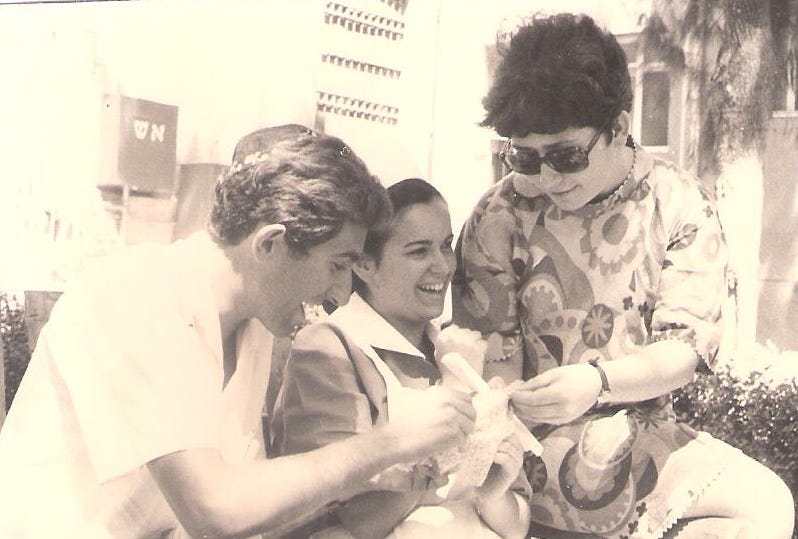
These are the same markets my mother told me about, that she would skip through with her friends, fingering the trinkets and tearing chunks of long oval Jerusalem bagels to dip in a little sachet of zaatar with eyes in their backs. “. . . but you know, anyone could stab you in your back if you aren’t careful . . .” she would recall. Those first years after the 1967 war—marked by the reunification of Jerusalem and the return of a Jewish presence to the Old City—were perilously safe, euphoric and uncertain all at once. Ancient prejudices were still jagged and would remain so for many years—perhaps an eternity (it is too soon to tell). But in the summer of 1967, there was some promise that perhaps all would come good, that perhaps this would be the last war.
Jews, Israeli and Diasporic, flowed into the Old City from which they had been forbidden for nineteen years. Their eyes wide and filled with tears, greeting one another with baruch ha’shav (welcome home), while the local Arab population eyed them warily, wearily, dejected by the empty promise of victory yet again. The youth ran around giddy with a sense of victory and the unshakeable feeling that they were living a miracle, and were quick to establish their quarters there, to establish a Jewish home within the walls of the Old City.
For the young people charged with reestablishing life in the rova—as the Jewish Quarter became known, there was no shortage of tasks to keep them busy. Under Jordanian rule, the Quarter had fallen to ruin. Emptied of its Jewish population, synagogues—some centuries old—were looted and desecrated, and even repurposed into stables or coops. It became a ghost town, but for some sheltering Arab ’48 refugees and squatters.
Har habayit b’yadenu, the Temple Mount is in our hands, as uttered by Col. Motta Gur, echoed in the ears of the young pioneers. And in their hearts, the words of Rav Avraham Yitzhak haCohen Kook—the first Ashkenazi Chief Rabbi of Mandate Palestine, who saw Jerusalem as the crown of the Jewish people from which the light of return and redemption would break through. Unlike the pious of the early Yishuv, this new cadre of youth were people of the land and the Torah, and embraced their tasks as part of a great cosmic plan.
My mother, well before she was my mother, was a young girl in the early days of her nursing studies at the famed Shaare Tzedek—a major teaching hospital in Jerusalem. Cheeky and clownish from a young age, and quite the coquette now that she had escaped the pressures and strictures of her Orthodox home, Tova was discovering her independence. She excelled both at her studies and at stretching the boundaries that the school tried to place on the young women in their tutelage. Study hours should have been enough to keep the young students in check, with early rises to wash elderly patients and gruelling shifts. Their clinical fieldwork exposed them to the lingering brutality of war up close.
But Tova and her friends made the most of their time by working hard and sleeping little. They’d dash to the Old City at every opportunity, to play sheshbesh (backgammon) and help the young men of the garin nachal—sentries and pioneers, protecting the newly thriving quarter and building it up. What better a place for a young woman to be, exhilarated by both a sense of sacred mission and the possibility of finding a suitor—or even a husband—amongst these valiant young men.
The garin was a collective of young pioneers who took on military and civic duty, charged with defending fragile borders and cultivating the land. In contrast to the units associated with the more secular kibbutzim, the garin in the Old City carried a different potency. The young men lived in the abandoned structures along Rehov Sha’arei Shamayim (Gates of Heaven Street), where they established the Moriah Settlement. In Jewish tradition, Mount Moriah—the Temple Mount—is considered the focal point of divine presence, prayer, and redemption. The reclamation of the Jewish Quarter was both a thoroughly modern and ancient act at once. The restoration work and community building reflected this spirit.
During the days, the young men would clear rubble with scrappy tools and wobbly wheelbarrows. The rova was filled with collapsed homes and desecrated synagogues, making the work labor-intensive and delicate. Below the rubble were remnants of many-centuries-old synagogues and there was a deep reverence for the work of revival. The days were punctuated by prayer times, early shacharit, the afternoon mincha—to end the traditional siesta, and then the evening aravit, after which the young women would arrive with fresh figs and oranges, and sweet tahini and date biscuits that they had baked in their nursing school kitchenette. As the evening descended, they would spread the sweet delicacies out and loll on the steps of the main square as the boys joined them, laughing and jostling for seats while the girls smoothed their skirts, carefully eyeing who was keen for whom.
Tova, with her auburn locks and warm brown eyes, lithe and fashionably dressed in a skirt just long enough to pass as modest in this crowd, jumped to her feet and climbed onto a pillar dramatically: “Who will sing for me tonight? A song of the homeland? A song of love?” Her friends giggled, both enamoured by and envious of her audacity, and she turned heads, as she had intended.
“Tova, you would have us think that one song would be enough for you!” called Mendi—the unit’s captain.
And they broke into laughter and song, singing songs of the land and love. As the evening wore on, a short man with a round face and big smile, bearded, turned up with a guitar on his back. The tone changed dramatically, as he gave warm hugs to the men in his path, and even warmer ones to the women, gently pushing his way through to sit in the inner circle. He cleared his throat as he opened his guitar bag, a gentle American lilt to the Hebrew he spoke. “I see the party has already begun, I hope I am not intruding!”
“No, no, Reb Shlomo! We’re only getting warmed up!” exclaimed the crowd, thrilled each time that the famous Singing Rabbi was back. And as he worked his guitar, strumming, he proclaimed, “Well, holy brothers and sisters, let’s make it a holy party then!” Many of the group came from religious homes, and Reb Shlomo brought them tunes of their childhood shorn of their heaviness.
He would stir them into a deep ecstasy, winding them up like a child’s toy, as the tunes intensified in speed and spirit. This was the spirit of the times—hard work by day and joyous song into the nights. Through his songs they reached deep for the roots that tied them to this city and to the people who came before them. He would tell stories of the tears that the Western Wall had absorbed over time: the grief of exiles, pogroms, the Holocaust, the Wall’s loss in exchange for Israel’s independence. And—with tears in his eyes and theirs—he would remind them of the sacredness of the now: “I heard the Wall singing . . . all those little tears singing and promising that the Almighty has not forgotten His promise.”
***
Here I am, nearly sixty years later, leading my daughters along the cobblestone lanes, trying to ready them for the moment they will see the Wailing Wall, trying to explain why it matters so. I wonder where to start. With all that has been fought and lost for this Wall? That King David bought and sanctified a threshing ground as a home for the Ark of the Covenant, an act that paved the way for the two Temples whose subsequent destructions were the impetus for the long exiles and scattering at the heart of the Jewish story and ours? With the fact that many thousands of years ago, our forefather Abraham was willing to give his son, Isaac, to God at that very spot? That this place has always been a flashpoint, with tensions between Jews and Muslims exploding periodically around access, back in the British Mandate and up until this day? That in recent decades even Jews desecrate the sanctity of this place in the name of politics and sectarian supremacy? My head spins, like the carousel to which the poet Yehuda Amichai likens Jerusalem.
Amalia looks at me closely as she sees my eyes redden at their rims. I suddenly feel bashful, so I try to make them laugh. I tell them that the Temple is considered the belly button of the world, the umbilical point of connection between heaven and earth, and for me, a point of connection to my mother’s world and mine. I know it may be too much for them to understand—they are after all just shy of eleven and seven—but one day they might remember and feel its pull. They giggle and poke at each other’s belly buttons. If only the giggle and wonder of children held as much power as the pain of this city. This city—broken and rebuilt, so many times over; hoped for and sung for and cried for by mothers and their daughters across generations.
Tamar Paluch is the co-editor of Ruptured: Jewish Women in Australia Reflect on Life Post-October 7 (LJLA, 2025 / Gefen, 2026). Her writing explores Jewish identity, grief, and the stories we carry across generations. Australian-born with deep Israeli roots, she has lived with her husband and daughters in many Jewish communities around the world, now residing in Los Angeles.
Five tiny delights
Family lore
Dappled light
Retraining my algorithm with funny animal videos
Beautiful notepaper
Road trips with the ones I love
Five tiny Jewish delights
The aleph-bet
Touching down in Israel
My late grandfather’s zemirot
Kneidelach
The laneways of Jerusalem

Beautiful!
Beautiful writing and a stunning piece of feminine storytelling. Nostalgic, touching, heartwarming. I love how you've made it not just a walk through the streets, but walk through history, both your own and that of the Jewish people.