

When She Flew
To be without a refuge is to be truly lost. — Haruki Murakami

Editor’s Note: Marlaina Cockcroft's retelling of Rapunzel in a time of pogroms is only too timely —David Michael Slater
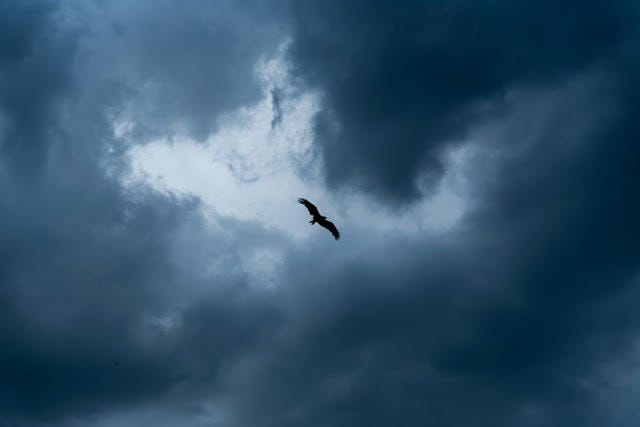
Photo Credit: Bird in Sky: Devang Punia via Unsplash
The first time she left the tower—
Why, of course, she left the tower. Tell me, good folk, would you sit helpless in a lonely room when you’re growing a rope out the back of your head? Right, I thought not.
The first time she left the tower, it was to tell her father she was never going back. What nonsense, keep her safe. Keep her prisoner, more like.
It hid in the woods outside town, a little ways from her father’s house. He’d bribed men to build it in secret, given them all he had. But the thin stone tower was cold at night and Zella had run out of books. Poor safety indeed.
So Zella put her lucky feather in her pocket, hauled up her great mass of hair—which was brown, by the way, not spun gold or whatever nonsense. Brown with a tinge of red, and it took half the day to brush. Yes, that is less romantic. I prefer the feel of the wind on my neck, personally.
Shall I continue? I said I’d pay for my ale with a story, and so a story you’ll have.
She hauled up her hair and threw it over the hook outside her window, then lowered herself down, glad to put her endless tresses to good use instead of tripping over them. The trees stood close, but not close enough. In the end, she shut her eyes and dropped the rest of the way, yelping as she tumbled onto the dirt.
She stole out of the woods and around the outskirts of the town she never saw to where her father’s house sat, huddled into a patchy bit of ground a polite distance from the other houses. It was no fine castle, but it had a door, didn’t it? A door wide open and inviting. Zella marched up, intending to tell her father she’d sooner take her chances by his side.
She froze when she saw the men with swords.
Their armor was dull and battered, but they bore the king’s mark. They loomed out of place in the small, neat room with its simple wood furnishings and scattering of books. Zella’s father stood with hands held out, a silent plea on his thin, careworn face. Zella ducked from the doorway and eased into the scrubby bushes and the shadows. Hiding was all she knew how to do.
“All the gold,” one of the king’s men said to her father. “All the jewels. Now, or I’ll be paid in your blood.”
“I have paid my tax to the king,” her father said hoarsely. “I have no more to give you.” His clothes were years out of date and patched together. Surely the men would see he was not wealthy (and Zella squeezed her hands together, knowing what it must have cost to build her tower). Surely they would leave.
Laughing, the men tore through the little house, smashing what they didn’t take. Zella watched them carry out bolts of fabric, a comb that was once her mother’s, even bags of flour. One of the men spat at her father’s feet. “Demon-blood. You don’t belong here.”
“You would not be the first to think so,” her father said softly to their backs.
The men walked away, cheering and slapping each other as though they’d won a great battle.
Zella huddled under her hair, remembering: Their old village burning in a surprise attack. Her mother injured, never to recover. Her father swearing he would keep Zella safe. But perhaps all her people’s villages were burning. Perhaps the tower was her father’s last resort.
Perhaps she was safer there after all.
She ran back to the tower, her hair piled up in her arms. But she didn’t have her father’s ladder. She pulled herself up the nearest tree, tearing her dress, snagging her hair on the branches. She yanked it free—leaving strands behind—and tossed it high, but no, still not close enough to the hook. Every rustle of leaves or gust of wind was the king’s men upon her, or her father, and she wasn’t sure which was worse.
She clutched the feather, hoping for luck. With her mother’s smiling face in mind, she whispered, “Help,” and jumped. In her hand, the feather quivered.
Instead of hard earth, she felt soft warmth around her. When she opened her eyes, she was on the back of the biggest bird she’d ever seen, bigger than ten houses, with brown and yellow feathers that neatly matched the one she carried. Massive wings beat back the air.
“Oh,” Zella said in wonder because her mother had told her about the Ziz. The king of the air, her mother said, the mightiest of birds. He carried their people where they needed to go, to help them find their fate.
Her mother had pressed the feather into her hands and said, “I helped him once. I found him thirsty during a drought and brought him water. He’ll be a friend to you if you need one.” Zella had laughed, thinking this a pretty story. Thinking her mother would always be there to tell stories.
“You knew my mother,” Zella said to the Ziz, though it seemed too impossible to be true. The great bird didn’t answer. He bore her to the open window, then waited, his wings in furious motion. Zella leaped inside and turned to thank the Ziz. He was already gone, barely a ripple in the wind.
When her father came the next day, climbing her hair with a basket of food and a new book, his pale bearded face was drawn and sad. “Are you well, Father?” Zella asked.
He dragged out a smile and fixed it in place. “Of course, child. Why shouldn’t I be?”
Zella touched the feather in her dress pocket. I ask you, how could she tell him the truth when he would lie so readily? She said nothing. Only smiled, and thanked her father for the bread and fruit. When he’d gone, she called the Ziz.
The king of the air could take her wherever she wanted. She could find another village to live in, one with more of their people. She and her father would be safe, they could mark their holidays and show their faces in public, and she could abandon this awful tower forever.
She stuffed her hair beneath her cloak, all coiled up in braids, and visited every hamlet, town, and city she saw from the air. She walked among the people, as the Ziz waited beyond the trees, and she listened.
She heard whispers about her people poisoning the wells. Angry mutters about her people cheating men out of their money. Jeers about her people consorting with demons.
You’ve heard those slanders too, I expect. Ever shared them yourselves?
Such a silent room. Best I continue.
When Zella heard the ugly words, she pulled her hood lower and walked on. But it wasn’t only words. Sometimes she saw men beaten in a town square, men who might have been her father. Sometimes she saw houses on fire and heard screams, and she ran to find the Ziz.
Back in the air, she flung the hood back and let her braids stream out behind them both like a bird’s wild plumage. Leaning back, her arms spread wide to catch the wind. In the air, she felt welcomed. With the Ziz, she felt peace.
She crouched and pressed her hands into the soft feathers. “Nowhere is safe, my king,” she said, raising her voice over the rush of air. “What do I do?”
He turned his great head to look at her. Fly with me, his round dark eye entreated. Fly with me and see the world. He peered at the ground with contempt and breathed a soft trill of relief whenever they ascended. Only distantly did Zella see the white creeping over his feathers.
Back in her tower, she smiled during her father’s visits, and he never noticed her windblown hair or the feather she’d braided into it. But she saw the strain around his eyes and how his hands had begun to shake. The king’s men came to his house often. She could hear the shouts as she flew overhead.
This was how things stood when she met the boy.
His name was James. He was a weaver, young, newly taken over his father’s business. He met with Zella’s father about selling his wares, then wandered outside. He never should’ve been able to find the long, thin line of a tower in the woods. But he had a craftsman’s sharp eyes, and a particular flower sprouting there made a beautiful dye. As he searched among the trees, he caught the glint of sunlight on red-brown hair.
“Why are you up there?” he called to the pretty girl at the window.
She froze. She’d been found, she’d endangered her father. But the broad-shouldered man with straw-colored hair offered the first true smile she’d seen in weeks. His smile felt safe.
In the end, she invited him up.
Every week, James brought his work to her father. Every week, he stole to her tower, and she lowered her hair for him. She called less and less for the Ziz. She was weary of her long search and entranced by the young man’s smile. James would protect her from angry muttering people, and her father as well, she was sure of it.
Anyhow, the Ziz seemed slower, smaller, at every visit, his feathers more faded, and she didn’t like to burden the aging king.
James found her lucky feather once, winding his hands through her hair. “What’s this?” he said playfully.
She blushed. “Only decoration.” James was a solid, sturdy man who’d never needed a magic feather for anything. He wouldn’t understand. But the Ziz, how could she pretend him away? She felt the king’s disapproval as though he were standing over her, his wings arched in an angry question.
“Leave with me,” urged James. His blue eyes were so earnest. “You shouldn’t have to stay up here. I’ll talk to your father, I’ll ask for your hand.”
Yes, and why not? He was kind, he made her laugh. He never said awful things about her people. She wouldn’t need the tower anymore. Her father would be pleased.
Together they lowered themselves to the ground. Together they walked into her father’s home.
Alone, she stumbled back to her tower.
No, her father said. You would betray your people, her father said. Liars, deceivers, to carry on while my back was turned, and he called his daughter names that burned against her ears. He ended his business with James, sent him away. He followed Zella to the tower, carrying his ladder, and ordered her to climb, for how else could he get her back where she belonged? And if she was dragging her fingers through her hair as though looking for something, face pale and sweating, that didn’t interest him.
The townspeople watched their passing—the reclusive merchant, the girl they’d never seen before, the ladder promising secret hoards—but he took no notice. Zella felt their eyes on her all the way to the woods. She clutched her hair closer.
Her father climbed the tower behind her, but once they were both inside he drew a sword.
She gasped and backed away. “I’m sorry,” he said, grabbed her hair, and in a few strokes, hacked it off.
“It’s to keep you safe,” he said. “You know that.” He stepped over her weeping body, his arms full of her hair, and he tossed it out the window with a great sobbing breath. He stood there a moment, looking down at her, sword dangling from his hand like a forgotten toy. “I don’t know how else to do it, Zella,” he said. “Please believe me, child.”
Zella lay still, her cheek pressed to the stone floor. She had lost her Ziz and her love in one moment, and she had no words for her father.
Silently he swung out the window.
And James? He was bereft. He took himself to the nearest tavern and poured out his sorrows as the barkeep kept pouring. Alas, several of those listening were the king’s men. As James droned on, the townspeople whispered behind their cups about the hidden daughter living in the secret tower. The merchant must be hiding his wealth there! Weren’t secret towers meant for hiding treasures?
The king’s men decided this was worth investigating. They hoisted swords and strode to the merchant’s house. Half the tavern followed, looking for a show.
James swore, later, that he’d pleaded with them to stop. He’d declared his love for the hidden girl. But the crowd, drunkenly brave and humming with suspicion, swept him aside and marched on without him.
Zella roused when she heard shouts, then a crash. She crept to the window to see a fire in the distance. Only her father’s house stood on that spot. She cried aloud.
“The tower! The tower!” They moved in one drunken mass toward her, torches alight. She wiped her tears and scrambled backward, scraping her hands across the floor, trying again to find the feather. Her small home seemed cozily perfect, now she knew she wouldn’t see it again.
The men screamed up to her as the flames marched closer. There was no hope the Ziz would still be listening, but how could she wait to die?
She stepped up to the window, stood a moment on the ledge. “My king,” she said over the shouts, “I’m sorry I turned away from you. I know now you’re my only friend.” She closed her eyes and took a step.
In a mossy patch at the tower’s base, something yellow and brown quivered.
The cheers of the crowd turned to screams as she tumbled. The screams turned to shrieks of terror as the Ziz swooped to catch her. The great bird’s talons raked across the crowd. Zella clutched her friend’s back and watched them run, those who still could, at any rate. Many lay where they had fallen, their bodies striped with blood. She supposed she should feel sorry about it.
“Thank you, my king,” Zella said as the screams dwindled to silence. But the aged Ziz’s breaths were rough and ragged, and she felt his wings tremble. Even her light weight was too much for him now.
He sank low enough to let her drop down. Over her pleas, he rose again, struggling to beat his wings, nearly veering into the trees around before vanishing into the night.
She knew he wouldn’t fly again. Tears streamed down her face.
Zella walked—openly now, no more hiding—to her father’s house. Two walls still stood, the rest in flames. Her father’s sword gleamed faintly in the ruins. As for her father, she saw a patch of leather that might have belonged to a boot. She sank to her knees.
Zella whispered the prayer for the dead, there amid the wreckage. She swiped the tears from her face and stood, using the folds of her dress to draw the sword free.
Now that she was used to it, the breeze felt wonderful on her bare neck. The sword was still hot from the flames, but even wrapped in her skirts it felt right in her hand.
She was out of town and down the rutted road to the next before James caught up to her. “You’re all right,” he said joyously. She stepped back from his embrace. “I tried to stop them,” he said, not meeting her eyes.
“I’m sure you did,” she replied.
“Forgive me,” he said hopelessly.
“I thought you would keep me safe,” said Zella. “But that isn’t your job. It’s not anyone’s job. Only mine.”
She kept walking.
One more thing her mother had told her about the Ziz. When it was his time to die, he would vanish into flames, replaced by an egg. Surely an egg, or a young Ziz, would need her help. It was only fair. First, of course, she’d have to find him.
Some say she wanders still.
I see by your faces that you were expecting a different ending. But that would be a different story.
May I trouble you good people for another round? No? Fair enough. Now you tell me something. I hear this town is plagued by a strange screaming, like a lonely demon. Is this so?
I can provide you relief if you point me in the right direction. No, no payment. Only a warning:
If you hear a screeching sound from above, you’d best get inside.
A pleasant evening, all.

Marlaina Cockcroft (she/her) is an author, journalist, and editor who lives in New Jersey. She frequently draws on Jewish folklore in her fantasy and horror stories for younger readers and adults. She is seeking representation for her middle grade novel, “Ava’s Golem,” which received the Sydney Taylor Manuscript Award from the Association of Jewish Libraries. Her short fiction can be found in magazines such as Factor Four, Daily Science Fiction, Mythic, and Dark Matter Magazine, as well as in anthologies like “Strange Fire: Jewish Voices from the Pandemic,” “Stories We Tell After Midnight, Volume Three,” “Dark Cheer: Cryptids Emerging, Volume Silver,” “Summer of Sci-fi & Fantasy: Volume Two,” “Fear Forge: Fall Quarter 2023,” and “Dragon’s Hoard 3.” She can be found @marlainawrites on Instagram and at marlainacockcroft.com.
What are five tiny delights that lift your spirits and make you happy?
Working with a sleeping cat next to me (this is common).
Tea, freshly brewed.
Talking about movies with my 17-year-old.
Playing a perpetual game of Name That Tune with my 15-year-old.
Our family tradition of Friday night ice cream.
What are five tiny JEWISH delights that lift your spirits and make you happy?
My Jewish holiday Disney pins! I own four Hanukkah pins and two Rosh Hashanah.
Making my mother’s chicken soup recipe and knowing from the aroma that I’ve gotten it right.
Lighting the Shabbos candles together, using the candleholders my husband gave me.
That moment of pride whenever I discover a particular celebrity is Jewish, or see a Jewish tradition portrayed accurately in a film or TV show.
Learning about the wild weirdness of Jewish folklore.
Absolutely brilliant and captivating. What amazing imagination and daring (in a good way) to revisit Rapunzel and create a story that draws you in and makes you want to read more. As for the allegories that make it relevant to today? Brilliance.
Loved it.
Well written. Liked the ambivalence of the ending & the symbolism, e. g. The great bird as the U. S. After WW II.