

Graphic Content
Historian Rafael Medoff tells Judith why he refused his publisher's demand to denounce Israel in 'Cartoonists Against the Holocaust.'

Editor’s Note: Dr. Rafael Medoff spent fifteen years assembling Cartoonists Against the Holocaust, a collection of editorial cartoons that tried to warn Americans, in real time, about the destruction of European Jewry. Dark Horse Comics accepted the book. Then his editor, Craig Yoe, demanded he add text accusing Israel of genocide as a condition of publication. Medoff refused, and Dark Horse canceled the book. This story is painfully familiar to many Jewish authors, but usually the bigotry is subtle: the quiet drop, the manuscript that's suddenly "not the right fit." This was blatant, in writing, and aimed at a Holocaust historian, which is why I jumped at the chance to interview Dr. Medoff. — Howard Lovy
Howard Lovy: Tell me about your professional background and how you began to study the Holocaust.
Rafael Medoff: I’ve been researching and writing about the Holocaust, and especially America’s response to the Holocaust, for more than forty years. That has included teaching at several universities, lecturing at synagogues and many other institutions, and writing books and articles.
Howard Lovy: How did that research transition into an interest in editorial cartoons?
Rafael Medoff: Looking through newspapers from the 1930s and 1940s to analyze the American media’s coverage of news about the Holocaust, I started coming across editorial cartoons that tried to draw the public’s attention to the plight of the Jews. I realized it was a new way to look at what was known in America about the Holocaust as it was taking place.
Howard Lovy: What is it about cartoons in particular that can sway public opinion? Did they, in fact, make a difference, since the U.S. public continued to be very isolationist during the rise of the Nazi regime?
Rafael Medoff: It’s always difficult to measure the precise impact of an editorial cartoon, or of a regular editorial or a news article, for that matter. These cartoons offer a snapshot of what Americans knew at the time concerning what was happening to the Jews, so they’re part of the bigger story of what our nation knew, and when.
Howard Lovy: Can you give some examples of editorial cartoons of the day?
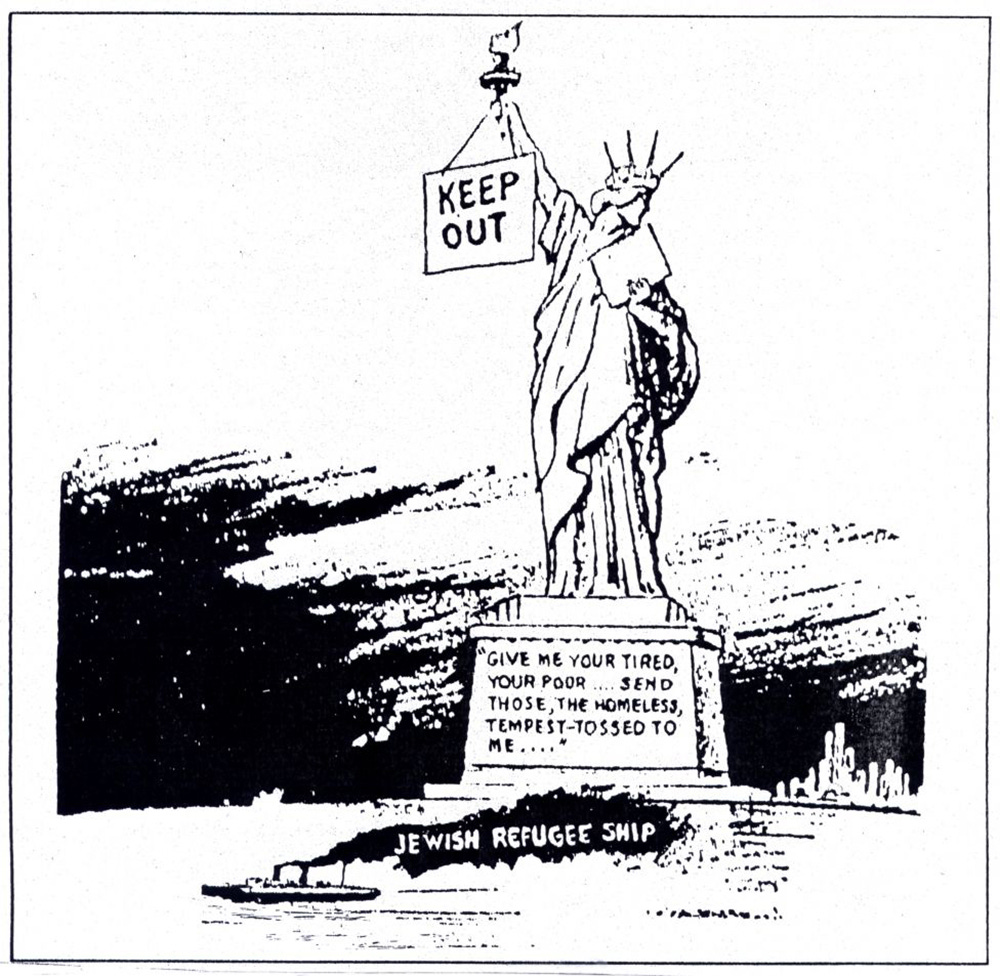
Rafael Medoff: Editorial cartoonists often take a well-known symbol and infuse it with new meaning. When the St. Louis, the Jewish refugee ship known as the “voyage of the damned,” was hovering off the coast of Florida in 1939, begging for permission to land, the New York Daily Mirror published a powerful cartoon by Fred Packer titled “Ashamed.” It showed the Statue of Liberty turning her head, in shame, as the St. Louis sails by because President Roosevelt turned it away. For so many years, the United States had been a haven for the oppressed, but in 1939, the government was turning its back on that noble tradition, and so even the statue was ashamed, so to speak.
Howard Lovy: Tell me about your history with Craig Yoe and Dark Horse. Was it amicable?
Rafael Medoff: Craig Yoe and I had a friendly working relationship for more than a decade. In our hundreds of conversations, he never mentioned Israel or Palestinians. He never expressed concern about Gaza when it was under the rule of Hamas all those years. Certainly he had his opinions, and some were unorthodox, to be sure, but he never tried to impose his political views on any of the projects we did together.
Howard Lovy: Walk me through what happened with Cartoonists Against the Holocaust.
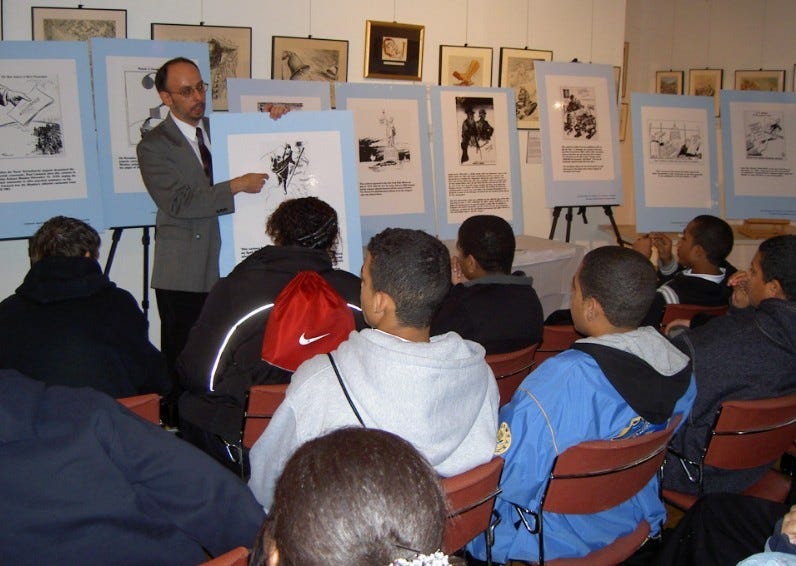
Rafael Medoff: Some years ago, I took a number of the cartoons that I found in my research and made them into a traveling exhibit, called “Cartoonists Against the Holocaust,” which I brought to high schools and middle schools, mostly in the New York area.
Teachers responded very enthusiastically to the exhibit, because they see these cartoons as a unique teaching tool. Keep in mind that in thirty-five states, the law requires high school students to learn about the Holocaust and other genocides. Books like The Diary of Anne Frank are valuable, but graphic images make a stronger impression on young people than plain text. Some of the teachers urged me to turn the exhibit into a book that they could use in their classrooms.
Subsequently, I found more cartoons in my research, and eventually I developed them into the book that Dark Horse accepted for publication, using the same title as the exhibit, “Cartoonists Against the Holocaust.”
Howard Lovy: What did Craig Yoe do?
Rafael Medoff: Dark Horse Comics accepted the book for publication, sent me a contract, and prepared a schedule for Cartoonists Against the Holocaust to be released in the summer of 2026. Craig Yoe was assigned as the editor for the project, as well as two other books of mine that Dark Horse accepted.
The other two, Cartoonists Against Racism and a nonfiction graphic novel called Whistleblowers: Four Who Fought to Expose the Holocaust to America, were published in 2024 without incident.
But last year, Craig started calling me and berating me about the war in Gaza. He made false, extremist accusations against Israel, saying that the Jews were victims of a Holocaust, and now they’re committing another Holocaust. He then sent me text that he wanted to add to Cartoonists Against the Holocaust, accusing Israel of genocide and stating that there are “concentration camp-style prisons” in the United States. I replied that both statements are false, as well as grotesque distortions of the Holocaust. He said he would not allow publication of the book unless I agreed to include the text. I refused.
Howard Lovy: Your September 3 response to Yoe is remarkable and should be reprinted as a guide for other authors on how to respond to these kinds of pressures. You also proposed a few compromises. Why did you work so hard to save the book when you could have just walked away?
Rafael Medoff: Because it’s so important to get this book into the hands of teachers. Helping young people understand the Holocaust is crucial to ensuring that such atrocities are never repeated--and ensuring that when there are human rights abuses, the international community doesn’t turn away again, as it did when the Nazis were slaughtering millions of Jews.
“Never compromise the truth. Be proud of your Jewish identity and your support for Israel. If a particular publisher or publication turns you down because of antisemitic or anti-Zionist bias, speak your mind and don’t back down.” — Dr. Rafael Medoff’s advice to young Jewish authors
Howard Lovy: Your case isn’t isolated. Other Jewish authors have been asked to pass a litmus test. They’re being asked to denounce Israel as a condition of participation, regardless of whether their work has anything to do with Israel. Why do you think they’re targeting Jews in particular?
Rafael Medoff: Different people target Jews for different reasons. Some do it simply because they’re bigots. Some do it because they think it will help them make money or gain votes. Some do it just to go along with the crowd.
Whatever the motivation, it’s clear that there is a new and escalating antisemitism that is infecting significant segments of American culture—now including the book publishing industry and the comics industry. Not long ago, the graphic novelist Miriam Libicki was banned from the Vancouver Comics Festival because its organizers found out that she once served in the Israeli army. In that case, a public outcry reversed the ban. But Jewish filmmakers have been pushed out of film festivals, Jewish authors are finding it harder and harder to get their books published, and Jewish speakers have been forced to withdraw from university commencement events. These horrific trends will continue unless we speak out against them.
I intend to bring Dark Horse’s outrageous cancellation of my book to the attention of my colleagues in the American Historical Association and the Association of Holocaust Organizations. Jewish scholars need to be aware of the dangers they are now facing. I’m also going to be notifying the Association of American Publishers, which is the trade association of the book publishing industry. Its statement of principles says that “censorship [of books] strikes at the very heart of our democratic ideals.” I am sure they will be deeply concerned that a major publisher is, in effect, censoring me.
Howard Lovy: Did Dark Horse think that accusing Israel of genocide would increase sales of the book?
Rafael Medoff: Craig Yoe, in his role as a Dark Horse editor, never claimed to me that adding the anti-Jewish text was necessary to sell books. He did say that he was worried some of his friends might be mad at him if he was connected to a Holocaust book that didn’t accuse Israel of committing a Holocaust. I told him the solution was simple—Dark Horse could assign my book to a different editor.
Howard Lovy: Is there a historical precedent that helps you make sense of this moment?
Rafael Medoff: There have been many instances in Jewish history where Jews were required to renounce their religion or identity in order to be accepted into some profession or social circle. What Dark Horse and Craig Yoe have done echoes some of those tragic episodes. It’s not identical, of course, but there are frightening similarities.
Howard Lovy: What is your advice to young Jewish authors who are asked to compromise the truth as their ticket into the literary world?
Rafael Medoff: Never compromise the truth. Be proud of your Jewish identity and your support for Israel. If a particular publisher or publication turns you down because of antisemitic or anti-Zionist bias, speak your mind and don’t back down. There are publishers and publications out there who will appreciate your talent and not apply a political litmus test to your work.
Howard Lovy: Can you talk about the role of Jews in the history of the comics industry?
Rafael Medoff: The annual San Diego Comic Con, the biggest comics convention in the world, took place last week. Many of the founders and pillars of the comics industry were Jews, including the creators of Superman, Batman, Spider-Man and so many others. Comic book publishers like Dark Horse would not exist if not for the innovations of those Jewish comics creators.
The San Diego convention is where the industry’s top awards, the Eisner Awards, are announced each year, and Dark Horse always wins some. The bitter irony is that the late Will Eisner, the comics pioneer after whom the awards are named, was a proud Jew and supporter of Israel. He also was a member of the Arts and Letters Council of my institute, the David S. Wyman Institute for Holocaust Studies. Will must be turning over in his grave at the news that a major comics publisher imposed an anti-Israel litmus test on one of its authors. Perhaps it’s time for Dark Horse to return the Eisner Awards it has won.
Howard Lovy: What is the future of Cartoonists Against the Holocaust?
Rafael Medoff: I’m considering all my options.
Thank you Howard for this…and Rafael…keep up the amazing work. We all need you.
I do hope that this vital book finds a publisher.